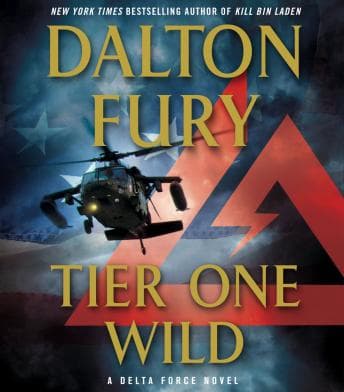

Look, I'm going to be honest about something that might cost me my English teacher credentials: I have zero business reviewing a military thriller. My expertise is Faulkner's stream of consciousness, not Delta Force's standard operating procedures. I teach kids who think Hemingway is a cocktail. But here's the thing - Dalton Fury's writing irritated me in exactly the way that made me keep listening, and I need to talk about it.
My complaint is simple. This book does not trust you with silence. Not for a second. Every chapter is another briefing, another op, another acronym I had to mentally decode while pretending to follow along with Denise's story about her sister's kitchen renovation during our Saturday lakefront walk. (Sorry, Denise. I was deep in Egyptian streets with Kolt Raynor while you were talking about backsplash tiles.) The pacing is relentless in a way that a literature guy like me finds both exhausting and - grudgingly - effective. Fury writes like a man who's been in rooms where hesitation gets people killed, and that urgency bleeds through every page.
When the Guy Who Lived It Writes It
Here's what separates this from the stack of airport thrillers I confiscate from students reading under their desks: Dalton Fury was an actual Delta Force commander. The man helped plan the operation at Tora Bora. He brought that same lived-in credibility to his other Delta Force novels, and One Killer Force reads like a man still walking those same hallways. So when Kolt Raynor moves through Cairo or runs through JSOC protocols, there's a granularity that you can't fake. The way teams stack up on doors, the specific bureaucratic friction between Delta and SEAL Team Six, the politics of who gets the green light on a target - it reads like someone transcribed muscle memory into prose. The SAM threat storyline with shoulder-fired missiles being smuggled from ex-Libyan spies isn't some writer's room invention. It's the kind of scenario that probably kept Fury up at nights when he was still active.
Now. Is the prose going to win any literary awards? No. Kolt Raynor is a archetype - the disgraced operator earning redemption - and the emotional beats land more like bullet points than poetry. My students would probably love this. I can already hear them: "Why can't we read THIS instead of Great Expectations?" And I'd say because Dickens teaches you patience, and patience is - but I'd be lying if I said I wasn't hooked by hour three.
The failed SEAL Team Six mission that pushes Delta to the front is a smart structural choice, actually. It raises the stakes without cheap tricks. Raynor isn't just chasing terrorists; he's operating in the shadow of another unit's failure, carrying that weight. That's decent character work buried inside all the tactical jargon.
Fliakos Earns the Call Sign
Ari Fliakos is the right narrator for this material the way a drill sergeant is the right voice for reveille - you don't question it, you just respond. His read of Raynor has a worn, coiled-spring quality. Not showy. He differentiates the team members through subtle vocal shifts rather than cartoon voices, which is exactly what this book needs. Fliakos pulls off that same quiet trick in Small Great Things, letting the story carry the weight instead of his voice. You're listening to operators, not theater kids. When he drops into female characters or Middle Eastern accents, he's careful enough that it doesn't pull you out of the scene, which is harder than it sounds.
The one genuine knock: pronunciation. Military folks and audiobook listeners who know their acronyms will catch moments where Fliakos stumbles on specific terminology. It's not constant, but in a book that trades on authenticity, every mispronounced acronym is a small crack in the immersion. I noticed it maybe three or four times across the eleven hours. For me - a guy whose military knowledge comes entirely from books and one uncle who won't stop talking about Vietnam - it wasn't a dealbreaker. For actual veterans? Might sting more.
I listened at my usual 1.0x because I wanted to catch the tactical details, but honestly? This is one of the rare books where 1.15x wouldn't lose you anything. The prose doesn't demand savoring. It demands momentum.
Who Gets the Green Light (And Who Should Stand Down)
If you loved Vince Flynn's Mitch Rapp or Brad Thor's Scot Harvath, this is their spiritual successor with an extra layer of operational credibility. If you're coming from literary fiction and want character interiority and beautiful sentences - this isn't your mission. That's not a flaw, it's a genre. Fury knows what he's writing and he executes it well.
If you want the authentic voice of someone who actually kicked in doors and made life-or-death calls writing fiction about exactly that? This is pretty much the real deal.
Worth Pausing the Faculty Meeting For
I wouldn't've picked this up on my own. But eleven hours later, walking the lakefront with Kolt Raynor's problems rattling around my head instead of grading rubrics, I'm glad I did. It's not Middlemarch. (Nothing is Middlemarch.) But Fury writes from a place of genuine knowledge that gives this book a heartbeat most thrillers don't have. Fliakos locks in as Raynor's voice and mostly holds the line. A few pronunciation stumbles and thin character work keep it from the top shelf, but for what it is? Solid. My 47 podcast listeners would be shocked I enjoyed this. My students would finally respect me.