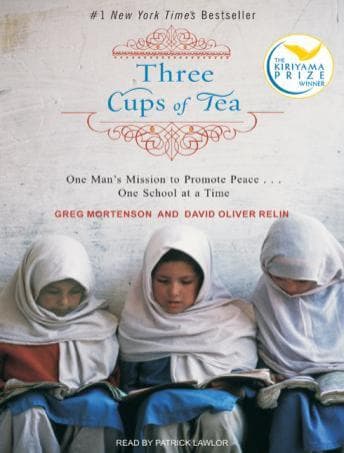

This is a book I've been meaning to get to for years. And honestly? I should've listened sooner. But I also should've done more homework before I did.
Let me back up. I was grading papers at 11 PM—the usual Thursday ritual—and Three Cups of Tea was keeping me company through the stack of sophomore essays on The Great Gatsby. (Spoiler: they all think Gatsby is "relatable." He's not. That's the point.) Mortenson's story of stumbling into a Pakistani village after a failed K2 attempt, being nursed back to health, and then promising to build a school? That's the kind of narrative arc I live for. It's almost too perfect for a memoir—the broken American saved by the very people the West often fears, who then dedicates his life to education in the shadow of the Taliban.
A Parable with Footnotes
Here's the thing about this book: it reads like a parable. And I mean that in the best and most complicated way. Mortenson's journey from climbing bum to humanitarian is genuinely moving. The scenes of him sleeping in his car, cold-calling donors, being hung up on by everyone with a checkbook—that's the unglamorous reality of trying to do good in the world. David Oliver Relin writes it accessibly, almost too accessibly at times. The prose doesn't demand much from you, which is fine for a 13-hour audiobook you're listening to while pretending to pay attention to Principal Martinez's budget presentation. (I wasn't. I was learning about the Balti people.)
But—and this is a significant but—I can't write this review without acknowledging the elephant in the room. After this book became a phenomenon, journalists raised serious questions about the accuracy of key events. Some of the most dramatic moments may have been embellished or fabricated. I'm an English teacher. I believe in the power of narrative. But I also believe in honesty, and it would be intellectually dishonest of me not to mention that the foundation of this "true story" has cracks in it.
Does that ruin the listening experience? Not entirely. But it changes it. You start listening differently. More skeptically. Which is maybe its own kind of lesson.
Patrick Lawlor's Energetic Climb
Patrick Lawlor narrates with genuine enthusiasm. He's clear, he's engaged, and he clearly believes in the material. For a 13-plus hour listen, that energy matters. I never felt like he was phoning it in, which is more than I can say for some audiobook performances I've endured.
That said—and I heard this from other listeners too—the foreign accents are rough. Look, I'm not asking for perfection. But when you're telling a story set primarily in Pakistan and Afghanistan, the voice work for local characters matters. It's part of honoring the people in the narrative. Lawlor's attempts pulled me out of the story more than once. It's not a dealbreaker, but it's noticeable.
The pacing also drags in spots. Some listeners mentioned the audiobook felt longer than reading the physical book, and I get that. There are sections—particularly in the middle, when Mortenson is doing the unglamorous work of fundraising and logistics—where the narrative loses momentum. I found myself reaching for the speed controls. (Yes, I know. I'm the guy who listens at 1.0x because "the author chose those words." But even I have limits.)
Who Should Listen (And Who Should Skip)
If you're drawn to idealistic narratives about education changing the world—and you can hold complexity alongside inspiration—this is worth your time. Skip it if factual accuracy in memoir is non-negotiable for you, or if uneven accent work in audiobooks pulls you out of the story.
The Teacher's Final Grade
I'm going to recommend this audiobook, but with caveats. The story is inspiring in its idealism—the idea that one person, with enough stubbornness and heart, can build schools in places the world has forgotten. That message still matters. My students would probably roll their eyes at the earnestness of it all, but that's exactly why they need to hear it.
But go in with your eyes open. Read the follow-up reporting. Understand that the line between memoir and myth got blurry here. The book won awards, became a #1 New York Times bestseller, and then became something more complicated—a conversation about truth in nonfiction. That tension between story and truth shows up differently in Majesty of Calmness—less dramatic, maybe, but more honest about what self-improvement actually looks like.
This reminds me of what Hemingway said about writing: "All you have to do is write one true sentence." The question Three Cups of Tea leaves you with is: how many of its sentences are true? And does the larger truth of its message survive the smaller falsehoods?
I don't have a clean answer. But I'm still thinking about it, which means the book did something right.