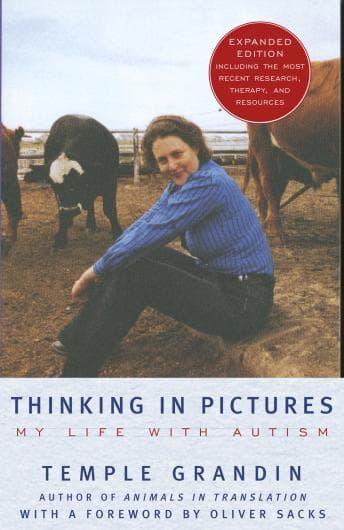

Everyone told me this book would make me "understand autism." That's not wrong, exactly, but it undersells what's actually happening here. Thinking in Pictures is less a memoir and more a guided tour of a fundamentally different operating system - and I mean that in the most literal, engineer-brain way possible.
I picked this up during a week where Kevin was out of town and I was filling the empty apartment hours with back-to-back listens. Started it on a Tuesday night while meal-prepping, figuring a 9-hour nonfiction title would be decent background. By the time I was chopping onions for Wednesday's lunch, I'd stopped multitasking entirely and was just standing in the kitchen, knife down, listening.
Your Brain Runs a Different Architecture Than You Think
Here's what got me: Grandin doesn't just say she thinks in pictures. She explains the actual mechanism - how when someone says "church steeple," her brain pulls up a sequence of specific steeples she's seen, like a database query returning image results ranked by recency and emotional weight. No abstraction layer. No generalized concept of "steeple." Just raw, indexed visual data.
As someone who spends her days thinking about distributed systems, this absolutely wrecked me. She's basically describing a mind that processes information with zero caching of abstract representations. Every concept is stored as concrete sensory instances. And she maps this processing difference onto her work designing livestock facilities - she can literally simulate a cow's visual perspective because her brain already works in that spatial, image-first mode. The fact that she designed a third of the livestock-handling facilities in the US suddenly makes perfect, structural sense.
The chapters on emotion were harder. Grandin is remarkably honest about what she doesn't experience - the full spectrum of complex social emotions that neurotypical people take for granted. She describes learning social rules the way you'd study a foreign language's grammar tables: memorize, pattern-match, apply. There's no bitterness in it, just this calm, analytical precision that somehow hits harder than any emotional plea would.
Deborah Marlowe Does the Quiet Part Right
So here's where I have to be honest about the gap between this audiobook and the book itself. Grandin didn't narrate this - Deborah Marlowe did. And Marlowe is... fine? She's clear, well-paced, professional. She handles the shifts between scientific exposition and personal anecdote without stumbling. But there's something inherently lost when someone else reads Grandin's words. The HBO movie had Claire Danes doing that specific flat-affect-but-not-emotionless quality that Grandin has in her real-life lectures, and Marlowe doesn't quite capture that. She reads it more like a well-produced science audiobook, which - technically accurate, but you lose some of the alien-familiar quality that makes Grandin's perspective so striking.
That said, Marlowe handles the technical sections well. There are stretches about neuropharmacology and brain imaging studies that could easily become a slog, and she keeps them moving. I bumped up to 1.5x for some of the medication discussion chapters (they read a bit like a textbook review of SSRIs and their effects on autistic individuals), and the narration held up fine at speed.
This Is Basically a Systems Architecture Doc for the Human Brain
What makes this book commute-worthy - and I did finish the back half across two morning trains - is that Grandin gives you a framework, not just a story. After listening, I genuinely think differently about how I process information. She makes you realize that verbal-sequential thinking (which most of us default to) is just ONE implementation. Her visual-spatial processing isn't broken or lesser - it's a different architecture with different tradeoffs. Better at spatial reasoning and animal behavior prediction. Worse at parsing sarcasm and small talk.
The book does show its age in spots. Originally published in 1995 (updated in 2006), some of the neuroscience has been superseded. And Grandin's perspective is explicitly her own - she's careful to note she represents one point on the autism spectrum, not the whole thing. But the core insight - that different neurological wiring produces genuinely different modes of consciousness, not deficient ones - still lands.
The ROI on this audiobook is high for anyone in tech, honestly. Not because of productivity hacks (this isn't that kind of book, thank god), but because it will permanently change how you think about thinking. About the assumptions baked into your own cognition that you've never questioned because everyone around you shares them.
Who Gets the Most Out of This
Perfect for: commute, meal prep, any solo activity where you can let your brain chew on big ideas. Skip for: gym sessions or anything requiring split attention - you'll want to actually absorb this.
If you've seen the HBO movie and think you've got the gist - you don't. The movie covers the biography. The book covers the neuroscience of being Temple Grandin, and that's a fundamentally different (and more valuable) thing.
I just wish Grandin had narrated it herself. The narration gap here reminded me of a similar issue I flagged in War on the West - where the delivery is technically competent but the author's own voice would have added a layer no professional narrator can replicate.