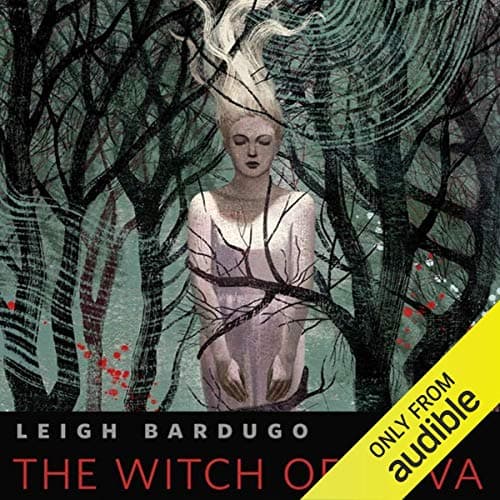

"There was a time when the woods near Duva ate girls." That opening line hit me within the first thirty seconds, and I knew I was in for something that would burrow under my skin. Leigh Bardugo's The Witch of Duva is barely an hour long, but it packs the unsettling punch of a story told around a dying fire — the kind where everyone knows the ending is going to hurt but nobody looks away.
This companion piece to Shadow and Bone reads like a Slavic folk tale dipped in something darker than ink. Nadya lives in a village where girls have been vanishing into the woods, and the villagers whisper about a witch. Meanwhile, her father has remarried, and the new stepmother — Karina — is all sweetness and fresh-baked bread. If your fairy tale instincts are tingling, good. They should be. But Bardugo isn't content to simply retell Hansel and Gretel with a Grishaverse coat of paint. She's playing a longer, crueler game, and the twist at the end genuinely caught me off guard even though I should have seen it coming.
What makes this work as an audiobook rather than just a quick read is Lauren Fortgang. She narrates with the cadence of someone who has told this story a hundred times before and still feels the weight of it. Her voice carries that particular quality of a folk storyteller — measured, warm enough to draw you in, cold enough to remind you that the woods are dangerous. She gives Nadya a youthful earnestness that contrasts sharply with the darker undercurrents of the plot, and her portrayal of Karina walks a careful line between maternal warmth and something just slightly wrong. For listeners who have followed Fortgang through the Grisha trilogy, there's a satisfying continuity here — the same world rendered through the same vocal lens, which grounds this short tale in the larger mythology without requiring you to have read anything else.
The atmosphere is really the star. Bardugo writes with economy that most fantasy authors could learn from. In under an hour, she builds a village that feels lived-in and desperate, a forest that feels ancient and hungry, and a family dynamic that feels both archetypal and specific. The dark folklore vibe — think The Bear and the Nightingale's Eastern European fairy tale energy compressed into a single sitting — makes every detail feel loaded with meaning. When Karina bakes, you're not just hearing about bread. When the woods are mentioned, they're not just trees.
I listened to this in one focused sitting on a quiet evening, and that's how I'd suggest approaching it. At 52 minutes, it demands your attention rather than your time. The story's complexity isn't in its length but in its layering — the way Bardugo plants seeds early that only bloom in the final minutes. Listening while distracted would rob you of the twist's impact, and that twist is really the entire point.
If I'm comparing this to its companion shorts — Demon in the Wood, The Too-Clever Fox, Little Knife — The Witch of Duva stands as probably the strongest of the bunch. It has the most complete narrative arc and the most satisfying gut-punch ending. It doesn't quite reach the depth of a full novel like Six of Crows, obviously, but that's comparing a razor to a broadsword. They do different things.
The content here skews dark. Children disappear. Violence lurks at the edges and occasionally steps into the light. The evil stepmother trope is deployed and then interrogated in ways that feel genuinely unsettling rather than comfortable. This isn't a bedtime story for younger listeners, despite its fairy tale trappings.
Who Should Listen (And Who Should Skip)
If you love dark fairy tale retellings, Grishaverse completionism, or short-form fantasy that respects your intelligence, this one's for you. Skip it if you need a longer narrative to feel invested, or if you're looking for something to put on for younger readers — the darkness here is real, not decorative.
My one hesitation about recommending this at full credit price is simply the runtime. Fifty-two minutes is a short investment for an Audible credit, no matter how good the material. The narration is excellent, the story is sharp, and the ending lands — but you could listen to this three times in the span of a single novel chapter. If you can grab it on sale or through a streaming service, you're getting one of the best bite-sized fantasy experiences available. At full price, the math is harder to justify even when the quality isn't in question.
Bardugo proves here that she understands something fundamental about fairy tales: they were never meant to comfort. They were meant to warn. And Fortgang delivers that warning with the skill of a narrator who knows exactly when to let the silence between words do the heavy lifting. That same understanding of darkness dressed in familiar clothing is something I explored in my review of Christmas Carol — Dickens knew the same trick, wrapping genuine horror in the costume of a moral fable.