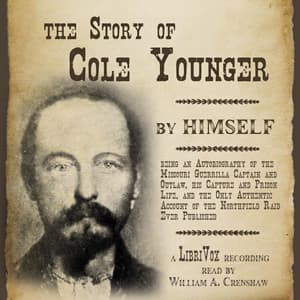

Look, I need to vent for a second. Cole Younger spends the first hour of this memoir basically saying 'I was just a nice Missouri farm boy and the Union soldiers were MEAN to me.' And okay, yes, the border wars were brutal and complicated. But my guy, you rode with Quantrill's Raiders. You robbed banks with Jesse James. At some point, the 'I was framed' energy gets a little exhausting.
I listened to this at 2 AM because Diego (the judgier of my two cats) knocked my water glass off the nightstand and I couldn't fall back asleep. Seemed fitting, honestly. Listening to an outlaw justify his life choices while staring at my ceiling in the dark.
The Audacity of Self-Mythology
Here's the thing that kept me listening despite my eye-rolls: Cole Younger is a fascinating unreliable narrator, and I don't think he even knows it. He writes about the Northfield bank raid—the one that basically ended the James-Younger gang—with this detached, almost clinical tone. Like he's describing someone else's bad decisions. The cognitive dissonance is wild.
William A. Crenshaw reads this exactly as it should be read: straight, no winking. He doesn't try to make Cole sympathetic or villainous. Just... matter-of-fact. Which somehow makes the whole thing more unsettling? When Cole talks about violence—and there's plenty of it, content warning for sure—Crenshaw delivers it the same way Cole wrote it. Flat. Normalized. That's not a criticism. That's the point.
At just over three hours, this is a quick listen. Almost too quick. I wanted more time to sit with the contradictions.
When History Writes Itself (Badly)
What makes this memoir genuinely valuable—and I mean this—is watching a man construct his own legacy in real time. Cole Younger wrote this after serving 25 years in prison, after his brothers died, after the mythology of the James gang had already calcified into American folklore. He's not just telling his story. He's arguing with the version of himself that already exists in the public imagination. Kitchen Confidential does something similar—Bourdain spends half the book wrestling with his own mythology, trying to control a narrative that's already gotten away from him.
Some moments hit differently than I expected. When he talks about his mother, there's this shift in energy. Crenshaw's voice softens just slightly—not dramatically, but enough. Cole's anger about what happened to his family during the war feels genuine in a way his justifications for robbery never do. Abuela would have understood that part, actually. The way family loyalty can make you rationalize almost anything.
The Gaps Tell Their Own Story
What Cole doesn't say is almost more interesting than what he does. Jesse James is barely in this book. Think about that. The most famous outlaw in American history, Cole's partner in crime for years, and he's practically a footnote. It's the same frustrating erasure I felt in George Washington—these historical figures who leave out the most interesting parts, whether deliberately or because they genuinely don't see what we're looking for. Was Cole still protecting him? Bitter about being overshadowed? Just tired of the whole mythology? I have theories, but Cole's not telling.
The production is clean but bare-bones—this is a LibriVox recording, so no fancy sound design or music. Just Crenshaw and Cole's words. For a memoir this intimate and strange, that works. You're alone with this man's self-justification, nothing to distract you from the spin.
Skip If You Want Adventure, Stay If You Want to Watch a Man Spin
If you're expecting a thrilling outlaw adventure, this isn't it. Cole Younger is not here to entertain you. He's here to explain himself, and those are very different things. Skip this if you want action or a straightforward historical account.
But if you're interested in how people construct narratives about their own lives? If you want to hear a real historical figure try to rewrite his legacy with his own voice? This is weirdly compelling. I listened with one eyebrow raised the entire time, but I didn't stop listening. History buffs, true crime adjacent folks, anyone fascinated by American mythology and the men who built it—this is your weird little corner of audiobook heaven.
No Tears, But My Brain Wouldn't Shut Up
I didn't cry. Not once. That's rare for me—I keep a spreadsheet, remember? But this book made me think in ways that romance and contemporary fiction usually don't. It made me uncomfortable in a productive way.
Cole Younger died believing he'd set the record straight. Listening to his memoir a century later, I'm not sure he did. But I'm glad I heard him try.







![Steve Jobs [unabridged audiobook] audiobook cover](/_next/image?url=https%3A%2F%2Fcovers.audiobooks.com%2Fimages%2Fcovers%2Ffull%2F9788499923406.jpg&w=1920&q=75)