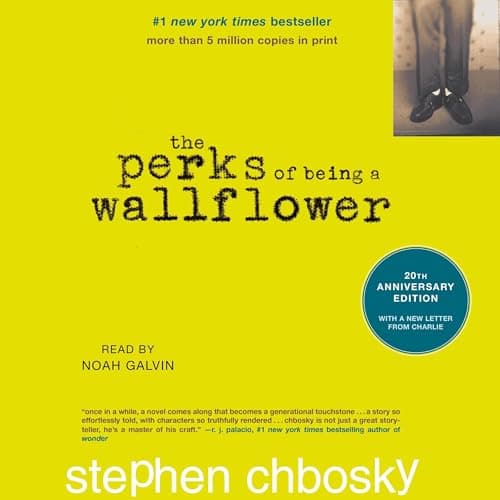

Charlie's first letter begins mid-sentence, mid-thought, mid-ache — and I wasn't ready for how hard that would hit me at seventy-three.
I was sitting on my porch, late afternoon, the dogwoods throwing long shadows across the yard and my sweet tea sweating through its glass. I'd picked this one up because a former student — now a grandmother herself — told me it changed her daughter's life. Six hours and twenty-three minutes later, the ice had melted, the sun had set, and I was sitting in the dark thinking about every student I ever had who sat in the back row, watching, never raising a hand.
Charlie Writes Like He's Afraid You'll Stop Reading
What Chbosky does with the epistolary form here is deceptively simple. Charlie writes letters to someone he'll never meet — "Dear friend" — and the effect is this strange, naked intimacy. He's not journaling. He's not confessing. He's reaching out into the void and hoping someone catches him. And Noah Galvin's narration understands this completely. He doesn't perform Charlie. He inhabits a boy who's trying very hard to sound okay while falling apart at the seams. I found a similarly unsettling kind of narrator unreliability — a voice trying hard to sound composed while something darker seeps through — in Yellowface.
Galvin reads these letters the way a teenager writes them — run-on thoughts that tumble forward, moments of forced cheerfulness that crack just slightly around the edges. When Charlie describes his first kiss, or the tunnel scene where he stands up in the truck bed and feels "infinite," Galvin doesn't push. He lets the word sit there. Infinite. Like Charlie himself can't quite believe he's allowed to feel that big. My late husband would have loved this — he always said the best readers know that silence is a kind of speaking.
The character differentiation is subtle. Galvin doesn't do voices so much as shift his weight. Patrick gets a little more air, a little more recklessness. Sam is softer, careful. Charlie's family members land heavier, more guarded. It works because this isn't a book about other people. It's about how Charlie perceives other people, and Galvin stays faithfully inside that lens.
The Quiet Violence of Remembering
Here's what I want to say to everyone who thinks this is just a coming-of-age story about mixtapes and Rocky Horror: you're not wrong, but you're not paying attention. The Rocky Horror scenes are vivid and alive, yes — Charlie discovering this strange ritual of community performance, finding a place where the misfits get to be loud. But underneath every good moment in this book, there's something Charlie isn't telling you. And Chbosky is patient enough to let you figure that out on your own.
When the truth about Aunt Helen surfaces — and I won't spoil it, but if you've taught young people for forty years, you feel it coming like weather — the book doesn't explode. It just gets very, very quiet. Galvin's reading in those final letters is stripped down to almost nothing. No drama. No vocal pyrotechnics. Just a boy trying to say something he's never had words for. Some stories need time to breathe, and this ending breathes like it's learning how.
I'll be honest: parts of the middle section feel young to me. The drug use, the party scenes, the high school relationship drama — I'm long past the age where any of that carries urgency. But that's the point, isn't it? Charlie is fifteen. His world is the size of his high school and his bedroom and the road to the tunnel. Chbosky never pretends otherwise, and I respect that restraint. He doesn't try to make Charlie's pain universal by making it grand. He makes it universal by making it specific.
Who Should Listen (And Who Should Skip)
If you were ever the quiet kid — the one who watched and listened and felt too much and said too little — this book will find the bruise and press on it. Gently, but it'll press. If you're raising one of those kids, or teaching one, listen to this so you remember what it costs to be that observant that young.
But if you need plot momentum or can't tolerate a passive protagonist who processes the world through letters to nobody, this will test your patience. And if explicit content involving minors is a hard boundary for you, be aware that Chbosky doesn't flinch from the uglier realities of adolescence — drug use, sexual abuse, violence. The content warnings exist for good reason.
The Porch Light's Still On
I set my playback to 0.85x, the way I always do, because the language here — plain as it is, simple as Charlie tries to keep it — deserves that pace. Chbosky writes the way good students write before they learn to be clever. Before they learn to hide behind vocabulary. And Galvin reads it the same way. No hiding.
I thought about my students. The ones who handed in papers that said too much between the lines. The ones I should've asked more questions. Charlie would've sat in my class, third row from the back, left side. And I hope — I really hope — I would've noticed him.