
"Sometimes you just have to take a leap of faith and raise a glass."
I was walking the lakefront with Denise last Saturday evening - one of those impossibly perfect Chicago summer nights where the skyline goes amber and the joggers thin out and you can actually hear yourself think - when Arthur Seuss made some breathlessly theatrical observation about Broadway staging, and I laughed out loud. Denise pulled out an earbud (she was listening to a true crime podcast, because we are fundamentally different people) and gave me a look. I just said, "Sorry. This kid reminds me of about six students I've had." She put the earbud back in. She knows.
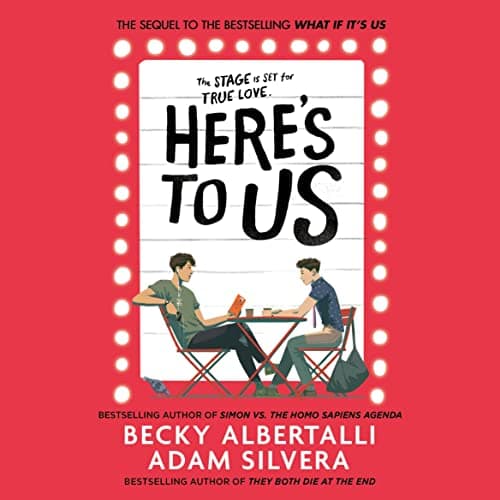
Here's the thing about Here's To Us: I went in expecting a cute YA sequel, and I got something that made me think harder about second chances than most "adult" literary fiction manages. Let's talk about what the authors are really saying here.
Two Authors, Two Narrators, Two Boys Who Can't Stay Away
Albertalli and Silvera split the writing the same way they split the first book - Albertalli writes Arthur, Silvera writes Ben - and the audiobook mirrors this with Noah Galvin voicing Arthur's chapters and Froy Gutierrez handling Ben's. This isn't just a production choice. It's an interpretive one. You're literally hearing two different sensibilities, two different rhythms of thought, alternating back and forth across ten hours.
Galvin's Arthur is all energy and impulse and that specific brand of anxious optimism that makes you want to protect him and also tell him to sit down. There's this moment - maybe around hour three? - where Arthur spots Ben with Mario in what looks like a romantic situation, and Galvin does this thing with his voice where the brightness just... dims. Not dramatically. Not actorly. It dims the way a real twenty-year-old's voice dims when his stomach drops. The narrator understands that pause is punctuation.
Gutierrez gives Ben this quieter register, more guarded, more internal. Ben's a writer working on a fantasy manuscript with Mario, and you can hear in Gutierrez's delivery that Ben overthinks everything - sentences, relationships, the distance between what he wants and what he thinks he deserves. When Ben's narrating scenes with Mario, there's genuine warmth, genuine connection. But when Arthur enters the frame, Gutierrez shifts into something more electric and more uncertain simultaneously. It's subtle work. My students would hate this. I love it.
The Mess of Being Twenty and Still Figuring It Out
What surprised me most is how seriously this book takes the idea that two people can be right for each other and still not be ready. Arthur has a boyfriend back home. Ben has Mario. These aren't placeholder relationships or villainous obstacles - they're real connections with real people, and the book respects that even as the old spark between Arthur and Ben keeps catching.
This is where Silvera's half particularly shines. Ben's internal monologue about Mario - who's his writing partner, his Spanish tutor, and "an even better kisser" - carries real weight. You feel the guilt of having genuine feelings for someone while your brain keeps circling back to someone else. The prose deserves to be savored there. Silvera's writing has always been good at making emotional ambiguity feel honest rather than manipulative, and Gutierrez's delivery leans into that restraint.
Albertalli's Arthur chapters are faster, more propulsive, more prone to spiraling. This reminds me of what Hemingway said about writing - that what you leave out matters as much as what you put in. Albertalli does the opposite, and it works: Arthur puts everything in. Every feeling, every overreaction, every dramatic reinterpretation of a two-second interaction. Galvin clearly enjoys this. You can hear it. When Arthur's narrating, the audiobook picks up speed and warmth like a runaway train made of feelings.
What the Universe Owes You (Spoiler: Nothing, But Also Maybe Everything)
The book plays with this idea of cosmic intervention - are Arthur and Ben fated, or are they just two people who keep bumping into each other in a city of eight million? It never fully commits to an answer, which is either the book's greatest strength or its most frustrating quality depending on what you want from a love story.
I'll say this: around hour seven, there's a scene where Arthur and Ben are finally honest with each other about why the first time didn't work, and both narrators - through their respective chapters' reflections on that conversation - absolutely nail the emotional complexity. It's not a dramatic confrontation. It's two people who grew up a little and are scared that growing up means growing apart. If you loved Simon vs. the Homo Sapiens Agenda, this is its spiritual successor in emotional intelligence, even if it's messier and less tidy.
The ten-hour runtime is just right. Long enough to let the relationships breathe, short enough that the will-they-won't-they tension doesn't curdle into frustration.
Who Should Listen (And Who Should Skip)
If you loved the first book, or if you're a sucker for second-chance love stories that don't pretend the messy parts are simple — this one's for you. Skip it if you need your romance wrapped in a bow by the final chapter; this ending earns its hope but doesn't hand you certainty.
Worth Pausing the Faculty Meeting For
Look - I'm a 40-something English teacher. I'm not the target demographic. But good writing about being young and confused and hopeful is good writing, full stop. We still read the classics for the same reason we still listen to the new stuff: because the question of whether love is enough, whether timing matters more than feeling, whether you can get a second chance without wrecking what you built in the meantime - that question doesn't expire. I found a similar kind of timelessness in To Paradise, which also refuses to let love stories be simple — though it swings for something much more structurally ambitious than this one, and lands about three-quarters of the way there.
Galvin and Gutierrez make this audiobook worth choosing over the print version. The dual-narrator format isn't a gimmick here. It's the whole point.
I finished the last chapter back on the lakefront, three days later, different walk, same wife. Denise asked if I cried. I told her I didn't. (I did. A little. Somewhere around hour nine. Don't tell my fourth period.)