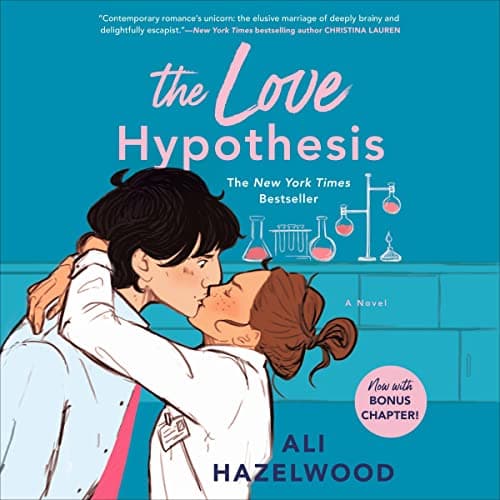

Look, I need to get something off my chest: the miscommunication trope in romance novels makes me want to throw things. Just talk to each other. Use your words. You're both scientists at Stanford — you understand the value of clear data exchange. So yes, The Love Hypothesis tested me on that front, and I suspect it'll test you too.
But here's the thing — I kept listening. Through an entire week of commutes, through cooking dinner, through folding laundry I definitely should have folded three days earlier. And that's because Ali Hazelwood builds something genuinely charming around that familiar frustration: a fake-dating romance set in the very specific, very nerdy world of academic biology, complete with grant funding anxiety, pipetting experiments, and the particular brand of imposter syndrome that haunts every grad student who's ever stared at a failed experiment at 2 a.m.
Olive Smith panic-kisses a notoriously grumpy professor named Adam Carlsen to convince her best friend she's dating someone. Adam, inexplicably, agrees to keep the charade going. The setup is ridiculous — and Hazelwood knows it's ridiculous, which is what makes it work. The STEM setting isn't decoration; it's load-bearing. The academic conference that becomes the story's inflection point carries real professional stakes, and Olive's grief over her mother and her fear of not belonging in her program give the comedy genuine emotional weight underneath.
Callie Dalton's narration is where this audiobook earns its reputation. She doesn't just read Olive — she inhabits the character's spiral energy. There's a scene where Olive is internally catastrophizing about her life choices while Adam stands there being stoically attractive, and Dalton delivers the internal monologue with this breathless, escalating panic that made me laugh out loud on the freeway. She catches the exact rhythm of someone who's smart but emotionally chaotic, and the vulnerability in her voice during Olive's quieter moments — processing her mother's death, questioning whether she deserves her place in the program — lands without melodrama. Dalton brought that same restraint to A Little Too Close, where she had to carry a similarly messy emotional interior without tipping into overwrought — worth a listen if you want to track what she does when the material asks something of her. She lets those scenes breathe rather than pushing.
Teddy Hamilton takes over for Adam's bonus chapter, and his read is a different animal entirely. He plays Adam with a low, controlled delivery — dry and clipped on the surface, with just enough warmth bleeding through the edges that you understand why Olive keeps being surprised by this guy. When Hamilton reads Adam's internal realization that he's completely gone for Olive, there's this slight catch in his voice, almost involuntary, that communicates more than the words on the page do.
The narration isn't without issues, though. Dalton's male character voices blur together noticeably. During scenes with multiple male characters — particularly when Adam and other professors or students are in conversation — you're relying on dialogue tags and context rather than vocal distinction. It requires more active listening than you'd want during, say, a noisy commute. And the bonus chapter from Adam's perspective? Polarizing is the polite word. Some listeners love seeing his pining from the inside. Others found the internal monologue surprisingly crude, tonally disconnected from the Adam they'd spent eleven hours getting to know. My advice: if you prefer Adam as someone whose feelings you piece together from actions rather than explicit inner narration, consider stopping before the bonus chapter starts.
The first half of the book is light and propulsive — the fake-dating setup, the banter, the comedy of two people who are terrible at pretending but somehow fooling everyone. The second half shifts into career betrayal, trust fractures, and deeper emotional territory. The transition works because Hazelwood has spent enough time making you care about Olive's research and professional ambitions that the stakes feel real when they're threatened. The slow burn is genuinely slow — hours of tension building through loaded glances and almost-moments — and the payoff, when it arrives, is satisfying. There is explicit sexual content, so calibrate accordingly.
The structural reliance on characters not communicating is the book's main weakness, and the audiobook format can amplify that frustration. Adam is written as brusque and emotionally guarded, and Dalton's narration of his dialogue — quiet, clipped, hard to read — sometimes makes it harder to parse his motivations than it would be on the page, where you might catch subtext in how a line is written rather than how it's spoken. It's a minor thing, but it contributes to those moments where you want to shake both of them.
At nearly twelve hours, the pacing holds. Nothing drags, nothing feels padded. It's a substantial listen that balances comedy, romance, and a surprisingly authentic portrait of academic life. If you've spent any time in a research lab, you'll recognize the world. If you haven't, the specificity is part of the charm rather than a barrier.
Who Should Listen (And Who Should Skip)
If you love fake-dating, grumpy-sunshine dynamics, and nerdy heroines who spiral — this is your audiobook. Readers who've survived academia will feel especially seen. Skip it if the miscommunication trope genuinely ruins books for you, because Hazelwood leans into it hard, and audio makes it even harder to look away.
This became a phenomenon because the formula works: likable protagonist, grumpy love interest with a hidden soft center, a setting that feels fresh, and enough emotional depth to anchor the comedy. Bride is where I'd send anyone who finishes this and wants to see Hazelwood push that formula somewhere genuinely stranger and darker — same authorial confidence, different emotional register entirely. The audiobook earns its place as the preferred format for a lot of listeners, even if the narration has its blind spots.