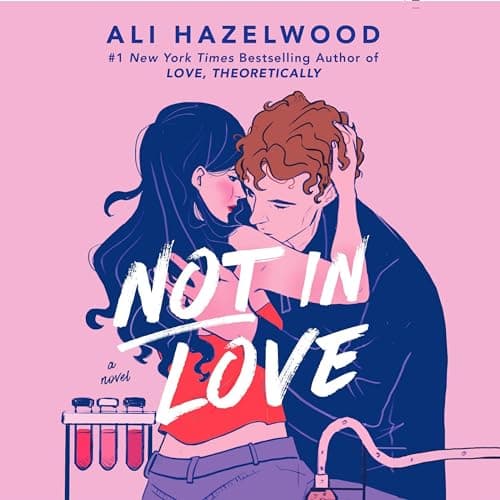

I need to get something off my chest: I am so tired of audiobook heroes who are supposed to be thirty-two but sound like they've been chain-smoking since the Carter administration. Jason Clarke voices Eli Killgore in Not in Love, and the man brings gravitas, presence, real vocal command — but he does not sound like a guy in his early thirties running a venture capital play on a biotech startup. He sounds like the guy who founded the venture capital firm twenty years ago and is now on his third divorce. It kept pulling me sideways during my evening runs, which is when I burned through most of this twelve-hour listen.
Okay. Now that I've said it, let me also say this: the audiobook still works, and it works specifically because of the duet format. I listen to a lot of business and science nonfiction, and what drew me to Hazelwood in the first place was the STEM angle — a romance author with a PhD in neuroscience who writes heroines whose jobs actually matter to the plot. Rue Siebert is a biotech engineer at a food science startup called Kline, and when Eli's firm moves to acquire her company, the corporate mechanics aren't just set dressing. There are real stakes: jobs, intellectual property, years of research. As someone who's sat through enough acquisition anxiety in professional life to recognize the dread, Rue's protectiveness over her work hit me in a very specific way.
Callie Dalton narrates Rue's chapters, and she's the reason I kept my earbuds in through the middle section when the plot starts to coast. Dalton plays Rue with this tightly controlled steadiness — almost clinical — that cracks open in small, specific moments. Rue is not your standard romance heroine. She's emotionally guarded to a degree that borders on avoidant, shaped by a childhood where financial stability was never guaranteed. Dalton's pacing mirrors that: measured, deliberate, like someone who's learned to hold everything at arm's length. When that armor finally slips, you hear it in Dalton's voice before you process it in the words. That's good narration.
Dalton brings that same controlled precision to Secretly Yours, though I'd argue this performance cuts deeper because the character actually demands it.But — and this is real — Dalton's measured delivery will test some listeners. If you find her pacing slow or her tone a little polished for your taste, you're staring down nearly twelve hours of it. I bumped to 1.15x around chapter four and left it there. It smoothed out the pacing without losing the emotional texture.
The push-and-pull between Rue and Eli is where the duet format earns its keep. When Clarke and Dalton trade off chapters, the romantic tension gets a physical dimension that a single narrator can't replicate. You hear two people orbiting each other from their own separate corners, and the chemistry lands differently when it's literally two voices in your ears. Clarke's commanding tone actually serves the forbidden-affair energy well — Eli is supposed to feel like someone you shouldn't want — even if the age of that voice doesn't match the character on paper. There were moments during his chapters where a line reading tipped from intense to genuinely unsettling, like he was narrating a thriller instead of a romance. It happened maybe three or four times across the whole book, but it was enough to notice.
The story itself follows the Hazelwood blueprint: workplace proximity, undeniable chemistry, a built-in expiration date on the relationship that you know won't hold. The food science setting is a nice departure — there's enough technical detail to feel grounded without becoming a lecture — and Rue's friend group (Florence and Tisha especially) provides warmth without stealing focus. Where the book sags is the middle third. The secret affair settles into a rhythm, and you can see every beat coming from a mile away. Hazelwood knows this. She's banking on the character work and the spice to carry you through, and for most of the runtime, they do. But if you're the type who needs plot momentum to stay locked in, that stretch will feel long.
Compared to The Love Hypothesis, this is a more grown-up book. I spent some time with my thoughts on The Love Hypothesis before coming back to this one, and that comparison held up on second look. Rue is more complex than Olive, the emotional stakes feel earned rather than manufactured, and the romance has a weight to it that Hazelwood's debut didn't attempt. But that lighter, almost fan-fiction energy that made The Love Hypothesis so easy to devour? It's not here. You're trading charm for substance, and whether that works for you depends on what you came for.
Who Should Listen (And Who Should Skip)
If you want a romance that treats its heroine's career like it actually matters — real corporate stakes, real science, real consequences — and you're okay with a slow-burn middle that asks for patience, this is your listen. The duet narration makes it genuinely better as an audiobook than as a page read. Skip it if you need constant plot momentum or if a hero voice that skews older than the character will bug you for twelve straight hours. If you do pick it up, sample a few minutes of Clarke's chapters first so his voice doesn't blindside you. And if Dalton's cadence feels too deliberate, nudge the speed up slightly before you bail. The emotional payoff in the final quarter is worth the patience.