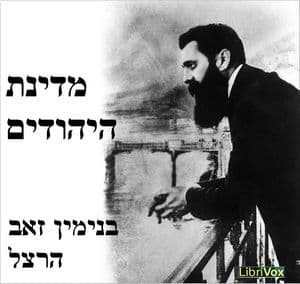

This is basically a product requirements document for a country.
I'm serious. Herzl's The Jewish State reads less like a political manifesto and more like a startup pitch deck from 1896 - here's the problem (anti-Semitism in Europe), here's the market analysis (Jewish diaspora demographics), here's the proposed solution (sovereign state), here's the implementation plan (land acquisition, immigration logistics, governance structure). At under 4 hours, it's shorter than most sprint planning meetings I've sat through, and honestly more actionable than half of them.
A 128-Year-Old PRD That Actually Shipped
I listened to this on a Sunday morning while debugging a flaky integration test that kept timing out - the kind of task where you need something in your ears but your hands are on the keyboard. And weirdly, Herzl's systematic approach to nation-building mapped onto how I think about systems architecture. He's literally spec'ing out a society: governance layer, economic layer, social infrastructure, migration pipelines. He even addresses failure modes and edge cases. The man was thinking about scalability before the word existed.
What caught me off guard is how practical he is. This isn't some starry-eyed utopian ramble. He's talking about the Society of Jews vs. the Jewish Company as separate entities with distinct responsibilities - basically separating concerns between the political organization and the economic implementation arm. The cold calculus of how technology and economics reshape human labor and displacement is something Rise of the Robots wrestles with too, though from the opposite direction - less about building new systems and more about what happens when the old ones get automated out from under you. He addresses financing, land negotiation with existing powers, and how to handle the transition of Jewish-owned businesses in departure countries. It's cold, methodical, and kind of fascinating when you realize he wrote this as a largely secular, assimilated Austrian journalist who didn't even speak Hebrew.
The Argentina bit is wild. He genuinely considered it as a viable alternative to Palestine, weighing it on practical merits like available land and climate. Knowing how history actually played out, reading that section feels like finding a deleted feature branch that never got merged.
Omri Lernau Does the Job, Nothing More
Let me be straight: the narration is functional. Omri Lernau reads clearly, paces well, and doesn't get in the way. But this is a political pamphlet, not a novel - there are no characters to voice, no dramatic scenes to land. It's one man reading another man's argument. Clean audio, no production issues that I noticed. For a text like this, "clear and neutral" is probably the right call. You don't want someone doing dramatic pauses on economic policy proposals.
That said, at 1.5x this flew by. The writing style is dense but not academic - Herzl was a journalist, and it shows. Sentences are punchy, arguments are stacked efficiently. I bumped to 1.75x for some of the more repetitive economic sections and didn't lose anything.
Who Should Queue This Up (And Who Shouldn't)
Perfect for: anyone who's read about the founding of Israel but never gone back to the literal source document. If you've ever argued about Zionism at a dinner party (or on Twitter, which is worse), you should probably read what actually started the political movement. It's like reading the original RFC before arguing about protocol implementation.
Skip for: anyone expecting a dramatic historical narrative or a deep personal memoir. This is a pamphlet. A brilliant, historically consequential pamphlet - but still a pamphlet. If you want the human story behind Herzl, this ain't it. He's deliberately impersonal here, writing as an engineer of political change, not as a man processing his own Jewish identity.
Also worth noting: at 3 hours 47 minutes, this is a single commute round-trip for me. The ROI on this audiobook is actually pretty solid for that reason alone - you get a foundational primary source document in less time than it takes to watch two episodes of whatever Kevin's bingeing.
The Commit That Changed the Main Branch
Here's the thing that stuck with me after the audio ended: Herzl published this in 1896 and died in 1904. Israel was established in 1948. He never saw it. But the spec he wrote - this under-4-hour document - basically defined the requirements that a dozen other people spent fifty years implementing. Not perfectly, not without massive conflict and cost, but the core architecture he proposed? It shipped.
That's either inspiring or terrifying depending on your perspective. Probably both. Either way, it's worth the listen just to understand where the blueprint came from.