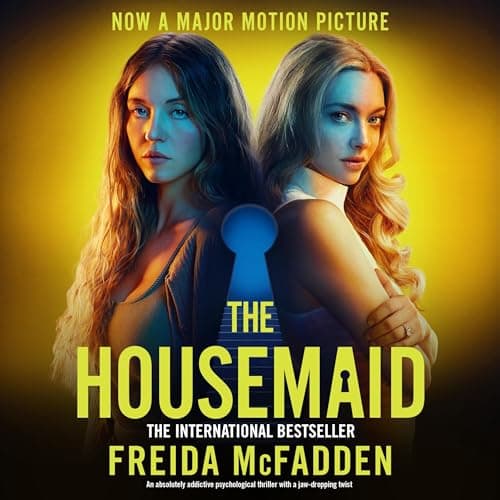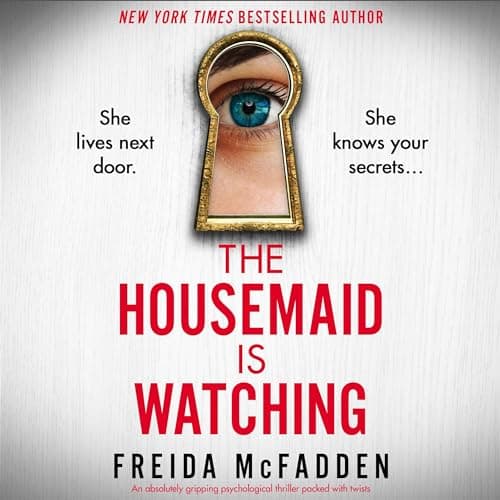

Everyone keeps telling me Freida McFadden is the queen of domestic thrillers, and I keep nodding politely while privately thinking most domestic thrillers have the tension of a wet paper towel. So I went into The Housemaid Is Watching with my arms crossed and my expectations low — which is probably exactly the position McFadden wants you in before she starts pulling the rug out.
I was shelving returns at the library on a dead Tuesday afternoon, earbuds in, when the cul-de-sac started feeling wrong. Not horror-wrong — I know horror-wrong — but that specific suburban dread where everyone's smiling too wide and the casseroles arrive too fast. By the time Mrs. Lowell's maid opened the door in her white apron with that ice-cold stare, I'd stopped shelving entirely and was just standing in the 600s holding a copy of The Joy of Cooking like an absolute fool.
The Suburban Uncanny Valley Actually Works Here
Look, I live for atmospheric dread. Shirley Jackson invented it. And while McFadden is not Shirley Jackson — nobody is — she does something clever with the neighborhood dynamics that I genuinely didn't expect from a bestseller thriller series. The paranoia isn't supernatural. It's social. Millie watching her husband leave the house late at night, the neighbor across the street whispering warnings, the maid who looks at you like she's already planned how to dispose of your body — it's all grounded in the specific terror of "we just signed a thirty-year mortgage and something is very wrong with this street."
The first act, though? I get why people got impatient. The early dialogue between Millie and Enzo feels like it was written for readers who need every emotional beat spelled out in capital letters. "I love our new house." "I love it too." "We worked so hard for this." It's not bad, it's just... padded. Like McFadden doesn't trust you to pick up on context. For a book that later pulls some genuinely sharp twists, the opening plays it frustratingly safe.
Two Narrators, One Clear MVP
Lauryn Allman carries this book. Full stop. Her Millie has this quality I can only describe as controlled exhaustion — the voice of a woman who's been through enough to know exactly how dangerous "normal" can be, but who's desperately trying to believe in the picket fence anyway. When the paranoia ramps up and Millie starts whispering her fears into the dark, Allman drops her register to something genuinely unsettling. Not dramatic. Not overwrought. Just a woman who knows she should be afraid and is trying to keep it together for her kids. The narrator commits. That's rare.
Ina Marie Smith handles the secondary perspective and gives Martha — the Lowells' maid — this stiff, measured quality that made me deeply uncomfortable every time she spoke. There's something about the way she delivered certain lines that felt like someone reciting pleasantries while holding a knife behind their back. The dual-narrator setup works because the two voices create different textures of unease. Allman's is warm anxiety. Smith's is cold observation.
That said, neither narrator can fully save the early pacing. When the dialogue is thin, even good delivery can't disguise it. I nearly bumped the speed to 1.25x in the first two hours. Held off, and I'm glad I did, because once the neighborhood secrets start unraveling around the midpoint, the pacing locks in and doesn't let go.
Not Horror, But It Borrows Well
Here's where I have to be honest with my horror-brained self: this isn't horror. It's a psychological thriller wearing horror's coat. And that's fine — as long as we're clear about what we're getting. The dread here isn't existential or cosmic. It's domestic. It's "who is my husband texting at midnight" and "why does my neighbor know things about me she shouldn't." If you scare easily, this'll get under your skin. If you're used to actual horror, you'll appreciate the craft of the tension without losing sleep over it. I had a similar experience with Kindred in Death — procedural on the surface, but the psychological architecture underneath is doing real work if you're paying attention.
What McFadden does understand — and this is where I tip my hat — is structural misdirection. The final twist isn't just a surprise; it recontextualizes earlier scenes in a way that rewards attentive listeners. I actually went back and relistened to a chunk of the middle section after finishing, and yeah, the breadcrumbs are there. She's not cheating. That earns respect.
(Shirley — the cat, not Jackson — was asleep on my chest during the final hour. She did not react to the twist. I, however, said a word out loud that I cannot print on a family website.)
Who Gets the Keys to This House (And Who Should Keep Walking)
If you burned through the first two Housemaid books and want closure for Millie's arc, this delivers — though it's a different animal, more focused on family than on Millie-as-weapon. If you're new to the series, McFadden claims it works as a standalone, and she's mostly right, though you'll miss some of the satisfaction of watching Millie's past inform her present.
Skip if you need your thrillers to hit the ground running. The first two hours are the price of admission, and not everyone will find them worth paying. Also skip if you're coming in expecting genuine horror — this is dread-as-thriller, not dread-as-nightmare.
The Lights Stayed On, But My Suspicion Didn't
My podcast listeners are going to love this — not because it's horror, but because it's a clean example of how to structure dread in a domestic setting. McFadden knows that the scariest thing about suburbia isn't what's hiding in the basement. It's what's hiding behind the neighborly smile. She doesn't always trust her audience enough in the early going, but when she lets the machinery run? It runs sharp.