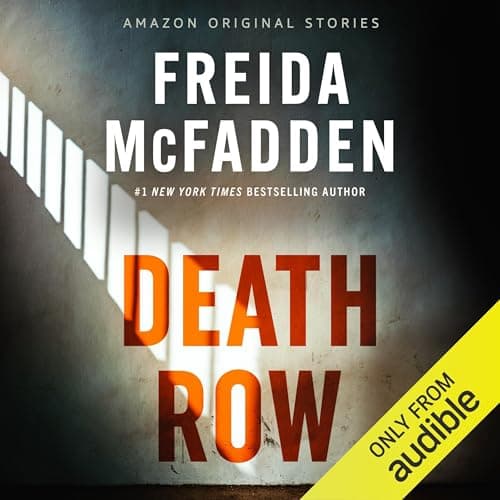

I finished this one sitting in my SUV outside a client's office in north Austin, killing ten minutes before a threat-assessment meeting, coffee going cold in the cup holder. Not ideal prep for corporate PowerPoint land. Then Talia Kemper spots the husband she's supposedly murdered, alive, in the visiting area. That's the kind of premise that makes you stay parked and text, "Running five late."
Let me cut to the chase: Death Row is a sharp little psychological thriller dart. It hits fast, sticks for a while, and then the ending is going to decide whether you salute or throw something at the wall. For me? Worth the listen, not worth a full credit at 1 hour 44 minutes.
The hook here is simple and nasty in the best way. Talia is on death row for killing her husband. She had an alibi. No clear motive. Nobody cared. Then, with appeals fading and execution getting close, she sees a man she recognizes instantly — the dead husband who may not be dead at all. That setup does exactly what a short thriller needs to do: it puts a live grenade in your hand early and dares the author to hold onto it.
Where this works
Freida McFadden understands momentum. There's no scenic route here. The story moves from Talia's certainty, to the system ignoring her, to the awful clock of execution getting closer. And because it's so short, every visit, every appeal-related beat, every new doubt matters more than it would in a padded-out domestic thriller.
I also liked that the premise plays with a very specific fear: not just wrongful conviction, but the total helplessness of knowing something impossible is true while everyone around you assumes you're lying or unraveling. I've seen this scenario play out in real life — not the fake-dead-husband part, obviously, but the institutional version of it. Once a machine decides what you are, good luck convincing it otherwise.
The last stretch is where the book earns its keep. Those final chapters have the edge-of-the-seat energy people are talking about. Not because McFadden turns this into an action sequence. Because she tightens the screws on Talia's situation and lets the listener sit in that panic. Short-form suspense lives or dies on that back-end acceleration. This one mostly lands it.
Mostly.
Where it wobbled
This is where it lost me a little. The short format gives the story punch, but it also leaves some of the emotional and logical groundwork undercooked. If you like McFadden most when she has room to build a bigger trap and then spring it, this may feel more like a clever exercise than a fully satisfying meal.
A few listeners called the ending confusing or childish. I wouldn't go that far, but I get the complaint. The twist is absolutely the point of the whole operation, and if you don't buy what McFadden is selling in those final minutes, the entire story drops a letter grade. That's the risk with a story built this heavily around a final reveal. No redundancy. No safety net.
And because we're dealing with death row, appeals, prison visits, and a woman insisting she didn't kill the man everyone says is dead, the story really needs your full attention. Miss a couple details while unloading groceries or arguing with GPS, and you may come out the other side thinking, Wait — hold on. Who knew what, and when? Not a book for distracted listening. Whisper of Evil gave me the same problem — one of those audiobooks where you realize you've been half-listening for ten minutes and suddenly nothing tracks.
Lauryn Allman keeps the whole thing on the rails
Ranger approved this one. He got the long evening walk while I finished the last chunk, and Lauryn Allman's performance did a lot of the heavy lifting.
She's got a low, mellow tone that works especially well for Talia because it avoids the usual thriller-narration trap of sounding hysterical just to prove stakes. Instead, Allman plays Talia with a controlled strain — like someone trying very hard to stay rational while the walls keep inching inward. That choice matters. If Talia sounded overwrought from the jump, the premise would get a lot flimsier.
Her suspense beats are clean too. She doesn't oversell the prison-visit scenes, and that helps. When Talia sees the recognizable stranger she believes is her husband, Allman lets the shock register without turning it into melodrama. Same deal in the appeal-heavy sections and the final run of chapters. She understands that tension usually sounds better when a narrator tightens the voice rather than turning up the volume.
No production gimmicks here. No music, no sound effects, no full-cast circus. Just one narrator, clean audio, and enough differentiation to keep characters straight in a story that really can't afford confusion. Mission accomplished.
Who Should Listen (And Who Should Skip)
Pick this up if you want a one-sitting thriller built around a nasty central premise and you're willing to accept that the ending is the entire bet. Skip it if you need rich character development, airtight realism, or a long runway before the reveal. This thing is a sprint.
Compared with McFadden's longer work, this feels lighter on payoff than The Housemaid, mostly because there just isn't enough runtime to build the same level of dread or aftermath. But as a short hit of psychological suspense? It does the job.
My advice: grab it on sale, through a subscription, or as a palate cleanser between heavier listens. At 1.25x, it moves like a stolen car and doesn't overstay its welcome.
SITREP: strong premise, solid narration, effective final stretch, slightly shaky landing depending on your twist tolerance. Not top-tier McFadden. But for under two hours, it's a pretty efficient little ambush.