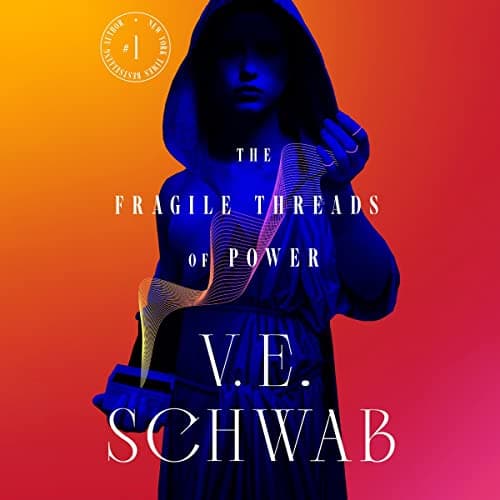

I was three hours into this on a rainy Saturday, feet up, coffee going cold, when I realized I'd been unconsciously slowing my breathing during Kosika's chapters. That's the kind of detail that tells you whether a fantasy audiobook is working — not whether the worldbuilding is clever (it is), but whether the performance physically changes how you sit in your chair.
Here's the thing people keep saying: this is a smooth continuation of the Shades of Magic series. That's half right. V. E. Schwab picks up seven years after A Conjuring of Light, and the world has genuinely changed. Kell and Lila are mostly offstage. A teenage Antari named Kosika has claimed the throne of White London, building a theocracy on the bones of Holland's legacy and her own blood. King Rhy faces a rebellion that wants to burn the monarchy down entirely. And a new character, Tes — a girl who can see the literal threads of magic connecting objects and people — stumbles into possession of a device that could crack open the sealed doors between worlds. What this actually feels like is a new series wearing the old one's coat. The familiar warmth is there, but the shape underneath is different. Heavier. More political.
The narration is where this audiobook lives or dies, and two-thirds of it is outstanding. Michael Kramer handles Rhy's sections with this particular quality I can only describe as regal exhaustion — you hear a king who's tired of performing kingship but can't stop. When he shifts to other characters in those same chapters, the transitions aren't just accent changes; they carry different emotional weights. Kate Reading's pacing with Lila and Kell feels like she's holding something back, which is exactly right for characters who've been holding themselves back for seven years. Reading does this same thing across thousands of pages of Wheel of Time — I tracked how she handles suppressed emotion in Eye of the World and it's a genuine through-line in how she approaches women who know more than they're saying. There's a moment where Reading voices Lila noticing something she doesn't want to notice, and the micro-pause before the next line does more work than a paragraph of internal monologue could.
Marisa Calin as Tes is where the conversation gets complicated. Her acting instincts are strong — she captures Tes's anxious, quick-thinking energy with a theatrical precision that fits the character. The problem is speed. Her sections clip along noticeably faster than Kramer and Reading's passages. Whether this is performance choice or post-production compression, the effect is like switching from a vinyl record to a podcast on 1.2x. Every time the narration shifted to Tes, I needed thirty seconds to recalibrate. During a long listening session — I did about six hours straight one Sunday — that recalibration started to feel like friction rather than storytelling.
The production team clearly coordinated to keep character voices consistent across all three narrators, and when a character crosses from one narrator's territory into another's, the handoff mostly lands. That's a genuine technical achievement. But "mostly" is doing work in that sentence. The pacing mismatch undercuts the consistency they built everywhere else.
As story structure, this is unambiguously a first-in-trilogy setup book. Multiple POVs — Tes, Kosika, Kell, Lila, Rhy, plus antagonists — mean some threads get deep development while others are clearly being positioned for later payoff. Tes carries the most immediate narrative urgency because she's holding the device everyone wants. Kosika's chapters are the most emotionally destabilizing — Schwab writes a child-ruler who genuinely believes a dead god chose her, and the combination of absolute power and adolescent emotional volatility is genuinely frightening. Schwab has a particular gift for characters who are dangerous precisely because they're sincere — Vicious runs on the same terrifying logic, where the scariest thing isn't that someone is evil but that they've reasoned themselves into believing they aren't. The returning characters, though? Some of them feel like they're stretching before a race that hasn't started yet. If you're coming back specifically for Kell and Lila adventures, recalibrate those expectations. They're here, but they're not driving.
Schwab's magic system translates beautifully to audio. Tes's ability to perceive threads of power gives the narration a physical texture — you feel the pull, the tension, the snap when something breaks or reconnects. It's the kind of sensory writing that an audiobook can amplify rather than flatten.
At 21 hours and 35 minutes, this demands your attention. The shifting POVs, the three different narrator voices, the layered political dynamics across multiple Londons — this is not a background-while-cooking listen. I tried it during a long drive once and had to rewind twice when I missed a POV transition. Save it for sessions where you can actually focus.
Buy this if you remember enough of Shades of Magic to enjoy a politically heavier, more structurally ambitious return and you're patient with setup-heavy first-book energy. Skip it if you want nonstop Kell and Lila action or if narrator shifts between chapters pull you out of a story. The payoff for the threads Schwab is laying here will come in later books — this one asks you to trust the construction.