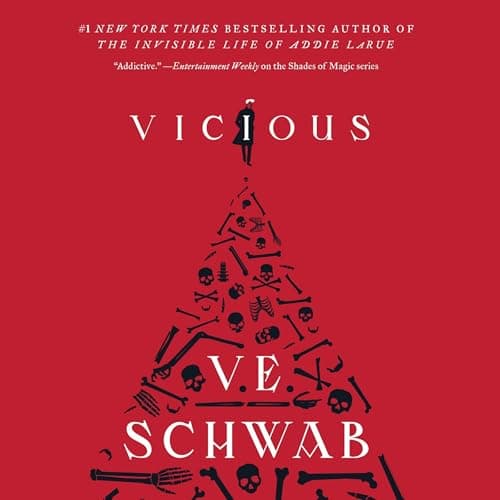

I made the mistake of starting this at 11 PM on a Tuesday, thinking I'd listen to a chapter or two before sleep. Three hours later I was wide awake, staring at the ceiling, still hearing Jeremy Arthur's voice in my head as Victor Vale calmly explained why he was going to destroy his former best friend. This is not a bedtime audiobook. This is the audiobook equivalent of black coffee at midnight.
Vicious is built on a premise that sounds like it could be a comic book origin story played straight — two college roommates discover that near-death experiences can trigger superpowers, decide to test the theory on themselves, and everything goes catastrophically wrong. But Schwab isn't interested in superhero triumphalism. She's written a revenge thriller where both leads believe they're the hero and neither one deserves to be. Victor Vale is cold, calculating, and genuinely capable of hurting people without flinching. Eli Ever is a charismatic zealot who's decided God wants him to murder every other superpowered person on the planet. You root for Victor not because he's good but because Eli is worse, and that uncomfortable math is the engine that drives everything.
What sold me on the audio version specifically is how Arthur handles Victor's voice. There's this controlled flatness to it — not monotone, but restrained, like a man who learned long ago that showing emotion is a tactical mistake. Then a moment lands where Victor's composure cracks, just slightly, and Arthur lets you hear it without overselling it. It felt physical. Like watching someone's knuckles go white around a glass they're about to break. His Eli is the opposite: warm, earnest, the kind of voice you'd trust immediately, which makes the slow reveal of what's underneath so much more disturbing. By the time Eli's god-complex fully crystallizes, that warmth hasn't left Arthur's delivery — it's just been recontextualized, and it's chilling.
Arthur does something similar in Warm Up, where a character's surface likability quietly curdles over the course of the runtime — though the stakes there are considerably lower.
The supporting cast gets real attention too. Sydney, the young girl Victor picks up after his prison break, comes through as genuinely fragile without tipping into precious-child territory. And June — Arthur gives her this light accent that several listeners have flagged as a highlight, present enough to distinguish her but never tipping into cartoon. It's the kind of restraint that separates a skilled narrator from someone just doing funny voices.
Schwab's structure here is the element that will either hook you or lose you. The story jumps between present day and ten years earlier, and it does so constantly, sometimes mid-chapter. On the page, you've got visual cues — headers, formatting. In audio, you've got Arthur, and he earns his paycheck. His younger Victor and Eli sound different from their present-day selves — not through obvious pitch changes but through pacing and energy. The college-era scenes have a reckless velocity to them. The present-day chapters are slower, heavier, loaded with the weight of what happened between then and now. I never once lost track of where I was in the timeline, which is remarkable given how aggressively Schwab cuts between them.
But here's the trade-off: you need to actually pay attention. I tried switching to this during a grocery run on day two and immediately had to rewind. The nonlinear plotting relies on you catching details that pay off chapters later, and half-listening will leave you confused rather than intrigued. This is a headphones-on, phone-away kind of listen. If you give it that, the structure becomes one of its best features — every timeline jump is withholding exactly the right piece of information, so when the reveals land, they hit like plot twists even though the information was there all along.
At nine hours and change, Schwab doesn't waste a minute. There's no padding here, no subplot that exists to fill pages. It reads like a book that was edited with a scalpel, and Arthur matches that economy. No vocal flourishes for their own sake, no dramatic pauses that overstay. Just clean, sharp delivery that trusts the material.
I've seen a handful of reviews calling the story shallow, and I think those readers wanted a 400-page character study about the nature of heroism. That's not what this is. Vicious is a precision instrument — tight, mean, and efficient. The moral complexity isn't delivered through internal monologues about ethics. It's delivered through choices, through watching two brilliant men justify increasingly terrible things to themselves while Arthur makes both justifications sound almost reasonable.
Who Should Listen (And Who Should Skip)
If you want morally grey characters who make you feel genuinely conflicted, a narrator who knows exactly when to hold back, and a plot that rewards your full attention — this is your listen. Skip it if you need a clear hero to root for, or if you're looking for something you can half-follow while doing chores. This one demands your whole brain.
If you're coming from Schwab's Shades of Magic series or Addie LaRue, recalibrate. This is darker, faster, and less interested in making you feel wistful. Arthur also narrates the sequel Vengeful with the same quality, so the series holds up in audio if you want to commit. I spent about a week after finishing this one just sitting with Vengeful queued up and refusing to start it because I wasn't ready for it to be over — and it absolutely held. For my money, this is one of those audiobooks where the narrator doesn't just serve the story — he gives it an edge the text alone might not have.