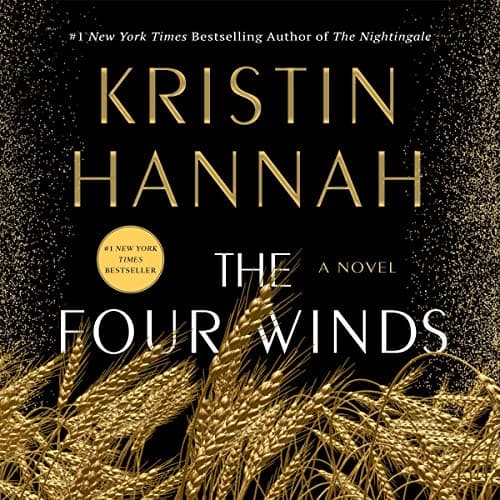

"My land tells its story if you listen."
That line hit me somewhere around hour three, and I had to stop walking. Just stood there on the lakefront path like an idiot, November wind off Lake Michigan cutting through my jacket, while joggers swerved around me. Denise had stayed home with a cold, so it was just me and Julia Whelan and the Texas panhandle in 1934, and I'm telling you — the contrast between the freezing lake air and the dust-choked world Whelan was building in my earbuds was almost too perfect.
Steinbeck's Joad Family Had a Sister, and Her Name Is Elsa
Let's talk about what Kristin Hannah is really doing here. Yes, The Four Winds is a Dust Bowl novel, and yes, the comparisons to The Grapes of Wrath are inevitable — they share migrant camps, California's ugly nativism, the grinding machinery of poverty. But where Steinbeck gave us the collective struggle through a family of men (sorry, Ma Joad, you deserved more pages), Hannah centers the entire weight of the Depression on one woman's body. Elsa Wolcott starts the novel as someone her own family has basically written off — too tall, too sickly, too old at twenty-five in 1921 Texas to be worth marrying. She's not heroic. She's not even particularly confident. And that's exactly what makes the next fifteen hours so devastating.
Because Hannah tracks Elsa's transformation with a patience that some listeners will find slow — and I get that complaint, I do. The first third of the book is a long simmer. Elsa's marriage to Rafe Martinelli, a man who wanted freedom and got a wife instead, unfolds with the kind of quiet domestic erosion that doesn't make for exciting chapter endings. But this is the foundation. When the dust storms arrive — and Hannah describes them with a visceral horror that made me actually hold my breath during a scene where Elsa tries to seal her children's bedroom with wet rags while black dust pours through every crack — you understand what's being lost. Not just crops. Not just money. An entire way of understanding yourself.
Julia Whelan Knows That Silence Is a Sentence
Whelan does something I rarely hear even from excellent narrators: she lets Elsa's silence land. There are moments — particularly in the scenes between Elsa and her mother-in-law Rose, who is the beating Italian heart of this book — where Whelan holds a beat just long enough for you to feel the words Elsa can't say. Rose's voice carries a slight warmth, an earthiness, that Whelan distinguishes from Elsa's more restrained, almost apologetic tone. It's not showy character work. It's the difference between a narrator who performs and one who inhabits.
Now, fair warning: Whelan employs a Southern dialect in the dialogue sections that took me a few chapters to settle into. Some listeners have compared the experience to being read to in school — and look, I've been the guy reading to a classroom for twenty years, so I know what that sounds like. Julia Whelan pulled off something similar in Lying Game, where the pacing felt slow to some reviewers but was doing real structural work underneath. Whelan's delivery isn't that. But I can see how someone listening at 1.5x or while doing dishes might lose the emotional register. This book demands 1.0x. The prose deserves to be savored, and Whelan's pacing is calibrated for attention, not ambiance.
The mother-daughter relationship between Elsa and Loreda is where Whelan's emotional precision really pays off. Loreda is furious — at the dust, at her absent father, at her mother for not being furious enough. Whelan gives Loreda's anger a sharpness that contrasts with Elsa's worn-down steadiness, and the scenes where they clash have a rawness that reminded me of actual arguments I've overheard between my students and their parents at conferences. That specific, uncomfortable kind of love that looks like resentment.
The Part Where I Disagree With the Bestseller Lists
Here's where I have to be honest. Hannah is a gifted storyteller with a real talent for historical immersion. The Dust Bowl sequences are extraordinary. The California chapters — the migrant camps, the labor organizing, the cruelty of landowners who treat desperate people like disposable tools — carry genuine political weight. That Hemingway line about needing to know ten times more than you put on the page? Hannah clearly did the research.
But the romantic elements feel like they belong to a different, simpler book. Rafe Martinelli is thinly drawn. The love story that launches Elsa's entire trajectory — a single night of rebellion — never fully convinced me, and by the time the novel introduces a second potential romance in California, I found myself wishing Hannah had trusted Elsa's story to stand without it. My students would hate this take. They want the romance. I wanted more of Elsa arguing with cotton field bosses.
The ending is bold. I won't spoil it, but I will say it's the kind of choice that either elevates the book to literature or tips it into melodrama, depending on what you bring to it. I listened to the final chapter standing in my kitchen at midnight, papers ungraded on the table, and I sat with it for a long time afterward.
Who Gets the Assignment (And Who Gets a Hall Pass)
If you loved The Grapes of Wrath, this is its spiritual successor — told from the perspective Steinbeck never gave us. If you're coming from Hannah's The Nightingale, expect less wartime thriller and more slow-burn survival. Skip this one if you need constant plot momentum or if romance subplots in historical fiction make you impatient — the first third is a slow build and the love story never quite earns its real estate. The bonus author interview at the end is worth staying for, especially Hannah's comments about why she chose a female protagonist for a story usually told through men.
Worth pausing the faculty meeting for. Just maybe not the budget presentation — this one requires your full attention.
(Principal Martinez, I promise I was listening to your remarks about the new copier contract. I was not crying about dust storms in the Texas panhandle. That was allergies.)