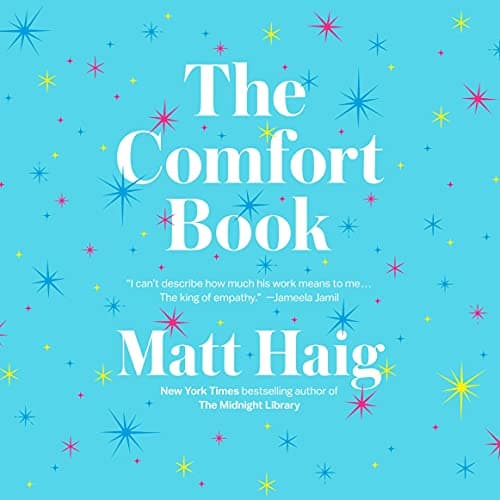

Three hours and ten minutes. That's it. That's the whole thing.
I started this at 11 PM on a Tuesday, couldn't sleep, anxiety doing its usual late-night tap dance on my prefrontal cortex. Pulled up Matt Haig's The Comfort Book thinking it would be the auditory equivalent of a warm blanket — something to quiet the noise. And honestly? It mostly is. But I have thoughts.
A Psychologist's Notes on Someone Else's Therapy Journal
Here's what The Comfort Book actually is: Matt Haig's personal collection of aphorisms, micro-essays, and borrowed wisdom, originally written as reminders to himself during depressive episodes. It's not a self-help book in the prescriptive sense — there's no framework, no five-step plan, no CBT worksheets. It's more like reading someone's marginalia from the darkest and most luminous moments of their life, stitched together in fragments that range from two sentences to a few pages.
What makes this psychologically interesting to me is the mechanism at work. Haig is essentially doing what narrative therapists call re-authoring — taking his worst experiences with depression and suicidal ideation and reframing them into something instructive, something survivable. The research actually shows that this kind of meaning-making — finding the lesson inside the suffering — is one of the strongest predictors of post-traumatic growth. So when Haig writes about being at his lowest and discovering that the view from rock bottom sometimes has unexpected clarity, he's not being trite. He's demonstrating a genuine psychological process.
But — and this is where I get conflicted — the fragment-based structure means you never sit with any single idea long enough for it to really land. One moment he's referencing Epictetus, the next he's listing things that make life worth living (spoiler: includes swimming and pizza), and then he's sharing a deeply personal anecdote about wanting to die at twenty-four. The tonal whiplash isn't jarring exactly, but it does create this strange pacing where nothing quite builds. It's comfort as scattered reassurance rather than comfort as sustained argument. The fragmented structure reminded me of how For Women Only also leans heavily on assembled observations and survey data points rather than a cohesive narrative thread — and how that same format either feels revelatory or like a listicle depending entirely on what you walked in expecting.
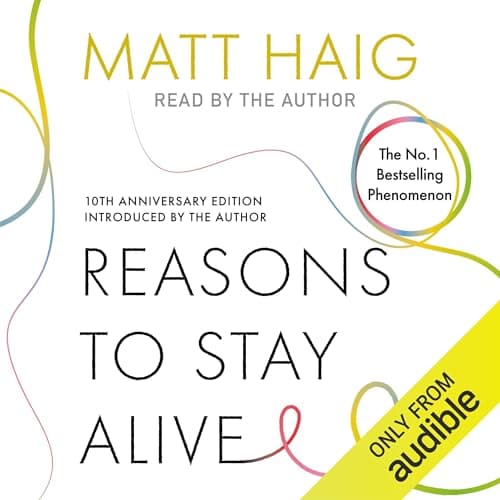
I found myself asking: why does this format work for some people and actively frustrate others? I think the answer is expectations. If you come in wanting Reasons to Stay Alive — Haig's earlier, more structured memoir about depression — you'll find this disjointed. If you come in wanting a book you can dip into at random, like a daily meditation app in audiobook form, it lands differently.
Haig Reading Haig (The Author-as-Narrator Problem)
Here's the thing about author-narrated nonfiction: sincerity is easy, but vocal craft is hard. Haig's voice has this quiet British steadiness that works beautifully for the raw, vulnerable passages — when he talks about depression, you believe him completely because you're hearing the actual person who survived it. There's no performance layer between you and the pain. That's rare and valuable.
The problem is a noticeable room resonance in the recording. It's subtle but persistent — like he recorded in a space that wasn't fully treated acoustically. During the shorter, quieter entries it creates an almost echoey quality that pulled me out a few times. If you're listening on good headphones late at night (guilty), you'll notice. Through car speakers? Probably fine.
His delivery also gets a bit same-y across the three hours. Because there's no narrative arc, no characters, no dramatic variation — just Haig reflecting in his calm, measured tone — it can drift toward the dulcet end of things. Not boring, but... lulling. Which, depending on your mood, is either exactly what you need or the reason you zone out during the section about ancient Stoic philosophy and miss something genuinely good.
Who Gets the Prescription (And Who Should Skip It)
If you're in a dark place and need someone who's been there to tell you — with genuine authority — that it gets better, this is the book. Haig earns that authority. He's not theorizing about suffering from a comfortable distance. My therapist would have thoughts about this book, and I think most of them would be approving, because it models something important: the act of building your own evidence file against despair.
But if you want depth — psychological rigor, sustained argumentation, a framework you can actually apply — skip this one. The comfort here is warm but thin. You'll feel better during the listen and probably forget most of it by Thursday. Some of the observations land as genuinely wise. Others land as the kind of thing you'd find on a well-designed Instagram tile. And at three hours, it's over before it can really challenge you.
The Case File, Closed
This is a fascinating case study in what happens when a writer turns their coping mechanisms into a book. It's honest, it's kind, it's imperfect. It's also very short and structurally scattered in a way that either serves you or doesn't. I'm glad I listened to it at midnight with my brain doing its worst. It helped. But I won't pretend it changed how I think about anything — it just reminded me of things I already knew, in a gentle voice with slightly too much reverb.