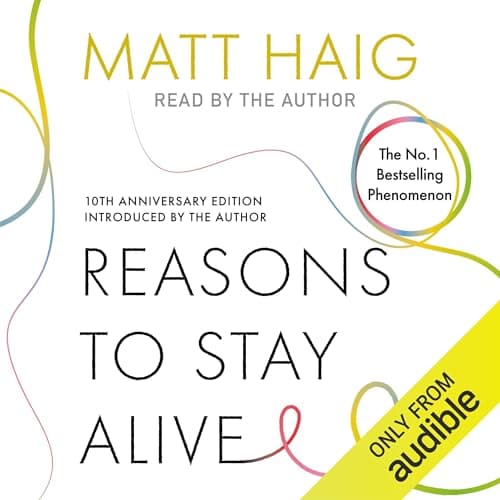

What happens when the person reading you a book about nearly dying is the person who nearly died? That question sits at the heart of this audiobook experience, and it changes everything about how you receive Matt Haig's words.
Reasons to Stay Alive is Haig's account of his breakdown at age 24 — the depression that swallowed him whole, the panic attacks that left him unable to cross a road, and the slow, unglamorous process of learning to exist again. At just over four hours, it's a short listen, but those four hours carry real weight. Haig writes in fragments — short chapters, lists, imagined conversations between his present and past selves — and the audiobook format actually suits this structure well. You're not slogging through dense paragraphs; you're absorbing bursts of honesty, one after another, like someone sitting across from you and telling you the worst thing that ever happened to them.
And that's essentially what's happening here. Haig narrates his own book, and his performance is the single most important element of this audiobook. There's no actorly polish, no dramatic crescendos timed to hit you in the gut. Instead, you get a man reading words that clearly still cost him something to say out loud. When he describes the physical sensation of a panic attack or the terrifying flatness of severe depression, his voice carries the residue of those experiences. It's not performative vulnerability — it's just vulnerability. That frank, unguarded quality makes certain passages land with startling force.
I found myself listening to this during a quiet afternoon, and I'm glad I did. This is not an audiobook you throw on during a commute and half-absorb between lane changes. Some sections — particularly the descriptions of his most acute episodes — demand your full attention, and honestly, they demand a bit of emotional readiness too. There were stretches where I had to pause, not because the writing was bad, but because it was doing its job almost too well. I can absolutely see why some listeners have described the experience as exhausting. Haig doesn't shy away from the ugly, suffocating reality of what depression actually feels like from the inside, and hearing it in his own voice adds a layer of intensity that a different narrator might have softened.
But here's the thing — the book isn't just a catalogue of suffering. Haig is genuinely funny in places, and the structure keeps pivoting between darkness and light. He'll give you a devastating passage about wanting to disappear, then follow it with a wry list of reasons he's glad he didn't. The tonal shifts feel earned rather than manipulative because you know this is one person's real timeline — not a crafted arc designed to make you cry and then feel better. The hope in this book is hard-won, and you can hear that in how Haig reads it. When he talks about recovery, there's no triumph-of-the-human-spirit gloss. There's relief, gratitude, and the quiet acknowledgment that he got lucky in ways not everyone does.
Where the audiobook is less effective is in its self-help adjacent moments. Haig occasionally shifts into advice mode — tips about reading, running, being present — and these sections feel thinner than the memoir portions. In print, you might skim a list and move on. In audio, you sit through it, and the pacing dips. Not a dealbreaker, but at under five hours, you notice when the energy drops.
The brevity is both a strength and a limitation. It means nothing overstays its welcome, and the fragmentary style stays fresh throughout. But it also means certain ideas get introduced and abandoned quickly. If you're coming to this looking for a comprehensive guide to managing depression, you'll want something more systematic — think Atomic Habits logic applied to mental health routines. Defeating SAD sits closer to that structured end of the spectrum — it gave me something to actually do, which is a different need than what Haig is trying to meet here. Reasons to Stay Alive is more of a companion piece — the kind of book you keep on your phone for a bad day, not a textbook you study.
For anyone who has experienced depression or loves someone who has, this audiobook offers something rare: the sound of someone who has been inside the worst of it, speaking plainly about what it was like and how he found his way back. It won't fix anything. Haig would be the first to say that. But there's a particular comfort in hearing another human being say, in their own imperfect voice, that the thing you're feeling has an other side — and that the other side is worth reaching.
Who should listen: Anyone who's lived through depression (or watched someone they love go through it) and wants to feel less alone in that experience. Also worth it if you've read Haig's fiction — particularly The Midnight Library — since hearing him narrate the real experiences behind those stories adds a dimension you can't get from the page. Who should skip: If you need a structured, actionable mental health guide, this isn't it. And if you're in an acute low right now, the vivid descriptions of Haig's worst episodes might be more than you want to absorb — queue it for a steadier day.
The short runtime and the emotional density make this a tricky value proposition at full credit price, but it's an ideal candidate for streaming or borrowing.