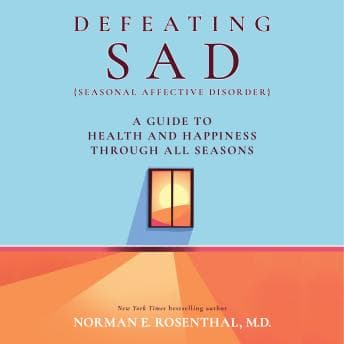

"The light doesn't just enter through your eyes. It enters through your mind."
I was standing in my kitchen around 7 PM, attempting to make dal that would make my mother proud (it wouldn't), when Dr. Rosenthal dropped that line. And I just... stopped stirring. Because here's the thing about studying psychology for a decade: you think you understand the brain-environment connection. Then someone who literally discovered a disorder explains it with the patience of a grandfather teaching you chess, and you realize you've been playing checkers.
The Man Who Named the Darkness
This is a fascinating case study in authority that doesn't feel authoritarian. Dr. Rosenthal didn't just write about Seasonal Affective Disorder - he identified it, named it, pioneered the primary treatment for it. That's not marketing copy. That's medical history. And yet, listening to him narrate his own work, there's zero ego in the delivery. His voice has this quality - warm, slightly professorial, the kind of cadence that makes you lean in rather than tune out.
What makes this audiobook compelling is the layering. He weaves in Shakespeare, T.S. Eliot, Emily Dickinson - not as pretentious garnish but as evidence. Poetry as case study. The research actually shows that metaphor helps us process emotional concepts more deeply, and Rosenthal seems to understand this intuitively. I've seen this same principle weaponized (badly) in Manifesting Change, where metaphor becomes a substitute for actual evidence. When he quotes Dickinson on despair, it's not decoration. It's diagnostic.
The author-as-narrator choice works here in ways it often doesn't. I've suffered through academics reading their own work like they're reciting grocery lists. Rosenthal sounds like he's having a conversation with you specifically. Like you're in his office and he's genuinely invested in whether you feel better come February.
Summer SAD: The Plot Twist Nobody Talks About
I found myself asking: why does everyone focus exclusively on winter depression? Rosenthal dedicates serious attention to summer SAD - the lesser-known cousin that manifests as agitation, insomnia, decreased appetite. As someone who's always felt vaguely wrong during July (my therapist would have thoughts about this), hearing it validated as an actual clinical phenomenon was... something.
The structure is practical without being prescriptive. Light therapy gets the deep dive you'd expect from its pioneer, but he doesn't treat it as a magic bullet. Cognitive-behavioral approaches, medication options, exercise protocols, meditation practices - he presents them as a toolkit rather than a hierarchy. The protagonist of your SAD story gets to choose their weapons. That toolkit approach is what separates this from the one-size-fits-all prescriptiveness I criticized in 5 Love Languages.
At just under six hours, the pacing respects your time. No padding. No repetitive chapter summaries. He trusts you to follow along, which - having reviewed self-help books that treat readers like goldfish - I appreciated more than I can express.
Where the Light Flickers
Psychologically, there's one thing that doesn't quite track for me. The book occasionally feels like it's addressing someone with resources - someone who can afford light boxes, therapy appointments, the luxury of adjusting their schedule around optimal light exposure. The acknowledgment of socioeconomic barriers to treatment is minimal. Not absent, but minimal.
And while Rosenthal's narration is genuinely warm, the production is straightforward. No sound design, no supplementary materials, no chapter markers that would help you return to specific protocols. For a book this practical, that's a missed opportunity. I kept wanting to bookmark sections and found the navigation clunkier than it needed to be.
Who Should Press Play (And Who Shouldn't)
This is for you if: You've suspected your seasonal mood shifts aren't just "winter blues" and want someone credible to explain what's actually happening in your brain. If you're a clinician looking for patient-friendly explanations. If you appreciate science delivered with literary grace.
Skip it if: You're looking for a quick-fix listicle approach. If author-narrated audiobooks generally don't work for you. If you need highly produced audio with bells and whistles.
The Prescription I'm Actually Writing
Dr. Rosenthal exhibits classic teacher-healer patterns - the rare combination of deep expertise and genuine accessibility. He's not performing authority; he's sharing it. The audiobook functions less like a self-help manual and more like a consultation you'd pay $400 for, except it's six hours long and you can pause it to rescue your burning dal.
Will it cure your SAD? Obviously not. (My therapist would have thoughts about anyone promising that.) But will it make you feel less alone in your particular darkness, while giving you evidence-based tools to fight back? Yes. And sometimes that's exactly what you need to hear - from someone who's spent forty years listening.