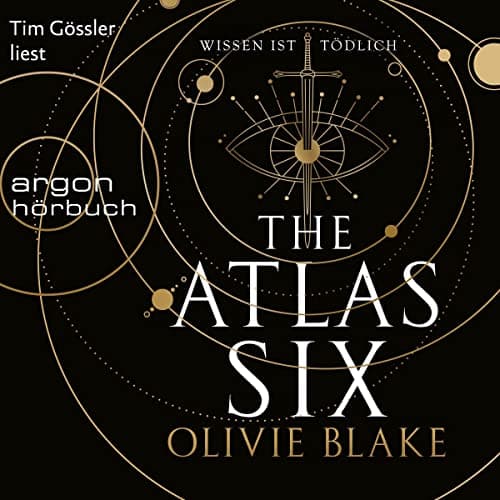

Can we talk about how frustrating it is when a book assembles six of the most insufferably brilliant characters imaginable and then makes you wait sixteen hours to find out which one dies? Because that's exactly what The Atlas Six does, and I spent most of my listening time oscillating between genuine fascination and wanting to shake every single character by the shoulders.
Let me back up. Olivie Blake's dark academia phenomenon — the one that exploded on TikTok before landing a traditional publishing deal — arrives in German as "Wissen ist tödlich" (Knowledge is Deadly), and that subtitle isn't just marketing fluff. The premise is irresistible: the Library of Alexandria never burned. It's been operating in secret for millennia, guarding humanity's darkest knowledge. Every decade, six magicians are selected for initiation. Only five survive. Game on.
The six recruits are a deliberately volatile cocktail. You've got Libby and Nico, rival physicists of magic who can barely stand each other but whose powers amplify when combined. Parisa, a telepath who weaponizes seduction. Callum, an empath who's essentially a walking ethical violation. Tristan, a cynical gangster's son who sees through every illusion. And Reina, a quiet naturalist whose connection to magical forces runs deeper than anyone suspects. Blake throws them together and lets the paranoia, attraction, and intellectual one-upmanship do the heavy lifting.
And here's where the book will either hook you or lose you entirely: this is a novel of ideas disguised as a fantasy thriller. Long stretches are devoted to characters debating the nature of consciousness, the ethics of power, and whether knowledge itself is inherently corrupting. If you came for action sequences and magical battles, you'll be checking your phone. If you came for six morally questionable geniuses trying to outthink each other while pretending they're not terrified, you'll be riveted.
Tim Gössler handles the German narration with steady professionalism. Sixteen hours and forty-five minutes is a significant commitment, and he maintains a consistent, clear delivery throughout. With six POV characters — each with distinct personalities ranging from sardonic to predatory to quietly contemplative — a single narrator faces a real challenge. Gössler keeps things readable and distinct enough to follow, though I wouldn't say any particular voice became iconic. He's competent and reliable, which for a book this dialogue-heavy and philosophically dense is exactly what you need. Nobody wants a narrator chewing scenery when the text is already doing the intellectual gymnastics.
The pacing, though — and this is where I suspect the 2-3 star reviews cluster — is genuinely slow. Blake builds tension through character dynamics rather than plot momentum. For the first half of the audiobook, very little actually happens in terms of external action. Characters circle each other, test boundaries, form alliances, and break them. It's a chess match where every piece thinks it's the queen. Brilliant when you're in the mood for it. Maddening when you're not.
What works exceptionally well in audio format is the atmosphere. Dark academia lives or dies on vibes — old libraries, dangerous knowledge, beautiful terrible people making questionable choices — and hearing the story unfold creates an immersive quality that reading on the page sometimes struggles to match. Crimson Crown gave me a similar feeling — that specific atmosphere where the social maneuvering IS the danger, and you're holding your breath waiting for someone to finally make a fatal mistake. There's something about listening to these characters scheme and seduce and betray that makes the experience feel appropriately conspiratorial, like you're eavesdropping on conversations you shouldn't hear.
The magic system deserves mention because Blake treats it more like theoretical physics than traditional fantasy. Characters don't wave wands or cast spells; they manipulate fundamental forces, bend probability, and weaponize perception. It's cerebral and often abstract, which again will divide listeners. I found it genuinely interesting — the way magic functions as an extension of each character's psychology is smart writing. Think of it less like D&D spell slots and more like each character has a PhD in a different branch of reality-hacking.
My biggest complaint? The book ends on a substantial cliffhanger. Not a gentle "the adventure continues" conclusion but a genuine "wait, WHAT?" moment that demands you immediately pick up book two. For a sixteen-plus hour investment, I wanted more resolution. Blake clearly wrote this as the first movement of a larger composition, and it shows. Individual character arcs advance but nothing truly resolves.
The German translation reads well in audio — no moments where I felt the language was fighting the source material. The prose is sharp and occasionally cutting, which suits the tone perfectly.
Who Should Listen (And Who Should Skip)
If you're the type who gets genuinely excited debating magic systems and moral philosophy — if you've ever spent an hour arguing about alignment charts or whether the ends justify the means — this is your audiobook. Patient listeners who love character-driven scheming will eat it up. Skip it if you need plot momentum to stay engaged, or if you listen while multitasking; you'll be hopelessly lost by hour three. It's ambitious, occasionally pretentious, and absolutely confident in what it's doing — which is both its greatest strength and the thing most likely to drive you crazy.