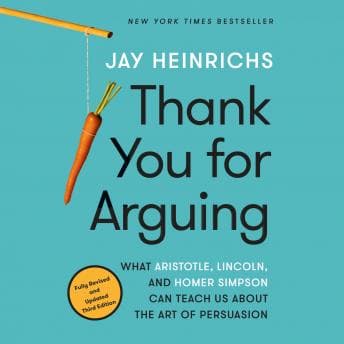

I was debugging a particularly nasty race condition at 11 PM—the kind where you stare at logs until your eyes bleed—when I decided to take a break and let this audiobook run while I made my fourth cup of coffee. By the time I got back to my desk, Jay Heinrichs had explained why my last three Slack arguments with product managers had failed so spectacularly. Turns out I'd been using logos when I needed pathos. Who knew.
Bottom Line: Worth your commute. This is basically a CS algorithms course but for winning arguments—practical, dense with techniques, occasionally too clever for its own good.
Your Argument Stack Is Probably Broken
Here's the thing about rhetoric books: most of them are either ancient philosophy that puts you to sleep or modern business fluff that could've been a LinkedIn post. Heinrichs threads a weird needle by making Aristotle's three appeals (ethos, pathos, logos) feel like debugging tools. He breaks down persuasion into components—concession, timing, framing—the way you'd break down a system architecture. The Eddie Haskell Ploy? That's basically social engineering with a sitcom name. Stalin's Timing Secret? Creepy name, but the concept of strategic delay actually maps to how I think about async communication at work.
The 14+ hours is... a lot. I finished this across maybe 8 commutes plus some weekend cleaning sessions. Some sections absolutely could've been condensed—there's a whole chunk about his family arguments that feels more like therapy than instruction. But when he's on, he's on. The breakdown of Lincoln's rhetorical tricks, the analysis of how politicians use code-switching—this stuff is genuinely useful for anyone who has to convince humans of anything. Outliers does something similar with success patterns—breaking down what looks like magic into learnable components.
The Author-as-Narrator Gamble
Heinrichs narrates his own book, and look, this is a polarizing choice. I've seen reviews calling him condescending, even insufferable. I didn't get that vibe, but I can see how his professorial tone might grate if you're not in the right headspace. He's clearly having fun with the material—maybe too much fun sometimes. The wit lands about 70% of the time. The other 30%? You can practically hear him waiting for applause.
What I will say: there's some dated stuff in here about his wife and women generally that made me wince. Nothing egregious enough to stop listening, but enough that I noticed. It's got that "written by a boomer who thinks he's progressive" energy in spots. Your mileage will vary depending on your tolerance for that kind of thing.
Audio production is clean—no weird artifacts, consistent volume. I ran this at 1.5x without issues, though I bumped to 1.75x during the more anecdotal stretches. Fair warning: some of the rhetorical terms (paralipsis, enthymeme, chiasmus) are easier to absorb at normal speed if you actually want to remember them.
The ROI Calculation
Perfect for: train, gym, housework. Skip for: deep work or anything requiring your full attention.
Here's my honest take. If you're in any role where you need to persuade people—so, like, every knowledge worker ever—there's genuine value here. I've already used the "concession" technique in two design review meetings. (Spoiler: it works.) The framework for identifying what kind of argument you're actually in (blame-focused vs. values-focused vs. action-focused) has saved me from at least three pointless Slack threads.
But if you want pure efficiency, you could probably get 80% of the value from the first 6 hours and skim the rest. The later chapters get into speechwriting and written rhetoric, which is less immediately applicable unless you're, I don't know, running for office or writing manifestos.
Ship It (With Caveats)
Who should grab this: Anyone in tech who's ever lost an argument they should've won. PMs, eng leads, anyone who has to sell ideas internally. Also genuinely useful for understanding how you're being persuaded by others—I now notice rhetorical tricks in all-hands meetings and it's both enlightening and slightly depressing.
Who should skip: If you have zero patience for dad jokes or academic tangents, this will irritate you. If you want a quick tactical playbook, this ain't it. Also maybe skip if you're already well-versed in classical rhetoric—this is 101 level, not advanced.
I'm giving this a solid recommendation with caveats. It's not a must-listen, but it's absolutely worth a credit if you've ever walked out of a meeting thinking "I was RIGHT, why didn't anyone agree with me?" The answer is probably in here somewhere, buried between a Homer Simpson reference and a Latin term you'll immediately forget.