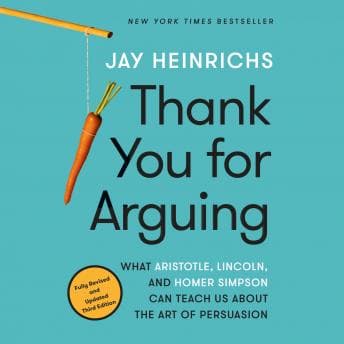
Look, I teach rhetoric to teenagers five days a week. I've assigned excerpts from Aristotle's Rhetoric to juniors who would rather watch paint dry. So when a book promises to explain persuasion through Bart Simpson and Winston Churchill in the same breath, my first instinct is suspicion. My second instinct is jealousy. Because Jay Heinrichs has basically written the book I wish I could hand my students instead of photocopied Aristotle - and the fact that it actually works is both thrilling and a little annoying.
The Guy Who Won't Stop Underlining His Own Sentences
Here's my complaint, and I'm leading with it because it's the thing that nearly made me switch to music during a late-night grading session: Heinrichs narrates his own book, and he reads every sentence like it's the thesis statement. Every. Single. One. You know that teacher - maybe you had one, maybe you are one (I'm trying not to be one) - who puts air quotes around everything and leans forward like they're about to change your life? That's Heinrichs behind the microphone. The emphasis is relentless. By hour three, I started to feel like I was being persuaded to feel persuaded, which is either incredibly meta or just exhausting.
And yet. The man knows his material cold. He'll walk you through Cicero's five canons of rhetoric and then pivot to how his own teenage son used concession - agreeing with a parent's premise to disarm the argument - to get out of trouble for breaking curfew. That anecdote about his kid deploying classical rhetoric at the dinner table? I've stolen it for my classroom three times already. My students actually laughed. At rhetoric. In a public school. In Chicago.
Aristotle Walks Into a Bar (and Meets The Simpsons)
What Heinrichs does well - really well - is treat rhetoric not as some dusty academic subject but as a living, breathing toolkit. He breaks persuasion into logos, ethos, and pathos the way a mechanic breaks down an engine: here's what each part does, here's when it fails, here's how to fix it. The chapter on "decorum" - essentially reading the room and matching your argument to your audience - is something I wish every human being would absorb before posting on social media.
The pop culture references land about 70% of the time. His analysis of political speech patterns is sharp. His breakdown of how advertisers exploit what he calls the "future tense" of deliberative argument - getting you to focus on what will happen rather than what did happen - made me stop and rewind twice. (Denise asked me why I was muttering about Aristotle on our Sunday lakefront walk. I told her I was having a professional crisis. She put her headphones back in.)
But here's where the comparison to actual classics gets interesting. If you've read Quintilian or even a decent textbook on argumentation, chunks of this will feel familiar, just dressed up in a Hawaiian shirt. Heinrichs is packaging ancient knowledge for a general audience, and he's good at it - but let's not pretend he's breaking new ground. He's translating. Which is valuable. Just different from discovery.
14 Hours Is a Lot of Persuasion
At fourteen and a half hours, this is a commitment. The density of information is real - Heinrichs throws terminology at you fast, from kairos (timing) to syncrisis (comparing alternatives) - and if you're listening while doing anything that requires actual brainpower, you'll miss things. This is not a background listen. I tried it during a faculty meeting once and realized I'd absorbed neither the book nor Principal Martinez's facilities update. Honestly, the only audiobooks I've managed to fully absorb during divided-attention situations are the genuinely repetitive ones — I reviewed Learn Spanish for Beginners in 2019 a while back, and its loop-friendly structure is basically the opposite of what Heinrichs is doing here. (Sorry again, Principal Martinez.)
The book would genuinely benefit from being about two hours shorter. Some chapters repeat concepts with slightly different examples, and a few of the extended family anecdotes - charming in small doses - start to feel like padding. Heinrichs is clearly a storyteller who loves his own stories, and the author-as-narrator format means nobody edited him down.
That said? For anyone who's never studied rhetoric formally, this is an excellent entry point. My students' feedback confirmed it - they found his examples approachable in ways my Aristotle handouts never were. And if you're someone who argues for a living (lawyers, marketers, parents of teenagers), the practical applications are genuinely useful.
Who Gets an A, Who Gets Extra Credit Elsewhere
If you're new to rhetoric and want a lively, example-heavy introduction: this is your book. If you're a teacher looking for accessible material to pair with classical texts: grab it. If you already know your Aristotle and Cicero and want advanced analysis: you'll find this surface-level, and that's okay - it's not written for you.
Listen at 1.0x if you're taking notes. (The author chose those words, after all.) But honestly? This might be the rare case where 1.25x actually helps - it smooths out some of the over-emphasis in Heinrichs' delivery and keeps the pace from dragging during the anecdotal stretches.
The Assignment I'd Actually Give
This reminds me of what Hemingway said about writing - that the most essential gift for a good writer is a built-in, shock-proof BS detector. Heinrichs is essentially trying to give you one for arguments. He mostly succeeds. The narration is the weak link - enthusiastic but wearing - and the length tests your patience. But the content? My students would actually enjoy this. And that's the highest compliment I can give a book about Cicero.