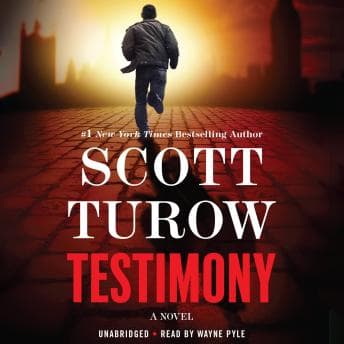

Everyone keeps telling me Scott Turow is the gold standard for legal thrillers. Presumed Innocent, they say. A master of the form, they say. So I went into Testimony expecting the literary equivalent of a well-constructed prosecution — tight, purposeful, every detail pointing toward something. What I got was more like a sprawling deposition that keeps going off on tangents while you sit there thinking, "Okay, but where are we going with this?"
I was making dal makhani — the kind that takes three hours of patient simmering — which felt cosmically appropriate for a thirteen-and-a-half-hour audiobook that also requires patience and a willingness to trust the process.
Bill ten Boom Is Having a Midlife Crisis and We're All Invited
Let's talk about our protagonist. Bill ten Boom is fifty, has walked out on his marriage, his career, his entire life in Kindle County, and has essentially fled to The Hague to investigate war crimes for the International Criminal Court. The protagonist exhibits classic avoidance behavior dressed up as noble purpose. And look — Turow knows this. He's self-aware enough to make Boom's reinvention feel desperate rather than heroic, which is psychologically honest. The man isn't saving the world; he's saving himself from having to sit with the wreckage of his own choices.
What makes this character compelling is that Turow lets him be mediocre at it. Boom isn't a genius investigator. He's a competent lawyer who's in over his head with international politics, Balkan history, and the kind of moral ambiguity that doesn't fit neatly into American courtroom procedure. I found myself asking: why does Boom really pursue this case with such tenacity? Is it justice for 400 buried Roma, or is it the first thing that's made him feel alive since he blew up his marriage?
The case itself — an entire Roma refugee camp allegedly buried alive by a grenade-triggered avalanche during the Bosnian War aftermath — is genuinely haunting. The research actually shows that Roma communities were disproportionately victimized during the Yugoslav Wars, and Turow uses this real historical horror as his foundation. But here's my frustration: the supporting cast never quite earns the complexity the plot demands. Esma Czarni, Ferko's barrister, is positioned as this alluring, morally ambiguous figure, but she reads more like a function of the plot than a person with an interior life. Same with Major General Merriwell — disgraced military leader desperate to clear his name. These are types, not people. Psychologically, this doesn't track with the sophistication of the central mystery. Turow gives us a fascinating case study in institutional complicity and then populates it with characters who feel like they wandered in from a less interesting book.
Compare this to his earlier Kindle County novels, where even minor characters had specific tics and contradictions that made them feel observed from life. Here, the ambition of the international scope seems to have thinned out the character work.
Wayne Pyle and the Accent Problem Nobody Can Ignore
Okay. So. The narration.
This is a book set in The Hague, Bosnia, and Washington DC, featuring characters who are Dutch, Bosnian Roma, Serbian, British, and American. It demands a narrator with serious range. Wayne Pyle does not have serious range. His attempts at foreign accents — and there are many, because the book requires many — are genuinely distracting. The British accents land somewhere between Mary Poppins and a BBC parody, and when Bosnian characters speak, there's this vaguely Eastern European affect that feels like it was assembled from Cold War movie villains rather than any actual familiarity with the region.
This matters more than usual here because the credibility of characters like Ferko Rincic — a Roma survivor whose testimony is literally the spine of the entire book — depends on you taking them seriously. When Ferko's voice sounds like a cartoon approximation of "Eastern European person," it undermines the gravity of what he's describing. Four hundred people buried alive. That deserves better. The narration in Justified Murder handles morally weighty material with exactly the kind of gravity I kept wishing Pyle would find here.
Pyle's baseline American narration is... fine. Functional. He handles Boom's internal monologue competently enough. But in an audiobook where half the characters are international and the setting spans three continents, "fine American narration" with terrible accents is a real problem. My therapist would have thoughts about my decision to stick with it for thirteen hours anyway.
Who Gets the Most Out of This
If you're a Turow completist or a Kindle County devotee, you'll want this — but maybe grab the print edition. The legal procedural elements are genuinely interesting; Turow understands the bureaucratic machinery of international courts, and there's something satisfying about watching Boom navigate competing jurisdictions and political pressures. If you need strong character psychology or a narrator who can handle an international cast, this isn't it. And if you're new to Turow, start with Presumed Innocent. That's the book that earned the reputation.
The Case File, Closed
Testimony has a great premise trapped inside an uneven execution. The central mystery — who buried those people, and why — kept me listening through the dal, through the dishes, through reheating leftovers the next day. But Turow's two-dimensional supporting cast and Pyle's accent work kept pulling me out right when I wanted to lean in. A good book. A mediocre audiobook. There's a difference, and this is exactly the kind of case that proves it.