
What do you do when a child tells you they crossed three countries alone because the gang back home said they'd kill their little brother if they didn't? Do you write it down on a form? Check box 14 of 40? Move on to the next question?
I listened to this one on a Tuesday morning, sitting in my car in the driveway after night shift, engine off, not ready to go inside and make pancakes and be normal. Two and a half hours. I didn't move until it was done.
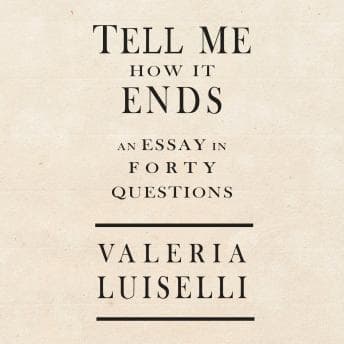
Valeria Luiselli isn't a journalist or a policy wonk. She's a Mexican novelist who volunteered as a Spanish interpreter in immigration court, translating a 40-question intake form for undocumented children — most of them from Guatemala, Honduras, El Salvador — who showed up at the US border alone and are now trying to explain to a legal system why they deserve to stay alive. This book is structured around those 40 questions. That's not a gimmick. It's the whole point. Because the questions are bureaucratic and the answers are unbearable, and the gap between those two things is where this entire crisis lives.
The Form Doesn't Care What Happened to You
Here's what hit me hardest, as someone who fills out paperwork on people in crisis for a living: Luiselli describes children who can't answer Question 1 — their own name — because they've been coached not to give it. Children who don't know what city they were born in. Children who answer the gang-related questions with a blankness that she eventually recognizes isn't confusion. It's survival. They've learned that the wrong answer gets you killed before you get to the border, and they haven't yet learned that the wrong answer in this room gets you deported back to where the killing is.
I've triaged patients who couldn't tell me their own name. The reasons are different but the helplessness of the moment — when someone is in front of you and the system you're operating inside of is not built for what they actually need — that part I recognized bone-deep.
Luiselli doesn't let herself off the hook either. She's applying for her own green card while doing this work, which she notes with the kind of irony that doesn't need explanation. She has papers. These kids don't. She gets to go home. The Family Upstairs deals with a different kind of displacement — people falling through the cracks of systems that were never built to catch them — and I kept thinking about it here, though Luiselli's stakes are so much starker it almost feels wrong to mention in the same breath.
What Laurence Bouvard Does With Quiet Fury
The narration is doing something specific here that I want to name: Bouvard never performs the outrage. She doesn't cry, she doesn't editorialze with her voice, she doesn't signal to you when you're supposed to feel something. She just reads it — and the restraint is what makes it devastating. When Luiselli writes about a child who was asked why she left home and answered "because I was afraid" and the interpreter had to explain that "afraid" isn't a legally recognized basis for asylum — Bouvard reads that sentence like she's reading a medical chart. Flat. Precise. Final.
That's the right call. Because the horror is already in the words. Pushing it would've been condescending. The ALA gave this the 2019 Listen List recognition, and I get it — this is exactly the kind of performance that serves the material instead of competing with it.
At 2 hours 32 minutes, this isn't a long listen. But it is a dense one. I wouldn't do this at 1.25x. You need the pauses.
Who Needs to Hear This (And Who Might Not Be Ready)
If you work in healthcare, social work, education — if you are regularly the person between a vulnerable human and a system that wasn't designed for them — this book will feel uncomfortably familiar. Not because immigration court is like a trauma bay. But because Luiselli is describing what it feels like to be the translator between someone's actual reality and the language the institution accepts. I know that feeling. I've spoken it in triage rooms.
If you want something that'll make you feel better about America, skip it. If you want something that'll make you feel righteous and then let you move on, also skip it. Luiselli doesn't give you resolution. The 40 questions don't have clean answers. Most of the children in this book are still in legal limbo, or were deported, or she doesn't know what happened to them — which is its own kind of answer.
Carlos asked why I was still sitting in the car when he came out to check on me. I told him I was finishing something. He brought me coffee and didn't ask more questions. He's a good man.
Night shift approved. But bring yourself fully to it.