
"One freezing morning in early March, I made a dash for a tiny police station in rural Minnesota."
That line - roughly two-thirds through the audiobook - hit me while I was sitting alone on a Saturday morning, coffee going cold, still in my pajamas. I'd started this book the night before after Kevin fell asleep. I wasn't on my usual Caltrain zombie march. Couldn't be. This one demands you be fully present.
TL;DR: Not your typical commute listen. This is a raw, unflinching memoir that will wreck you - and should. Cassandra Campbell's restrained narration is exactly what this material needs.
The Walls Were Always There Before the Amish Ones
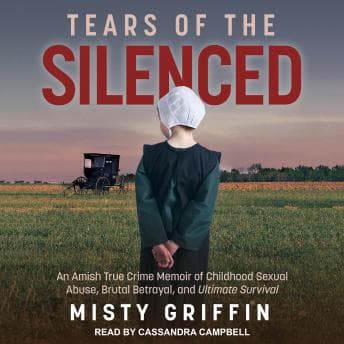
Misty Griffin's story doesn't start with the Amish. That's the part that caught me off guard. The first several hours cover her childhood on an isolated mountain ranch where she and her sister were kept as literal slaves - no school, no contact with the outside world, a loaded rifle propped by the door at all times. Her step-father constructed a prison without bars, and her mother chose complicity. When the family eventually moved them into an Amish community, it wasn't rescue. It was a lateral transfer from one cage to another, just with different rules and a different dress code.
The structural horror here is systemic. Sexual abusers in the Amish community received six weeks of shunning. Six. Weeks. As someone who debugs distributed systems for a living, my brain kept searching for the escalation path, the failsafe, the circuit breaker - but that's the whole point. No escalation path existed. The community was a closed loop. When the bishop himself assaulted Misty, the "resolution" mechanism was the same institution that enabled the abuse. It's like filing a bug report with the person who wrote the bug on purpose.
What makes Misty's account stick is the specificity. She doesn't generalize. She describes the exact mechanisms of control - how isolation was maintained, how the lack of any identity documents (no ID, no social security card) functioned as invisible chains even after the physical ones were gone. She left the Amish with a second-grade education and zero framework for understanding the modern world. That detail alone demolished me.
Campbell Trusts the Material (And She's Right To)
Cassandra Campbell is an AudioFile Golden Voice narrator for a reason, and what she does here isn't flashy. That's exactly the point. She reads Misty's words with steady, clear delivery that never tries to dramatize what's already devastating. No vocal quivering for effect. No theatrical pauses designed to milk your tears. She sounds like someone reading sworn testimony that happens to be about a life - controlled, honest, and devastating precisely because she doesn't reach for devastation.
I normally listen at 1.5x. Dropped to 1.0x within the first hour and never sped back up. Partly because the content demands processing time between passages. Partly because Campbell's pacing is already calibrated so carefully that speeding it up felt disrespectful, like fast-forwarding through someone on the witness stand. She lets silence do work in places where another narrator would've filled the gap with vocal theatrics. Smart choice. Brutal result.
This Is Not a 6:17 AM Caltrain Book
I'm going to be honest: I would not listen to this surrounded by half-conscious engineers on a packed train. This isn't commute-worthy in my usual sense. It requires focused, uninterrupted listening - not because it's structurally complex, but because it's the kind of story you owe your full attention to. There are descriptions of abuse involving children and animals that will make you set your phone down and stare at nothing for a minute. Maybe longer.
But here's what I wasn't expecting: the final stretch. Misty escapes with nothing - literally nothing, not even a concept of how modern life works - and she claws her way toward a nursing degree. It's not a tidy redemption arc wrapped in a bow. It's messy and halting and she's honest about how broken she still was, how the scars didn't magically heal. Dead Set on Living sits in similar territory - a recovery narrative that's honest about how non-linear and unglamorous the actual waking-up process is, and doesn't pretend otherwise. The ROI on this audiobook isn't entertainment or productivity optimization. It's perspective. The kind that makes you feel genuinely embarrassed for complaining about your 2 AM production outage.
Who Needs to Hear This (And Who Shouldn't Right Now)
Listen if: You want to understand how closed communities structurally enable abuse, or you're a survivor looking for someone who gets it without sugarcoating. Also genuinely valuable if you work in social services, education, or child advocacy - there's practical insight into how these systems fail real people.
Skip if: You're in a fragile headspace around CSA or domestic violence (seriously, the content warnings are not decorative), or you need something you can half-listen to while coding. This is not background audio.
Perfect for: A quiet weekend alone, a solo long drive, any time you can give it your full attention without interruption.
The Commit Message
Misty Griffin wrote herself out of a life that was architectured to keep her voiceless. Cassandra Campbell narrated it without ever getting in the way. I finished it in one weekend, which is unusual for me with non-fiction that isn't about distributed systems or startup failure modes. It sat with me for days after. Still is, if I'm being honest.
Not every book needs to be entertaining. Some just need to exist, and you need to hear them.