
Look, I spend my days trying to convince sixteen-year-olds that The Great Gatsby isn't just about rich people partying (it is, but don't tell them I said that). Sometimes, after a long day of circling comma splices and explaining for the thousandth time why Wikipedia isn't a primary source, I just need a story where a guy fights a gorilla.
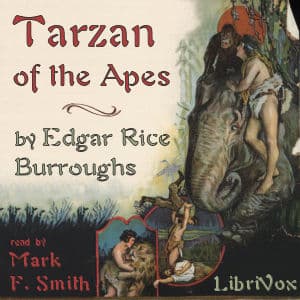
Enter Tarzan of the Apes.
We all think we know this story. The Disney movie, the yell, the vine-swinging. But actually reading—or listening to—Burroughs' original 1912 text is a whole different beast. It's darker, weirder, and surprisingly formal. And honestly? It was exactly the brain-cleanser I needed this week.
The Gentleman in the Jungle
Let's talk about Mark F. Smith. If you've spent any time in the world of public domain audiobooks (LibriVox, my old friend), you know this voice. Smith brings that same steady reliability to Adventures of Sherlock Holmes, another classic that benefits from his no-nonsense approach. He doesn't do the Hollywood blockbuster thing. No Hans Zimmer score swelling in the background or sound effects of monkeys screeching every four seconds.
He just reads.
And it works. Smith has this steady, grandfatherly cadence that feels like he's sitting in a leather armchair reading to you by a fire. (Or in my case, reading to me while I aggressively grade sophomore essays on the bus.)
Some people might find his delivery a bit flat if they're used to full-cast productions with bells and whistles. I get that. After listening to his reading of Sense and Sensibility, I've come to appreciate that restraint—sometimes the text just needs room to breathe. He's not doing a distinct, gravelly Batman voice for Tarzan and a falsetto for Jane. But for a text this dense—and Burroughs loves his dense, Victorian-adjacent descriptions—you need a narrator who gets out of the way. Smith respects the punctuation. He understands that the prose is the star here, even when the prose is describing a man biting a lion.
Pulp Fiction Before It Was Cool
Here's the thing about Burroughs: the man wrote pure, unadulterated pulp. And I mean that as a compliment.
The writing is incredibly elevated for what is effectively a superhero origin story. Tarzan isn't just "me Tarzan, you Jane." In the book, he teaches himself to read English without ever hearing it spoken. (Is that impossible? Yes. Do I care? No.)
Smith's narration really shines when Burroughs goes into his long, philosophical tangents about "civilization" versus the "savage." He handles the archaic language with a rhythm that makes it easy to digest.
Now—and this is the teacher in me putting on his glasses—we have to talk about the elephant in the room. Or the ape in the room. This book is over 100 years old. The cultural attitudes are... distinct products of their time. There are moments regarding race and gender that will make you cringe. It's not malicious so much as it is deeply, deeply dated.
If you can put on your "historical context" goggles, though, the adventure holds up. The pacing is relentless. Tarzan gets dropped into the jungle, parents die (classic Disney trauma), apes adopt him, and then it's just a gauntlet of survival. It's visceral.
Who's This For (And Who Should Skip It)
If you want to see where the action hero blueprint started—and you have patience for 1912 prose—this one's for you. Skip it if dated cultural attitudes are a dealbreaker, even with historical context goggles firmly in place.
Notes from the Grading Pile
I listened to this while walking the dog and during a particularly useless faculty meeting about "synergy." (Principal Martinez, if you're reading this, I was totally taking notes.)
Mark F. Smith isn't going to win an Audie award for theatrical drama, but he delivers a clean, classic performance that fits the material perfectly. It feels like opening a dusty first edition in a used bookstore.
It's melodramatic. It's improbable. It's absolutely ridiculous in places. But it's also the blueprint for basically every action hero we have today. Just maybe don't try the vine-swinging at home.