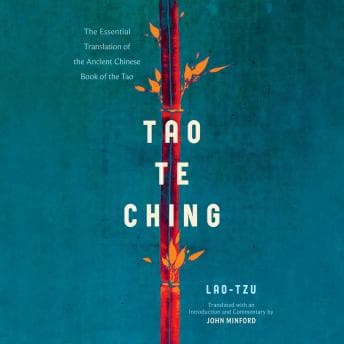

So here's the thing everyone gets wrong about the Tao Te Ching: they treat it like a fortune cookie factory. Bite-sized wisdom, Instagram-ready quotes, slap it on a yoga studio wall and call it enlightenment. I went into John Minford's translation expecting more of the same — and I was wrong. Pretty spectacularly wrong, actually.
I started listening during one of those 2 AM insomnia spirals where your brain decides it's the perfect time to replay every awkward thing you've said since 2016. My therapist would have thoughts about using ancient Chinese philosophy as a sleep aid, but honestly? It worked. Not because it knocked me out — because it made my brain shut up for five consecutive seconds, which is basically a miracle.
This Isn't the Tao Te Ching You Speed-Read in College
What makes this edition genuinely different is the architecture. Minford doesn't just hand you Lao Tzu's eighty-one chapters and wish you luck. Each chapter gets layered with commentary — ancient Chinese scholars, then modern voices like Ursula K. Le Guin and Margaret Mead weighing in. It's like sitting in on a seminar that spans two thousand years. The research actually shows that meaning-making is fundamentally a social process; we understand texts better when we see how others have wrestled with them. Minford seems to intuitively get this. You read the original verse, sit with it, then hear how a 3rd-century Taoist mystic interpreted it versus how a 20th-century anthropologist did. The gaps between their readings are where the real psychology lives.
At 7 hours and 21 minutes, this is a LOT of Tao. Most editions clock in at maybe 2-3 hours. That extra time is all commentary, and whether that's a feature or a bug depends entirely on what you came for. If you wanted pure text, you'll be frustrated. If you're the kind of person who reads footnotes (guilty, always guilty), this is your format.
Edoardo Ballerini's Voice as a Stillness Delivery System
Here's where I have to be honest about a tension I felt the entire time. Ballerini's narration is calm. Very calm. Deliberately, almost aggressively calm — the kind of steady, unhurried pacing that makes your shoulders drop two inches without you noticing. For the Tao Te Ching verses themselves, this is perfect. The man turns "The Tao that can be told is not the eternal Tao" into something you feel in your chest rather than just parse intellectually.
But — and this is the part that bugged me — he uses that same register for everything. The original verses, the ancient commentary, Le Guin's distinctly modern voice, Dyer's self-help energy. They all come out in the same measured tone. I found myself asking: why does the commentary sound identical to the primary text? These are radically different voices across millennia. A little tonal shift — even subtle — would've helped my brain categorize what I was hearing. It's not a dealbreaker, but by hour five, I was occasionally losing track of whose interpretation I was absorbing versus Lao Tzu's actual words. That matters psychologically. Attribution affects how we process and trust information. The psychology of how we assign meaning based on source is something I kept turning over while reading Unthinkable too — that book is essentially a case study in how the same events land completely differently depending on who's narrating them and what frame they're handed to you in.
One listener complaint I saw called for different readers for different sections, and yeah, I get it. A full-cast approach would've been overkill for a contemplative text, but some vocal differentiation between the layers? That would've elevated this from good to exceptional.
The Psychology of Non-Doing (And Why Your Brain Resists It)
What makes the Tao Te Ching fascinating as a case study in human psychology is how directly it contradicts every impulse Western self-help has trained into us. We're told to set goals, optimize, hustle. Lao Tzu says: stop. Just — stop. The concept of wu wei (non-action, or effortless action) is basically the anti-productivity hack. And Minford's commentary actually helps bridge that gap for a modern listener, contextualizing why "doing nothing" doesn't mean passivity but rather alignment with natural patterns.
I kept thinking about this during my morning jog the next day — how the chapters on water (yielding, finding the lowest point, being soft) map onto what we know about psychological resilience. Rigid systems break. Flexible ones adapt. The research on cognitive flexibility backs this up, but Lao Tzu said it in about six words two and a half millennia ago. Show-off.
This is the kind of audiobook that genuinely rewards repeated listening. Not in a "you missed plot details" way, but in a "your brain is different today than it was yesterday" way. I've already gone back to certain chapters and heard completely different things.
Who Needs This (And Who Should Walk Away)
If you want a quick, clean reading of the Tao Te Ching — just the 81 verses, no extras — this isn't your edition. You'll be annoyed by the commentary density. If you're a scholar, a psych nerd, someone who likes to sit with ideas and turn them over slowly — this is genuinely excellent. Best consumed in small doses. Don't marathon it. (I marathoned it. Learn from my mistakes.)
My Prescription, Not My Diagnosis
I'm giving this a strong recommendation with one caveat: treat it like meditation, not entertainment. Put it on before bed, during a quiet walk, in those moments when your brain needs permission to slow down. Ballerini's narration, for all its sameness, creates a container of stillness that most audiobooks can't touch. The text itself? Timeless in the most literal, non-cliché sense. My therapist would approve.