
Jenny and I had one of those fights last week. You know the kind—starts about whose turn it is to call the plumber and somehow ends with you relitigating a decision from 2019. I was loading the dishwasher at 11 PM, still simmering, when I decided to finally start this audiobook that had been sitting in my queue for months.
Bottom line: This is 5 hours of couples therapy distilled into flash cards. And I mean that as a compliment.
The McKinsey Consultant in Me Loves This Framework
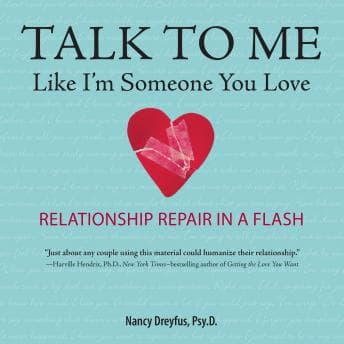
Dr. Nancy Dreyfus essentially created a communication protocol for when your emotional CPU is overloaded. The core concept is elegant—pre-written statements on cards that you hold up when you can't find the words. "Talk to me like I'm someone you love." "I'm not the enemy." "Can we start over?" Simple phrases that short-circuit the attack-defend loop most couples get trapped in.
What makes this actually useful is the "field notes" accompanying each statement. Dreyfus explains the psychology behind why "I need you to hold me without trying to fix me" works better than whatever you were about to say in the heat of the moment. She draws from real client sessions—couples who've been where you've been, saying the dumb things you've said.
The revised edition adds sections on intimacy and trust-building. Over twenty-five new statements. The intimacy chapter is... look, I listened to this on my commute and had to pause a few times. Not because it's explicit—it's not—but because Dreyfus gets uncomfortably specific about the unspoken negotiations that happen in long-term relationships.
The Format Trade-Off Nobody Mentions
Here's my issue: This book was designed as a physical object. Flash cards you can literally hold up to your partner. Listening to Gabra Zackman read "Hold up this card when you feel criticized" is a bit like listening to someone describe a painting. You get the concept, but you're missing the point.
Zackman's narration is fine—warm, professional, doesn't get in the way. But I found myself wishing for the physical book so I could actually use these tools in the moment. The audio format works for understanding the methodology. It doesn't work for implementation.
At 5 hours, this is mercifully efficient for a self-help book. Dreyfus doesn't pad with unnecessary origin stories or repetitive examples. She presents a tool, explains it, gives context, moves on. My 2.0x speed worked perfectly here.
What My Parents Would Think
My folks never had flash cards. They had 14-hour days at the dry cleaners and the unspoken Korean immigrant contract of "we sacrifice, you succeed." Their marriage survived on shared purpose, not communication workshops.
But I watched them struggle to talk about anything that wasn't logistics. Still do. This book made me think about what they might've said to each other if they'd had the vocabulary—or the permission—to be vulnerable.
Dreyfus isn't naive. She acknowledges that some relationships are beyond repair, that these tools work best when both partners are willing to try. She's also clear that this isn't a substitute for therapy when you need it. It's a supplement. What a Time to be Alone takes a similar approach to emotional self-care—practical tools you can actually use, not just theory. A first-aid kit for minor wounds before they become infected.
The ROI Calculation
The key takeaway is worth the listen. The other 4 hours? Actually also worth it—unusual for this genre.
I texted Jenny a summary of the core concept before I'd even finished. She responded with "So you're saying I should talk to you like I love you?" with three eye-roll emojis. Then: "Actually that's not the worst idea."
We haven't had a fight since. It's been six days. That's not nothing.
Who should listen: Couples stuck in the same argument loops who want a practical framework, not therapy-speak. Skip if you're looking for deep psychological exploration or if your relationship needs professional intervention, not flash cards.
Jenny would say I'm being harsh about the audiobook format limitations. Jenny is right—it's still valuable as a listening experience. But if you're serious about using these tools, buy the physical book after you finish the audio. Consider the audiobook your training manual and the cards your actual equipment.