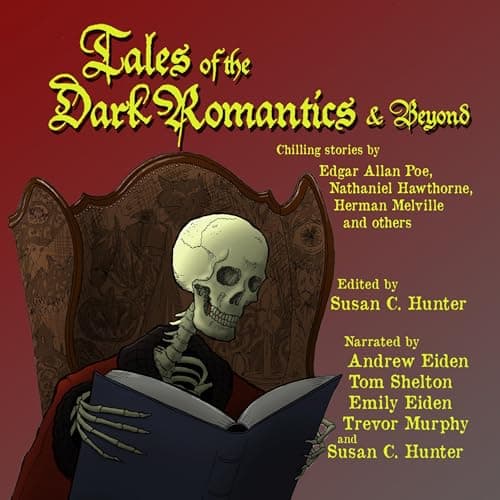
I was up past midnight, sitting in my home office with the rain doing its Seattle thing against the windows, captioning a batch of audio samples for a publisher client. The kind of tedious work where you need something playing in the background to stay sane. So I pulled up Tales of the Dark Romantics and Beyond figuring a six-hour anthology of Poe, Hawthorne, and company would keep me company through the grind. What I got was... uneven. Sometimes genuinely atmospheric. Sometimes just adequate.
Five Narrators, Thirteen Authors, and the Math Doesn't Always Work
Here's what's interesting about this collection structurally: you've got Andrew Eiden, Tom Shelton, Emily Eiden, Trevor Murphy, and Susan C. Hunter splitting duties across works by everyone from Poe to Louisa May Alcott to Alfred Lord Tennyson. That's a wild range. Dark Romanticism as a genre has a specific brooding, sin-obsessed, supernatural-leaning energy — and some of these authors only dabbled in it. The anthology acknowledges this upfront, calling out poets and folklorists "momentarily dabbling" in death and loss themes. I appreciate the honesty, but it also means the collection lurches between genuine dread and, well, Victorian poetry that doesn't quite fit the horror-adjacent vibe the title promises.
The narrator assignments matter here more than in most anthologies. Andrew Eiden — who's stacked with Audiofile Earphones awards — carries the weight you'd expect. His readings of the Poe material have the kind of deliberate pacing I need as a hard-of-hearing listener. Clarity over speed - always. When he slows into Poe's rhythmic, almost hypnotic sentence structures, I could follow every word even at lower volume while I worked. That's accessibility done right, even if it's probably not intentional.
But five narrators across 6 hours and 24 minutes means some readers get barely any runway. The transitions between narrator styles feel abrupt — you adjust to one voice's cadence and then you're dropped into someone else's approach. No musical interludes, no production bridges, nothing to smooth the handoff. For someone who syncs text and captions religiously, this kind of jarring shift pulls me right out of the atmosphere.
Where the Dark Actually Lands
The strongest sections are exactly what you'd predict: the Poe, Hawthorne, and Melville core. These are the canonical Dark Romantics and the narrators seem most locked in during these pieces. The pessimism, the supernatural weight, the obsession with human sin — the performance is layered enough to feel, even when my hearing aids are doing heavy lifting in a noisy room.
The surprises come from the edges. Washington Irving and Ambrose Bierce bring a different flavor — more folk horror, more sardonic. And then you hit Louisa May Alcott or Tennyson and the collection's thesis gets wobbly. Are we doing Dark Romanticism or are we doing "classic authors who once wrote something kind of spooky"? The "and Beyond" in the title is doing a lot of heavy lifting.
As a hard-of-hearing listener, this hit different than a single-narrator horror collection would. Multi-narrator anthologies are tricky for me because each new voice means recalibrating — figuring out someone's diction patterns, their consonant clarity, how they handle sibilants. Some of these narrators enunciate beautifully. Others lean into a dramatic murmur that sounds great on paper but turns muddy through hearing aids at low volume. Missed opportunity for tone shift here — a consistent production standard across all five voices would've elevated this significantly.
The 3.5-Star Question
This collection sits in an awkward middle space. The source material is (mostly) excellent — these are canonical works that have survived for a reason. The narration ranges from strong to passable. The curation is ambitious but unfocused. At 6 hours 24 minutes, it's not asking for a huge time commitment, which honestly works in its favor. You can treat it like a sampler platter of dark 19th-century literature and just accept that some bites are better than others.
But I keep coming back to what this could have been with tighter editorial vision. Pick a lane — either commit to the core Dark Romantics and go deep, or own the "Beyond" angle and contextualize why Alcott and Tennyson belong here. Belladonna is what a focused dark anthology feels like when the editorial vision actually commits — every piece pulling in the same shadowed direction. The collection tries to split the difference and ends up feeling like a playlist someone assembled with good taste but no thesis statement.
For what it's worth, I finished it. The rain stopped, the captioning got done, and I had Poe's rhythms stuck in my head for the rest of the week. That counts for something.
Worth Your Evening but Not Your Credit
This is a solid library borrow. If you're already into Dark Romanticism, you own better versions of the Poe and Hawthorne individually. If you're new to the genre, this is a decent (if inconsistent) introduction — just know that the "Beyond" selections dilute the darkness more than they expand it. The emotional layers come through even without sound in the best sections, but those best sections make up maybe 60% of the runtime. The other 40% is fine. Just fine.