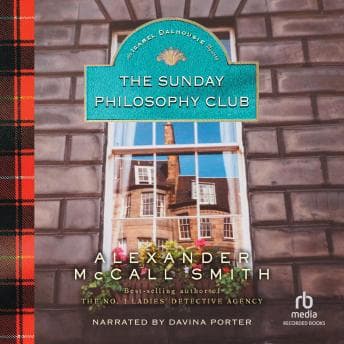

Look, I need to come clean about something. Linda loaded this into my Audible queue six months ago with a note that said "Try something without explosions for once." I ignored it. Then last Sunday morning I ran out of my usual backlog, it was raining in Austin, Ranger was asleep on my feet, and I figured - fine. Eight hours. How bad can philosophy and murder in Edinburgh be?
The answer is complicated.
When Your Murder Mystery Stops to Ponder Kant
Let me cut to the chase - if you're coming to this expecting a body drop and then a sprint to catch the killer, recalibrate immediately. A young man falls from a balcony at the Usher Hall in Edinburgh, and Isabel Dalhousie - philosopher, editor of the Review of Applied Ethics, and apparently the nosiest woman in Scotland - decides she needs to investigate. Fine. I'm in.
But then we spend... a lot of time inside Isabel's head. And Isabel's head is a busy place. She's weighing the moral implications of whether she even has the right to investigate. She's considering duty, she's thinking about her ex-boyfriend's new partner, she's debating ethical obligations to strangers. There were stretches where I genuinely forgot someone had died. I've sat through intelligence briefings with more urgency. That question of moral obligation around a death - whether you have the right to investigate, whether looking away makes you complicit - hits entirely differently in How I Helped O. J. Get Away With Murder, where the ethical reckoning isn't abstract and Edinburgh isn't involved.
And here's the thing that surprised me - I didn't entirely hate it. McCall Smith writes Isabel as someone whose brain never shuts off, and if you've ever been the kind of person who lies awake at 0200 running through every decision you made that day (and buddy, I have), there's something weirdly honest about it. She's not an action hero. She's a wealthy Edinburgh intellectual who gets tangled up in something because her conscience won't let her walk away. That's actually kind of refreshing. I just wish the "mystery" part had a bit more backbone.
The Edinburgh business community angle - the shady financial dealings, the corporate maneuvering - that should've been my wheelhouse. I consult with corporations on threats every day. But McCall Smith keeps it frustratingly vague, more interested in the moral questions around the investigation than the investigation itself.
Davina Porter Earns Every Penny of Her Paycheck
Here's where I have to give credit. Porter's narration is the reason I stuck with this for eight hours. Her Scottish accents aren't the Hollywood version where everyone sounds like they're auditioning for Braveheart. She gives Isabel this measured, warm, slightly amused tone that fits a woman who edits a philosophy journal and drinks good coffee in Bruntsfield. When she shifts to other Edinburgh characters, the class distinctions come through - sharper consonants for the business types, softer edges for the more casual interactions. It's subtle work. Not flashy, but precise.
Porter controls pacing like a good NCO controls a room - she knows when to slow down for Isabel's internal monologues and when to push through dialogue. At 1.25x (my standard), her Scottish lilt stays clean and intelligible, which isn't always the case with accent-heavy narration. That alone is worth noting.
This Is a Cup of Tea, Not a Shot of Whiskey
I kept waiting for the book to kick into a higher gear. It doesn't. And I think that's by design, which is both its strength and - for someone wired like me - its limitation. The mystery resolves, but it doesn't punch. There's no twist that made me mutter "you've gotta be kidding me" or lean forward in my chair.
If you loved the No. 1 Ladies' Detective Agency books, you know exactly what you're getting. McCall Smith writes like a man who enjoys a slow walk through a good neighborhood. Nothing wrong with that. It's just not where I live.
Who should grab this: Folks who want a smart, quiet mystery with genuine philosophical texture and an excellent narrator. People who find cozy mysteries too fluffy but hard-boiled too grim. If you read for character over plot, Porter and Isabel make a great pair.
Who should steer clear: If you need body counts, tactical sequences, or any scene involving someone running - this isn't your mission. My thriller readers, go elsewhere.
Cooper's After-Action Report
Linda asked if I liked it. I told her I respected it. She said that's the most military thing I've ever said about a book. She's probably right. Ranger slept through the whole thing, which is either an endorsement of its calm energy or a review in itself.