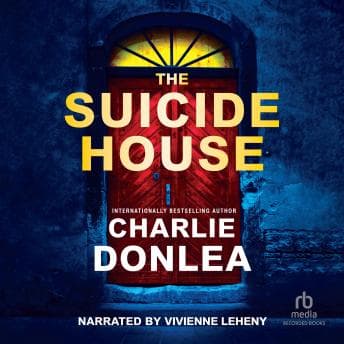

Charlie Donlea knows how to build a trap and bait you into walking straight through the door.
I was up way too late on a Tuesday with this one — Linda already asleep, Ranger sprawled across my feet under the desk, me supposedly reviewing a client's physical security assessment. Instead I had my earbuds in, staring at a spreadsheet I hadn't scrolled in forty minutes, because Donlea had me by the throat with this abandoned boarding house and its body count that wouldn't stop climbing.
The Game Behind the Game
Let me cut to the chase: Suicide House sets up a premise that's genuinely unsettling. An elite Indiana prep school. Two students murdered in an old boarding house in the woods. A teacher convicted. Case closed — except students who survived that night keep going back to that same house and killing themselves. That's a hell of a hook, and Donlea earns it.
What works is the layering. You've got the forensic reconstructionist Rory Moore — who's somewhere on the spectrum and processes crime scenes the way I've seen certain intel analysts process threat matrices, with this cold mechanical precision that masks something deeper — and her psychologist partner Lane Phillips working a podcast angle on the case. The podcast-within-the-book device could've been gimmicky but Donlea uses it as a legitimate investigative framework. Rory's method of physically reconstructing crime scenes, walking through them step by step, reminded me of how we'd do after-action reviews in theater. You walk the ground. You look at angles. You figure out what the official story missed. That same obsessive, piece-by-piece logic is what hooked me years ago in Girl with the Dragon Tattoo — Salander and Blomkvist digging through decades of buried evidence with that same refusal to accept the official verdict.
The Westmont Prep world is claustrophobic in the right way — rich kids with too much pressure and too many secrets, a candlelight game in that abandoned house that feels like something out of a horror movie but is grounded enough in teenage recklessness to be believable. The "Man in the Mirror" element — don't let your candle go out or something finds you — walks right up to the line of supernatural without crossing it, and I appreciated that restraint.
Where the Ammunition Runs Low
This is where it lost me in spots. Around the middle third, the pacing slows down when Donlea pulls back from the boarding house mystery to develop the relationship dynamics between Rory and Lane. I get it — it's a series, this is book two, you need character continuity. But when you've built this much tension around students dying and a possible ongoing conspiracy at the school, every chapter away from that central thread feels like a detour.
The resolution also moves fast — almost too fast for the amount of setup. I've seen this in briefings where someone spends forty-five minutes building context and then rushes through the actual recommendations in five. The twist lands, but I wanted more time sitting with the implications before Donlea wraps it up.
And look, I don't need every thriller to be Vince Flynn-level action, but there are stretches here where characters are essentially talking about what happened rather than the reader experiencing it directly. For a book about reconstructing events, there's a lot of telling and not quite enough showing in certain sections.
Leheny Gets the Job Done
Vivienne Leheny narrates this one solo and she handles it well. Her voice for Lane Phillips stood out to me — warm but authoritative, the kind of voice you'd actually trust in a therapist's office. Rory's more clipped, analytical delivery worked for the character's personality. Male voices were distinct enough that I never lost track of who was speaking, which is all I really ask from a single narrator handling a mixed cast.
Pacing was clean and consistent. I ran it at 1.25x as usual and never felt like I was missing anything or that she was dragging. No production issues, no weird audio artifacts. Solid, professional work.
Who Should Strap In
If you like psychological thrillers with a procedural edge — think crime reconstruction more than car chases — this is your lane. Fans of the first Rory Moore book will get what they came for. If you need constant action or if podcast-framing devices annoy you, maybe look elsewhere.
Worth your time? Here's the debrief: Suicide House is a smart, creepy thriller that builds an excellent premise and mostly delivers on it. The prep school setting carries genuine menace, and the central mystery of why survivors keep returning to die is the kind of question that keeps you listening past your bedtime. It's not perfect — the middle sags and the ending feels rushed — but Donlea clearly did his homework on forensic reconstruction and the psychology of group trauma.
Ranger slept through the whole thing, but that's not a knock. He sleeps through everything except the word "walk" and the sound of cheese being unwrapped. I, however, did not sleep. And that's usually a good sign.