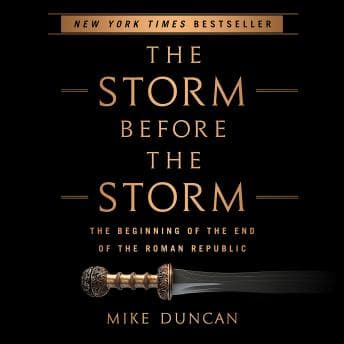

"Men who break the rules in a crisis rarely put them back together when the crisis passes."
That line hit me somewhere around hour six, stuck in Austin traffic on I-35, and I had to pull over. Not because of the traffic—I've sat in worse convoys in Anbar Province. But because Mike Duncan just described every institutional failure I've ever witnessed, from the Pentagon to Congress, in one sentence about guys who died two thousand years ago.
Let me cut to the chase: this is essential listening for anyone who wants to understand how democracies eat themselves from the inside.
When Your Enemies Become Your Countrymen
Duncan covers 146-78 BC, the period most Roman histories skip right over. Everyone knows Julius Caesar. Everyone knows Augustus. But the Gracchi brothers? Gaius Marius? Sulla? These are the men who lit the fuse, and Duncan makes you understand exactly how the explosion became inevitable.
The political machinations here are brutal. Tiberius Gracchus tries to redistribute land to veterans and the poor—gets beaten to death with chair legs by senators. His brother Gaius picks up the cause a decade later—forced into suicide. The pattern repeats: reformer rises, establishment crushes, norms erode, violence escalates. By the time Sulla marches his legions on Rome itself—something literally no one had ever done—you realize the Republic didn't fall. It rotted.
What got me was how familiar it all felt. Rising economic inequality. Citizenship fights. Veterans coming home to find their farms foreclosed. Politicians gaming the system until the system stops mattering. I've seen this scenario play out in real life—maybe not with gladii and proscription lists, but the dynamics are the same. Power concentrated. Middle class squeezed. Institutions weaponized.
The Podcaster Becomes the Author
Duncan narrates his own work, and if you've listened to The History of Rome podcast, you know exactly what you're getting. Clear, measured, with a dry wit that sneaks up on you. His explanation of the Italian Social War—basically Rome's allies demanding citizenship and Rome saying "no" until half of Italy revolted—is delivered with the kind of matter-of-fact clarity that makes complex political situations actually comprehensible.
Here's where I'll be honest: you can occasionally hear Duncan's opinions bleeding through. When he's discussing the optimates (the conservative faction) versus the populares (the reformers), there's sometimes a tone that suggests where his sympathies lie. Didn't bother me—the man's allowed to have views—but if you want completely neutral history, be aware.
The pacing works for focused listening. This isn't background noise material. Duncan expects you to track multiple factions, shifting alliances, and constitutional precedents that get violated then become the new normal. I listened at 1.25x and kept up fine, but I wouldn't recommend doing dishes while this plays. You'll miss something important.
The Marius Problem (And Why It Matters Now)
Gaius Marius might be the most fascinating figure here. War hero. Seven-time consul. The man who reformed the Roman army into a professional force. Also the guy who opened military service to the landless poor—which meant soldiers became loyal to their generals, not Rome. Duncan traces how this single reform, born of necessity during the Cimbrian Wars, planted the seed for every civil war that followed.
I spent 25 years in an institution built on the principle that we serve the Constitution, not any individual commander. Listening to Duncan explain how Rome's military gradually shifted its loyalty from the state to whoever paid them... it's a warning. Duncan clearly did his homework on the military reforms, and he doesn't oversimplify the strategic necessity that drove Marius's decisions. Good intentions. Catastrophic long-term consequences.
Sulla's march on Rome, when it finally comes, feels inevitable rather than shocking. That's Duncan's real achievement—he makes you understand the logic of the unthinkable.
Who Gets Value From This Intel
History lovers, obviously. Podcast fans who want Duncan's style in a more structured format. Anyone interested in how republics fail—and I mean actually interested, not just looking for partisan ammunition. The parallels to modern politics are there if you want them, but Duncan mostly lets you draw your own conclusions. Story of My Life takes a different approach to historical reflection—more personal memoir than political analysis, but equally concerned with how institutions shape individual lives.
Skip this if you want epic battle descriptions. The military campaigns are here, but they're not the focus. Duncan cares more about the Senate floor than the battlefield. Also skip if you can't handle complexity—there are a lot of names, a lot of factions, and Duncan assumes you're paying attention.
After Action Report
Ten hours well spent. Duncan takes a period of history that most people ignore and makes you understand why it matters more than the famous stuff that came after. The narration is solid if not spectacular, the research is thorough, and the writing has genuine wit without sacrificing substance.
Ranger slept through most of it, but that German Shepherd has no appreciation for constitutional crises. His loss.
Bottom line: if you want to understand how a republic can survive external enemies but destroy itself through internal dysfunction, this is the book. The Romans had 70 years between the Gracchi and Caesar. We might want to pay attention to how they wasted them.






![Steve Jobs [unabridged audiobook] audiobook cover](/_next/image?url=https%3A%2F%2Fcovers.audiobooks.com%2Fimages%2Fcovers%2Ffull%2F9788499923406.jpg&w=1920&q=75)