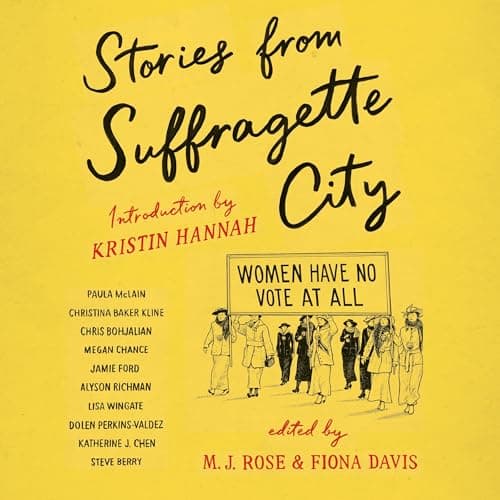

How many short story collections actually justify their own existence? Not as "oh, these are nice little sketches" but as something that genuinely changes how you think about a single moment in history? I found myself wrestling with that question at two in the morning, sitting on the back porch with Ranger sprawled across my feet and a bourbon I probably didn't need, listening to thirteen different authors try to make October 23, 1915 feel alive.
Let me cut to the chase: they mostly pull it off.
Thirteen Authors, One Day, and the Problem of Cohesion
The concept is bold - every story takes place on the same day, the massive suffragist march up Fifth Avenue where tens of thousands of women demanded the vote in New York City. That's your operational framework, and it's a tight one. What surprised me is how different the entry points are. You've got a young woman who just came to sell apples and gets swept into the march. You've got Ava Vanderbilt having her white-gloved worldview cracked open in real time. And then there's Ida B. Wells fighting to make sure the suffrage movement doesn't conveniently forget Black women - which, historically, it absolutely did.
The Wells story hit me hardest. Not because it's the most polished (some of the other entries have tighter prose), but because it refuses to let the movement off the hook. The suffrage fight wasn't some unified sisterhood moment. It was messy, racist in places, and full of the same political infighting I've seen in every organization that claims to be about a single cause. The author who tackled that thread - Dolen Perkins-Valdez - didn't flinch from it.
Compare that to the Vanderbilt piece, which felt more like a conversion narrative we've seen a hundred times. Privileged person encounters real struggle, has their eyes opened. It works fine, but it's the equivalent of a training scenario you've already run through. I ran into that same conversion-narrative fatigue reading Secretly Yours — competent, occasionally charming, but never quite surprising you the way the better entries in a collection can.
Tavia Gilbert Carrying Thirteen Voices on One Set of Shoulders
Here's where it gets interesting. Single narrator for a multi-author anthology means Tavia Gilbert has to shift not just between characters but between entirely different writing styles. Steve Berry writes differently than Christina Baker Kline, who writes differently than Jamie Ford. Gilbert has to be the connective tissue, and that's a heavy lift.
She handles it competently. I wouldn't say there were moments where I forgot I was listening to one person - the tonal range between a rough-handed apple seller and a Fifth Avenue socialite could've been wider. But she maintains clarity, and in a collection like this, clarity is the mission. You never lose track of whose story you're in, which matters when you're bouncing between thirteen perspectives over nine hours.
What I will say is that the quieter, more intimate stories benefited more from her style than the ones that needed bigger emotional swings. The stories that dealt with crowd energy and street-level chaos sometimes felt a little contained.
The Anthology Tax - Some Stories Earn Their Slot, Some Don't
Let's be honest about anthologies: they're uneven by nature. That's the deal you accept. Out of thirteen stories, I'd say maybe eight or nine genuinely earned their place. A couple felt like competent exercises - technically sound, historically grounded, but lacking that gut-punch quality that separates a story from a writing assignment. And one or two felt rushed, like the authors were constrained by the single-day framework rather than freed by it.
The strongest entries used the march as background pressure rather than centerpiece. The apple seller story works because the march is almost accidental to her day - she didn't come for politics, she came to survive, and politics found her anyway. That feels true. I've seen that scenario play out in real life - civilians who didn't sign up for the conflict suddenly standing in the middle of it, making choices they never expected to face.
Lisa Wingate and Chris Bohjalian both turned in solid work. Bohjalian in particular seems to understand that the most interesting moments in any movement happen at the margins, not the center.
Who This Briefing Is Actually For (And Who Should Stand Down)
If you're expecting a standard historical fiction novel with a single throughline, recalibrate. This is thirteen separate operations sharing a common objective. The payoff is in the accumulated weight - by the end, you feel like you've walked that avenue from different positions in the crowd.
Listen if you want history told through ground-level perspectives rather than textbook summaries, and if you can handle the inherent unevenness of a multi-author format. Skip it if you need a single protagonist to follow, or if choppy transitions between stories pull you out of the zone. Also - and I say this as someone who reads plenty of history - if you already know the suffrage movement's complicated racial politics well, some of this ground will feel familiar.
Worth your time? Here's the debrief: it's a well-executed anthology that occasionally rises above the form's limitations. The best stories here would stand alone in any collection. The weakest ones you'll forget by next week. The single-day framework is clever enough to justify itself without becoming a gimmick. Ranger slept through most of it, but he perked up during the Wells story. Smart dog.
Not the kind of book that changes your life, but the kind that makes a Tuesday night on the porch feel like it mattered.