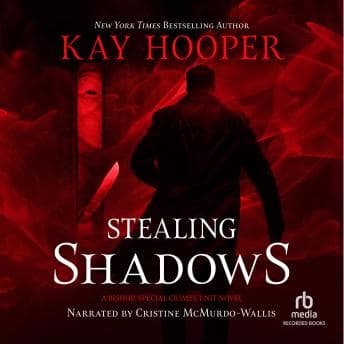

So here's the thing — I went into Stealing Shadows expecting paranormal-lite romance with a thriller veneer. The kind of book where the psychic protagonist conveniently sees just enough to move the plot forward but never enough to actually be disturbing. I was wrong about half of that.
I was shelving returns at the library on a rainy Tuesday evening, earbuds in, and Kay Hooper's serial killer decided to show up in Cassie Neill's head right as I was alone in the stacks. The lights in our back section flicker sometimes. They flickered. I'm not proud of the sound I made.
When the Killer's POV Actually Works
The conceit here is simple: Cassie can see through the eyes of serial killers while they're planning their crimes. Not during, not after — during the planning phase. And the way McMurdo-Wallis narrates those moments? She drops her voice into this hauntingly calm register, almost clinical, like she's reading a grocery list except the items are terrible. It's effective precisely because she doesn't oversell it. No breathless whispers, no dramatic pauses dripping with manufactured tension. Just this steady, flat delivery that makes you realize you're hearing someone contemplate murder like it's Tuesday's to-do list.
This understands that horror isn't about gore — it's about dread. The predator mind scenes gave me genuine chills, and that's coming from someone who listens to true crime podcasts to fall asleep. Dark Horses hit me with that same specific flavor of dread — the kind that doesn't announce itself, just sits down next to you in the dark and waits. Hooper leans into the psychic invasion concept harder than I expected for a book from the early 2000s paranormal romance boom. Cassie isn't just getting "visions" — she's losing herself in them, and the narration conveys that erosion of self without tipping into melodrama. When a body surfaces exactly where Cassie predicted and she becomes a suspect? The town's suspicion felt earned, not contrived.
Now. The romance subplot. It's there. It's fine. It does what it needs to do — gives Cassie a reason to stay in this small North Carolina town and provides the requisite tension between "I'm attracted to you" and "you might be complicit in serial murder." But I'd be lying if I said I didn't zone out during a few of those scenes. The thriller scaffolding is stronger than the romantic architecture, and the book knows it, even if it won't fully commit.
McMurdo-Wallis and the Mouth Problem
Okay, let's talk about the narrator situation, because it's genuinely split and I think both camps are right. Cristine McMurdo-Wallis does something I rarely hear in single-narrator performances of thriller/romance hybrids: her male voices actually sound like men. Not women doing gruff impressions, not cartoonish baritone — actual distinct masculine voices that I could track without checking who was speaking. Her southern accents land with the kind of restraint that tells me she either spent time in the Carolinas or studied someone who did. They're present without being a performance piece.
The narrator commits. That's rare.
But — and this is a real but — there are audible mouth sounds. Saliva. You can hear it. If you're the kind of listener who notices that stuff, it will crawl under your skin and set up permanent residence. I noticed it maybe four or five times across the eleven-plus hours, and each time it yanked me right out of whatever scene I was in. It's not constant, but when it hits, it hits.
And then there's the A-W-O-L thing. She pronounces it as individual letters — A. W. O. L. — instead of "ay-wall." Every single time. Look, I understand there's technically a debate about this pronunciation, but in the context of casual dialogue in a small-town thriller, it sounds stilted. Like someone reading a word they've only ever seen written down. Minor? Sure. But it stacks.
Who's Going to Love This (and Who Should Keep Walking)
If you're deep into Kay Hooper's Bishop/Special Crimes Unit series, this is where it starts — book one — and the psychic crime-solving framework gets established here with more care than I expected. If you like your thrillers with a paranormal edge but don't want full-blown urban fantasy, this sits in a sweet spot. If you scare easily, skip. If you don't, you need this — at least for those killer POV sequences.
If romance is why you're here, temper expectations. It's present but secondary. If mouth sounds in audio are a dealbreaker for you, maybe grab the print edition instead.
Shirley Jackson walked so this author could run — in a different direction, sure, more commercial, less literary — but the understanding of what makes psychic horror work? The violation of someone else being in your head? Hooper gets that.
The Card Goes Back in the Catalog
I listened to this across three shifts at the library and one late-night session at home. Shirley (my cat) was unimpressed. I was... more impressed than I planned to be. It's not reinventing anything, and the romance elements hold it back from the full commitment to darkness that would've made it something special. But McMurdo-Wallis's performance elevates the material beyond what it probably deserves on the page alone, mouth sounds and all. My podcast listeners are going to love this — or at least the argument about whether paranormal romance thrillers count as horror. (They do. Fight me.)