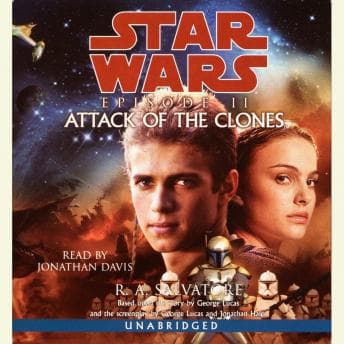

Can a novelization actually fix a movie? Like, genuinely repair the things that made you cringe in the theater? Because that's basically the question I kept turning over while listening to R.A. Salvatore's Attack of the Clones adaptation during a particularly brutal week of on-call rotations.
I started this one at 5:47 AM on Monday, standing on the Caltrain platform in the dark, coffee barely functional, and honestly? The opening chapters hit different when you're too tired to remember how awkward "I don't like sand" sounded coming out of Hayden Christensen's mouth. Salvatore gets inside Anakin's head in a way the film never could, and that internal monologue transforms the character from whiny teenager into something more like... a pressure cooker about to blow. You actually feel his frustration with the Jedi Council, his obsessive pull toward Padmé, the way his arrogance and insecurity are basically two threads of the same rope.
Salvatore Did the Patch, Lucas Wrote the Bug
Look, the source material is the source material. The plot beats are locked in - you're getting the assassination attempts, the Kamino mystery, the arena battle, all of it. But Salvatore adds connective tissue that the screenplay desperately needed. Padmé's political motivations get actual depth. The romance - which is still the weakest link, let's be honest - at least has internal logic when you can hear both characters' thought processes instead of just watching them stare at each other across a Naboo meadow. There's a scene early on where Anakin is meditating and his mind keeps drifting to Padmé despite his training, and it's this quiet moment of genuine conflict that the movie never paused long enough to give us.
That said, Salvatore can't fully debug Lucas's screenplay. Some dialogue is pulled directly from the script, and when Jonathan Davis has to deliver lines like Anakin's possessive declarations to Padmé, even his considerable skill can't make them land naturally. It's like watching someone try to optimize code that has fundamental architecture problems - you can make it run better, but the design flaws are still there.
Jonathan Davis Is Carrying This Production
Jonathan Davis does something clever here that I didn't fully appreciate until about hour 3: he matches the accents to the film actors' nationalities. His Obi-Wan has that clipped British cadence that immediately signals Ewan McGregor. His Yoda - and I say this as someone who's listened to a LOT of Yoda impressions across Star Wars audiobooks - is actually good. Not parody-good. Genuinely good. The syntax inversion sounds natural rather than gimmicky, which is harder than it sounds.
The production includes sound effects and music from the films, which honestly elevates the whole experience. Lightsaber hums during duels, ambient Coruscant city noise, the unmistakable Imperial March sneaking in at key moments. It's not full-cast drama, but it's way more immersive than a straight read.
One thing that bugged me (and apparently I'm not alone): Davis mispronounces "Kaminoans" in a way that pulled me out of the story every single time it came up. And given that Kamino is pretty central to the plot, it comes up a lot. Minor thing, but once you notice it, you can't un-notice it. It's like a typo in production code - technically everything still works, but it bothers you.
The 10-Hour Prequel Rehab Program
At 10 hours 22 minutes, this is basically a 4-commute book at 1.5x. The pacing is uneven - the middle section on Naboo drags compared to the Obi-Wan detective storyline on Kamino, which is genuinely engaging. I found myself wishing Salvatore had spent more time with Obi-Wan's investigation and less on the romance picnic scenes, but again, he's working within the constraints of the screenplay.
The ROI on this audiobook is honestly better than I expected. If you're a prequel-era fan who wants to understand why Anakin's fall matters, the internal perspective work here does 80% of the heavy lifting that the film couldn't. If you've never seen the movies... honestly, skip this and start with Thrawn or something. This assumes you know the universe.
Who Gets Value Here (And Who Doesn't)
Perfect for: train, gym, housework. The action sequences are vivid enough to keep you engaged during mindless tasks, and the quieter character moments work fine at 6 AM brain capacity. Skip for: anyone expecting Salvatore's Drizzt-level prose. This is a novelization doing its best within strict guardrails. On the topic of genre fiction that works harder than it has to within tight constraints, Chronicles of the Messenger of Death gave me a similar feeling - you can feel the author straining against the ceiling of what the format allows.
Star Wars completists and prequel apologists (I say that with love, Kevin is one of you) - this is worth your time. Everyone else? It's a solid listen but not essential.
The Commit Message
TL;DR: Worth your commute if you're already invested in the prequel era. Salvatore patches the worst screenplay bugs with genuine character depth, and Jonathan Davis's performance - minus a few pronunciation hiccups - carries the production. It won't convert prequel haters, but it might make you hate the prequels a little less. And sometimes that's enough.