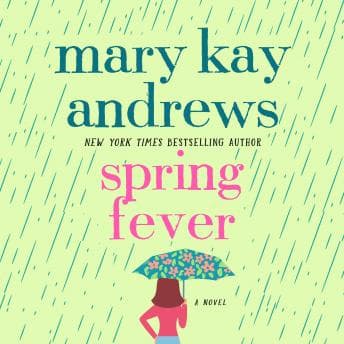

Denise and I were doing our Saturday lakefront walk — the one where we pretend we're exercising but really we're just moving slowly enough that it counts as standing — and she asked me what I was listening to. I pulled out an earbud and said, "Southern small-town drama about a woman who goes to her ex-husband's wedding." She gave me a look. "Marcus. Why." And honestly? I didn't have a great answer. I'd grabbed Spring Fever because I needed something that wasn't going to require me to cross-reference a family tree or parse Faulknerian syntax after a week of grading junior essays on The Great Gatsby. Sometimes you just need a book that knows exactly what it is.
And Spring Fever knows exactly what it is.
The Wedding That Didn't Happen and the Town That Won't Let Go
Here's the setup: Annajane Hudgens is at her ex-husband Mason's wedding, supposedly fine with it, supposedly moved on, supposedly engaged to a new guy. Then the wedding implodes — bride literally walking down the aisle when things go sideways — and suddenly Annajane's standing there realizing maybe four years of "I'm totally over him" was an elaborate performance she was putting on for herself. Mary Kay Andrews doesn't waste time pretending this is anything other than a second-chance romance wrapped in small-town secrets, and I respect that honesty.
What makes it work, though, is Hideaway Lake itself. Andrews writes small Southern towns the way someone writes about a place they've actually sat on a porch in. The family dynamics around the Bayless clan — they run a cherry soda company, which is such a specific, odd detail that it has to be drawn from something real — give the story a texture that goes beyond "will they or won't they." There's corporate scheming, family loyalty tests, and Celia, the almost-bride, who operates with the kind of calculated sweetness that anyone who's survived a faculty lounge recognizes immediately. She's the colleague who brings cupcakes the same week she's angling for your classroom.
But let's be honest. This is 15 and a half hours of audiobook. Fifteen. And a half. For a contemporary romance with a relatively straightforward plot, that's a commitment. There are stretches — particularly in the middle third — where Andrews is circling the same emotional ground Annajane already covered. Yes, she still has feelings for Mason. Yes, Celia is hiding something. Yes, the lake is beautiful and full of memories. I got it by hour six. By hour ten, I was listening during faculty meetings with a clear conscience because the plot was moving at roughly the same pace as Principal Martinez's PowerPoint presentations.
Kathleen McInerney's Sweet Tea Voice
Here's where it gets interesting, and where I have to be fair about a divided opinion. Kathleen McInerney narrates with a soft Southern accent that works beautifully for Annajane — warm, a little self-deprecating, the kind of voice you'd trust to tell you the truth about your haircut. Her Celia voice is genuinely clever: this "fake sweet" tone that drips with just enough honey that you can taste the poison underneath. It's character work, not just accent work. The narrator understands that pause is punctuation — she lets Annajane's realizations land before rushing to the next beat, and that restraint is worth more than any vocal pyrotechnics.
That said, some of the male voices and secondary characters feel a little thin. There's a child character she gives this tiny, pint-sized voice that's charming enough, but a few of the men blend together in a way that had me rewinding to figure out who was talking. And the Southern accent itself — look, I teach in Chicago, I'm not the authority on Southern dialect, but even I noticed it drifting in and out. Sometimes Mason's family sounds like they're from deep Georgia, other times they could be from suburban Indianapolis. It's not a dealbreaker, but it's noticeable across fifteen hours.
I'd give McInerney credit for comedic timing, though. Andrews writes witty dialogue — quick, sharp exchanges — and McInerney hits those beats with a rhythm that feels lived-in rather than performed. She's at her best when Annajane is being quietly sarcastic, which is often enough to carry the slower stretches.
Who Gets Invited to This Lake House
If you loved Dorothea Benton Frank or Elin Hilderbrand's beach reads, this is their spiritual successor — less literary ambition, more pure entertainment value. My students would hate this. I kind of loved it. Not in the way I love Middlemarch or even a really good historical fiction. The closest I've come to that particular reading pleasure recently was Outlander — also a second-chance love story in its bones, also longer than it strictly needs to be, and I also finished it a little sheepish about how much I'd enjoyed myself. But in the way I love a warm Saturday, a predictable walk, and someone telling me a story where I already know the ending but enjoy the telling anyway.
Skip it if you need plot efficiency. Skip it if uneven accents are going to pull you out of the story. And definitely skip it if you're looking for something that'll challenge your assumptions about narrative structure or the human condition.
But if you want something for a road trip, or a long weekend of yard work, or those 11 PM grading sessions where you need proof that love stories can still end well even when teenagers are butchering their thesis statements? It does the job. The prose doesn't demand to be savored — but it goes down easy, like the cherry soda the Bayless family bottles.
Worth Pausing the Faculty Meeting For? Almost.
Spring Fever is comfort food in audiobook form. It's not trying to be anything else, and McInerney serves it warm. I finished it, smiled, and told Denise the ending. She said, "Obviously." She was right. But sometimes obvious is exactly what you need.