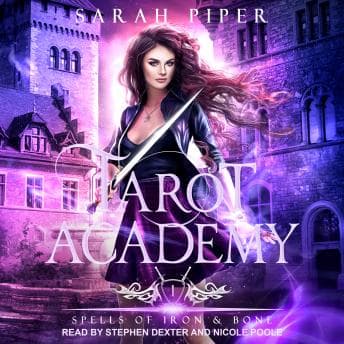

Paranormal romance with a magical academy isn't usually my territory. I'm more "Victorian ghost story" than "hot professors and forbidden magic." But Sarah Piper's Tarot Academy series kept popping up in my podcast DMs, and when I saw Nicole Poole was narrating? She's got an Audie nomination. I had to know.
I listened to this one during a slow week at the library. Headphones in, shelving returns, occasionally startling patrons when I snort-laughed at the mean-girl coven drama. (Yes, I'm a professional.)
The Dual Narrator Situation
Here's the thing about dual narration in romance—it can be magic, or it can be chaos. This one lands somewhere in the middle. Nicole Poole and Stephen Dexter are both genuinely talented. Poole's got this clear, emotionally engaged delivery that makes the protagonist's internal spiral feel real. Dexter brings the brooding male energy without tipping into parody.
But—and this is a real but—having both narrators read both perspectives? With characters named Stevie and Ani? I got confused more than once. My brain would be tracking a scene, then suddenly I'm three sentences deep wondering who's talking. Not a dealbreaker, but a speedbump. If you're the type who zones out during commutes and then has to rewind, this might trip you up.
Poole's voice is polished and expressive, though some listeners have noted she doesn't quite sound like a young protagonist. I see it. There's a maturity to her delivery that reads more "thirty-something woman reflecting on her chaotic twenties" than "actual chaotic twenty-something." For me, it worked—I'm not here for age-accurate voice acting, I'm here for emotional truth. And Poole delivers that.
Where the Magic Actually Lands
The premise is delicious. Illegal magic. Dead mother. Tarot prophecies. A university that's basically blackmailing our protagonist into decoding doomsday predictions. Piper understands that horror isn't about gore—it's about dread. And while this is firmly romance territory, she weaves genuine tension through the prophecy plot.
The world-building is accessible without being dumbed down. You don't need a grimoire to follow the magic system—it's intuitive, rooted in tea and tarot and inherited power. The pacing, though? It's a slow burn. Like, genuinely slow. There are stretches where the romantic tension and academy politics take center stage, and the apocalyptic stakes fade into background noise.
I didn't mind it. Shirley (my cat) was unimpressed by the love triangle dynamics, but I was invested. The "three scorching-hot mages" situation is exactly what it sounds like—this is a reverse harem setup with mature content. If that's not your thing, you'll know pretty quickly.
Production Quality and the Prophecy Payoff
Clean audio, professional production, no weird background hums or jarring edits. The technical side is solid. Both narrators are clearly working from good direction—their pacing matches, the emotional beats land, and the transitions between perspectives (once you adjust to the dual-voice setup) flow well enough.
What surprised me was how much I cared about the prophecy mystery. Urban fantasy romance can sometimes use plot as window dressing for the spice, but Piper actually builds something here. The mother's death, the cryptic tarot readings, the covert university with its own agenda—there's a genuine thriller skeleton underneath the romance flesh.
The mean-girl coven is delightfully petty. "Puts the psycho in psychic" is accurate marketing. These aren't subtle antagonists—they're catty and dangerous and exactly the kind of characters you love to hate.
Your Mileage Will Vary
If you're a paranormal romance listener who wants magic school vibes with mature content and a side of apocalyptic prophecy? This is your book. If you want something to binge during a long road trip or while doing mindless chores? The 10+ hours fly by once you settle into the rhythm.
Skip this one if dual narration confuses you, slow-burn pacing makes you antsy, or you need your fantasy grim and gore-forward. It's not trying to be dark fantasy. It's trying to be romantic urban fantasy with genuine stakes, and it mostly succeeds. Court of Thorns and Roses walks that same line between romance and high stakes, though with more fae politics and less tarot.
My podcast listeners are going to have opinions about this one. Half of them will love the tarot aesthetic and the unapologetic romance. Half will email me asking why I'm reviewing "that kind of book." (The answer is: because good narration is good narration, regardless of genre.)
Back to the Stacks
Would I continue the series? Probably. Nicole Poole's got me curious about where the prophecies go, and I've got a lot more returns to shelve.