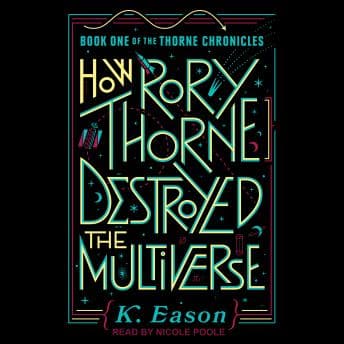

Okay, so here's the thing about fairy tale retellings in space: they can go real wrong, real fast. You get the twee factor cranked up to eleven, or the sci-fi elements feel bolted on like someone forgot they were writing a genre mashup. But How Rory Thorne Destroyed the Multiverse? This one actually works. Like, suspiciously well.
I started this during a marathon thesis-avoidance session (Dr. Patel, if you're reading this, I was definitely working on my procedural generation chapter) and ended up listening straight through my lunch, my afternoon coding block, and most of my evening gaming session. My D&D group was not pleased. Worth it.
Nicole Poole Nails the Sardonic Omniscient Voice
Nicole Poole does this omniscient narrator voice that's dripping with sardonic wit, and honestly? It's giving me strong Discworld vibes. The narrator isn't just telling you the story—she's commenting on it, sometimes with barely concealed amusement at the absurdity of political machinations and royal drama. It's a specific choice that won't work for everyone, but if you've ever wanted a book read to you by someone who sounds like they're rolling their eyes at the characters while secretly rooting for them, this is your jam.
The character voices are solid too. Poole shifts between genders and species without it feeling jarring, and she manages to make even the stock characters—the scheming minister, the somewhat dim prince—feel like actual people with inner lives. The transitions between perspectives are smooth enough that I never got lost, which is saying something because I was also trying to debug a particularly annoying pathfinding algorithm at the time.
Fairy Blessings Meet Interplanetary Politics
K. Eason is doing something clever here. She's taken the bones of a classic fairy tale—princess with magical gifts, political marriage, court intrigue—and transplanted it into a space opera setting with interplanetary consortiums and succession crises. But it's not just aesthetic. The fairy blessings (Rory has thirteen of them, the most useful being the ability to see through flattery and BS) become tools for navigating genuinely complex political situations.
The world-building is dense. Like, Sanderson-level attention to how things actually work. Pretties had that same commitment to showing you how its dystopian society functioned without over-explaining. There are arithmancy systems and alien species and competing political factions, and Eason doesn't hold your hand through any of it. Some listeners apparently found this murky or hard to follow in audio format, and I get that—this is not a book you can half-listen to while doing something else. (I learned this the hard way and had to rewind about twenty minutes after getting too deep into my code.)
But if you're the kind of person who likes understanding why the political situation is the way it is, who wants the magic system to have internal logic, who appreciates when an author has clearly thought through the implications of their premise? This scratches that itch hard.
A Feminist Retelling That Earns It
Look, I've read a lot of "feminist retellings" that feel more like checklists than stories. Strong female character? Check. Subverted expectations? Check. Actual interesting narrative? Eh, we'll get to that.
Rory Thorne isn't like that. She's clever without being a Mary Sue, she makes mistakes, and her rebellion against the systems trying to control her feels earned rather than inevitable. The book is interested in how small acts of resistance accumulate, how you work within broken systems while trying to change them. It's not preachy about it. It just... shows you.
The supporting cast is great too. Rory's got a team of allies who all feel distinct, and the dynamics between them carry a lot of the emotional weight. The somewhat foolish prince she's betrothed to is more complicated than he first appears. Even the villains have comprehensible motivations.
The Rough Edges
The ending is abrupt. Like, genuinely "wait, that's where we're stopping?" abrupt. It's clearly setting up the sequel, and while I'm definitely going to listen to it, I was left wanting more resolution than I got. Some listeners also mentioned wishing for more character reunions, and yeah, I felt that.
Fair warning: Eason's prose is wordy. The omniscient narrator style means you get a lot of commentary and asides, and while I personally loved it (it reminded me of the way Terry Pratchett would wink at the reader), if you prefer your narration lean and unobtrusive, this might drive you up the wall.
Who's Rolling Initiative on This One?
If you're a fan of smart fantasy that doesn't talk down to you, if you like your fairy tales with teeth and your space operas with actual political complexity, give this one a shot. Skip it if you need background listening or prefer straightforward prose—this demands your attention. My D&D group would love this—I'm already planning to steal some of the court intrigue for our next campaign.
(And yes, I did eventually get back to my thesis. Eventually.)