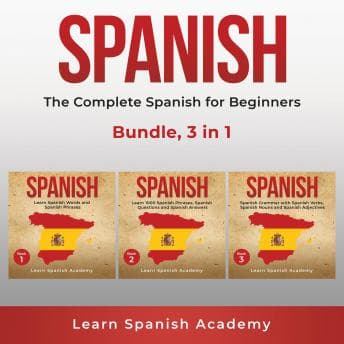

Can a language textbook actually work as an audiobook — or is it like trying to learn piano by listening to someone describe the keys?
I've been asking myself this question for years. Twenty years of teaching English, and I've watched the language-learning industry pivot hard toward audio. My students show up with Duolingo streaks longer than their attention spans, and half of them swear they're learning Spanish from podcasts. So when this 12-hour bundle from Learn Spanish Academy crossed my path, I figured it was time to put the format to the test. Not as a Spanish student, exactly — more as someone who's spent two decades thinking about how language gets taught and whether the medium matters.
I loaded it up during a Saturday afternoon walk along the lakefront with Denise. She gave me a look. "You're learning Spanish now?" No. I'm evaluating pedagogy. She put in her own earbuds. Smart woman.
The Textbook-in-Your-Ears Problem
Let's talk about what this thing actually is, because the marketing copy is doing a lot of heavy lifting with phrases like "secret principle" and promises of intermediate-level fluency. Strip that away and you've got a three-book bundle covering vocabulary (the 1000 most common words and phrases), grammar fundamentals, and verb conjugation across present, past, and future tenses. That's a reasonable scope for a beginner course. The structure — words and phrases first, grammar second — follows a frequency-based approach that's been around since Paul Nation's work in the '90s. It's not a secret. It's just good applied linguistics. But calling it a secret is better marketing, I suppose.
The dual narration from Leandro Bianco and Marina Vallejo Valcarcel actually makes sense here in a way it wouldn't for, say, a novel. You get both a male and female voice modeling pronunciation, which means you're hearing a slightly broader range of Spanish phonology. Bianco's delivery is clear and paced well for a learner — he doesn't rush through conjugation tables, which is merciful when you're trying to absorb the difference between "hablé" and "hablaba" without visual context. Vallejo Valcarcel brings good energy to the phrase sections. One listener I came across said the narrators' voices were "engaging and made it easy to follow along," and I'd agree — within the constraints of what this is.
And that's the thing. What this is.
Where Audio Bumps Against Its Own Ceiling
Here's my honest take as someone who thinks deeply about how people absorb language: a 12-hour audio course can give you pronunciation modeling that a textbook literally cannot. That's the format's superpower. Hearing the rolled r's, the soft d's, the way Spanish vowels stay clean and don't diphthongize the way English ones do — you can't get that from a page. The exercises where you're prompted to repeat phrases? Genuinely useful if you actually pause and do them. (I did not. I was walking. Denise would've had questions.)
But here's where I start to squint. Grammar tables in audio form are brutal. When you're conjugating "tener" across three tenses with six subject pronouns, your brain wants to see the grid. It wants the visual scaffold. Listening to someone read "yo tengo, tú tienes, él tiene, nosotros tenemos" in sequence is a bit like listening to someone read a spreadsheet aloud. You can follow it, sure. But retention? That's a different question. I kept thinking about how even Tolkien understood this — the appendices in Hobbit & The Lord of the Rings exist precisely because some information demands a page, not just a voice. The bundle doesn't seem to come with supplementary materials — no PDF, no companion text — and for a grammar-heavy course, that feels like a real gap.
The sequencing is smart, though. Starting with high-frequency vocabulary means you're building a functional word bank before you're asked to understand why "ser" and "estar" both mean "to be" but will ruin your day in different ways. One reviewer praised the teaching sequence specifically, and I think that's the bundle's strongest design choice.
Who Gets the Most Out of This
If you're a true beginner who wants exposure to Spanish sounds and basic vocabulary — maybe before a trip, maybe as a supplement to a more structured course — this works as a 12-hour immersion bath. It's not going to get you to intermediate fluency. (Nothing that makes that promise in 12 hours is being honest with you.) But it can absolutely prime your ear and give you a foundation.
If you're already at an intermediate level, skip it. You'll spend too much time on material you already know.
And if you're someone who learns best by reading and writing? This format alone won't be enough. Pair it with a workbook or an app. Audio is one channel, and language acquisition works best with multiple inputs — this reminds me of what we know about multimodal learning in literacy education, which is basically my entire professional life in four words.
My students would probably prefer the TikTok version. I get it. But there's something to be said for 12 hours of structured, sequential instruction that doesn't gamify everything into meaninglessness.
The Grade I'd Give It (And I Grade Hard — Ask My Juniors)
This is a competent, well-narrated language course that does what it says within the real limits of audio-only instruction. The narrators are clear. The structure is logical. The marketing oversells it. It's not a secret. It's not going to make you conversational in a weekend. But as one piece of a larger language-learning effort? It earns its place. Just don't expect it to do all the work alone. No single resource ever does — and that's true for Spanish the same way it's true for Faulkner.