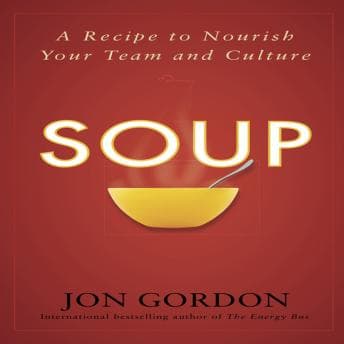

"The quality of your soup is determined by the quality of your ingredients." That's the central metaphor, delivered about 40 minutes in, and honestly? That's also where you could stop listening and walk away with 80% of the value.
I was waiting for Jenny at her dentist appointment - 2 hours and 23 minutes of dead time, which is basically the exact runtime of this book. The universe was telling me something. Whether it was "listen to this" or "you need to relax" is still up for debate.
The Soup Kitchen Version of Corporate Turnaround
Here's the setup: Nancy becomes CEO of Soup, Inc. (yes, a literal soup company - Gordon is nothing if not committed to his metaphors). Company's tanking, morale is in the basement, everyone's miserable. She wanders into Grandma's Soup House during lunch and - surprise - discovers that making great soup is basically the same as building great teams. Love. Care. Passion. Quality ingredients.
Look, my parents ran a dry cleaning business for 30 years. They didn't need a grandmother in an apron to tell them that caring about your work and your people matters. They just... did it. Every day. At 6 AM. This is what my parents did instinctively. Now it has a TED talk.
But here's where I have to be fair. The book isn't wrong. The principles - communication builds trust, negativity kills culture, leaders set the emotional temperature - these are real. I've seen companies die because nobody addressed the toxic middle manager poisoning the well. Nancy's journey from overwhelmed CEO to someone who actively cultivates engagement? That arc tracks. I've consulted for founders going through exactly that identity crisis. The identity-crisis-as-growth-opportunity angle gets a more honest treatment in Chimp Paradox, which at least acknowledges how ugly the internal rewiring actually is before you get to the tidy epiphany.
The problem isn't the ingredients. It's the portion size.
Two Hours of Broth, Thirty Minutes of Meat
At 2 hours and 23 minutes, this is already short by audiobook standards. And yet it still feels padded. Gordon stretches what could be a tight Harvard Business Review article into a business fable, complete with wise mentor characters and convenient epiphanies. Nancy discovers each "ingredient" - trust, culture, purpose, engagement - through tidy conversations at the soup house that wrap up too neatly.
My 2.0x speed couldn't save this one. Not because it's long, but because even at double speed, you can feel the lesson coming three minutes before it lands. Every scene at Grandma's follows the same formula: Nancy is struggling → she visits the restaurant → she receives wisdom through a soup metaphor → she applies it at work → things improve. Rinse, repeat, simmer.
Gordon narrates it himself, which is a double-edged knife. On the positive side, the guy clearly believes every word. His delivery is warm, earnest, and clear - you can tell he's given these talks to hundreds of corporate audiences. On the negative side, it occasionally tips into motivational speaker cadence. That slightly-too-enthusiastic rhythm where every sentence lands like it expects applause. Some moments felt like I was sitting in the third row of a conference ballroom with a lukewarm coffee and a name tag.
That said - he's readable. Listenable. Whatever. The man communicates clearly and doesn't trip over his own prose, which puts him ahead of half the business authors who insist on narrating their own work.
The Fairy Tale Problem
Here's my real issue: the story might sound a bit too fairy taleish. And I don't mean that dismissively. Fables work - The Energy Bus works for a lot of people, and this is the same playbook. But when you've spent years in actual boardrooms watching actual CEOs try to turn around actual failing companies, the frictionless success story starts to feel dishonest.
Where's the board member who undermines Nancy? Where's the VP who agrees in the meeting and then sabotages in the hallway? Where's the quarter where she does everything right and revenue still drops because the market doesn't care about your feelings? Real leadership is messy. This is leadership with the mess cleaned up.
I've seen this fail at three different companies - not because the principles were wrong, but because leaders read books like this and assume implementation is as simple as the story makes it seem. Culture change is a grind. A multi-year, unglamorous, two-steps-forward-one-step-back grind. Soup makes it feel like a long lunch.
Who Gets Fed and Who Goes Hungry
If you're a first-time manager or someone who's never read a leadership book - honestly, this isn't a bad starting point. It's quick, it's accessible, and the core concepts are sound even if they're not original. Use it as a gateway drug to deeper stuff. Girl, Stop Apologizing lives in that same gateway-drug tier for me - accessible, motivating, not breaking new ground, but useful if you're just building the habit of taking your own ambitions seriously.
If you've read any combination of Patrick Lencioni, Kim Scott, or even Gordon's own Energy Bus? You've already absorbed everything here in more developed form. Skip it.
If you're a consultant or experienced leader looking for frameworks you can actually implement? There's too much fluff and not enough substance. You'll be frustrated.
The Bottom of the Bowl
Bottom line: Soup is a 30-minute idea in a 2-hour-23-minute package, which is actually a better ratio than most business books. The principles are legit - my parents proved that decades before this was published. Gordon's narration is competent if occasionally too earnest. But the business fable format strips away all the complexity that makes leadership actually hard.
Jenny would say I'm being harsh. Jenny is right. But she'd also say that not every book needs to be for me, and she'd be right about that too. If you're new to this stuff, grab it on a free trial. If you've been in the game for a while, you already know what's in this soup.