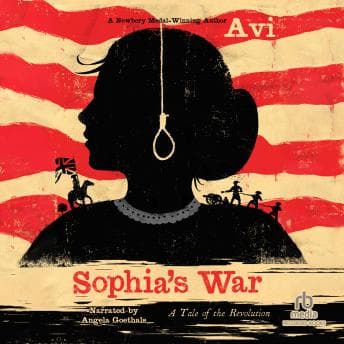

Okay, so here's my complaint: why does nobody talk about the American Revolution in fantasy terms? Because honestly, the espionage game during that war was basically a low-magic intrigue campaign. Dead drops, coded messages, double agents — this is the stuff my D&D group runs when we're tired of dungeon crawls. And Avi clearly gets that, because Sophia's War is less "here's what happened in 1776" and more "here's a 12-year-old girl running a spy mission in occupied New York City, and it's genuinely tense."
I picked this up on a whim. I was reorganizing my board game shelf — which is a whole-day project, don't judge me — and needed something lighter after back-to-back Sanderson rereads. Middle-grade historical fiction isn't my usual lane. But Avi won a Newbery for Crispin: The Cross of Lead, and I remembered liking that one when I was younger, so I figured seven and a half hours? That's nothing. That's a warm-up.
Nathan Hale Dies in the First Act and It Actually Hits
The book opens with Sophia witnessing the execution of Nathan Hale. Not referenced. Not described secondhand. She's there, watching a man hang for being a spy, and that moment becomes the engine for everything she does afterward. It's a smart narrative choice — Avi uses a real historical event as the inciting incident, and it gives Sophia's later decisions real weight. When she eventually gets pulled into espionage herself, you understand why she's terrified. She's seen what happens when you get caught.
What surprised me is how much the book leans into the moral ambiguity of wartime. This is aimed at middle schoolers, but Avi doesn't flinch. Sophia's brother disappears — possibly captured, possibly dead — and she's living under British occupation in her own home. There's a scene where she's working as a servant in a British officer's household, gathering intelligence, and the tension isn't action-movie tension. It's the slow, stomach-churning kind where one wrong word ends everything. My D&D group would love this — it's basically a social encounter where you're rolling Deception checks every five minutes.
The climactic espionage and betrayal sequences toward the end are where Avi really earns his Newbery pedigree. I won't spoil specifics, but Sophia discovers information about a betrayal plot that's rooted in actual Revolutionary War history, and the way Avi weaves the fictional character into real events is — okay, it's not Sanderson-level world-building, but it's doing something similar in a historical context. Building a system where the rules are real history and the character has to navigate within those constraints.
Angela Goethals Does the Quiet Work Well
Here's the thing about narrating middle-grade historical fiction: you don't need Steven Pacey doing seven distinct growls. You need someone who can carry a young girl's perspective for seven hours without making it feel cutesy or condescending. Angela Goethals does that. Her Sophia sounds earnest and scared and determined — sometimes all in the same sentence. There's a restraint to the performance that works for the material. She's not doing vocal fireworks, but she's consistent, and her pacing during the espionage scenes actually tightens in a way that sells the danger. The Winemaker's Wife narrator pulls off something similar — quiet, controlled delivery carrying enormous situational weight — and it stuck with me for the same reasons.
I don't have a ton of specific vocal quirks to call out here, honestly. This is a single-narrator, relatively straightforward production — no sound effects, no full cast. Goethals is solid, professional, and she clearly understood the assignment. If I'm nitpicking, I'd say a few of the male British officers blend together a bit, but that's a minor gripe in a book where the real drama is internal.
Roll for Initiative (But It's a History Test)
So who's this for? If you've got a kid in the 10-14 range who's into history — or who you want to be into history — this is a great gateway. It's short enough to not be intimidating, and the spy angle keeps it from feeling like a textbook. If you're an adult looking for a quick palate cleanser between epic fantasy doorstoppers, it works for that too. I read this instead of writing my thesis, and I regret nothing.
Who should skip it? If you need hard magic systems, progression mechanics, or anything over 20 hours, this obviously isn't your thing. And if you're expecting Hamilton-level Revolutionary War drama — big personalities, huge set pieces — you might find this too quiet. Sophia's War is a small story about a small person doing something brave in a very large conflict, and it's comfortable being exactly that.
The progression is satisfying — Sophia goes from witness to participant to genuine agent of change, and Avi earns every step of that arc. Seven hours well spent. Now back to pretending I'm going to work on Chapter 3 of my thesis.