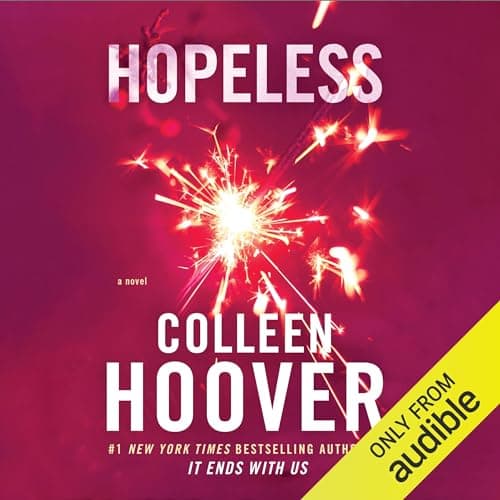

This book wrecked me at 7:15 in the morning while I was making pancakes for my kids.
I'd been on nights all week, just got home, still in scrubs, and I had the audiobook playing through my kitchen speaker because I was maybe forty minutes from the end and couldn't stop. Carlos walked in, saw me standing at the stove with tears running down my face, and just silently took the spatula. That man has been married to me long enough to know when a book has me by the throat.
The Slow Burn That Isn't What You Think It Is
Here's the thing about Hopeless — for the first several hours, I thought I knew exactly what I was listening to. New adult romance. Hot mysterious guy. Girl with a reputation. Witty banter via text messages. Holder's ego-deflating texts to Sky had me grinning on my drive home more than once. I was enjoying it the way you enjoy comfort food — warm, predictable, satisfying.
But Colleen Hoover is doing something sneaky. She's planting seeds the whole time — Sky's memory gaps, the way certain touches make her freeze, the baking binges that feel like more than just a quirky character trait. As someone who's worked trauma for fifteen years, I started getting that gut feeling around hour five or six. The one where you look at a patient's chart and something doesn't add up. I kept thinking, "There's something else here." And I was right, but I wasn't ready for how right.
The last couple of chapters hit like a code blue you didn't see coming. Everything snaps into place — the meaning behind Holder's tattoo, why he was really pursuing her, what Sky's been blocking out. I'm not going to spoil it. But the content warnings on this one exist for a reason. This is not just a love story. It's a story about what the mind does to protect itself, and what happens when protection becomes its own kind of prison. The only other narrative I've encountered recently that handles that particular kind of buried truth with the same emotional honesty is Diana: Her True Story in Her Own Words — a completely different format, obviously, but that same undercurrent of a person finally being allowed to say what they couldn't say before.
Angela Goethals Earned Her Paycheck on This One
Goethals narrates as Sky, and she nails the voice of a seventeen-year-old girl who is smart, funny, and carrying something she can't name. The timing is what got me — the way she handles the humor in the first half versus the raw, stripped-down delivery in the final hours. There's a shift that happens when Sky starts remembering, and Goethals doesn't oversell it. She gets quieter instead of louder. That's the right instinct.
I'll be honest — with a single narrator, you don't get distinct voices for every character. Holder doesn't sound dramatically different from, say, Six or Sky's adoptive mother Karen. But it doesn't matter as much as you'd think because this story lives inside Sky's head. Goethals keeps you locked into that perspective so completely that by the time the revelations come, you feel them the way Sky feels them — confused, then horrified, then something that sits between grief and relief.
Carlos asked why I was crying in the car. I blamed allergies. (It was not allergies. It was hour eleven.)
Where the Seams Show
Look, I'm not going to pretend this book is perfect. The first half leans heavy into high school drama — gossip, rumors, reputation politics. If you're past a certain age (or just past a certain patience level after a twelve-hour shift), some of it reads young. Sky and Holder's dialogue occasionally veers into that hyper-articulate territory where teenagers sound like they've been workshopping their lines. And there's a pacing issue — a lot of the major action and revelations are packed into the last 80 pages or so, which means you spend hours in slow-build mode before everything detonates.
But here's what I'll say as someone who works with trauma patients: the way Hoover handles the psychological elements isn't sensationalized. It's not exploitative. Sky's responses — the dissociation, the fragmented memories, the physical reactions — are more accurate than what I see in most thrillers that think they're being edgy. The psychological details ring true. Finally. (Close enough for me to nod instead of throw my phone.)
Who Should Listen (And Who Should Skip)
If you want romance with real weight underneath it and you're okay with a slow build that pays off hard, this is for you. If you need action every chapter or you're listening while distracted — doing dishes, half-paying attention — you'll lose the thread. This one needs your focus, especially in the second half. Skip it if you're looking for something light or if you can't do heavy subject matter right now — no shame in that.
And fair warning: the content is heavy. Abuse, childhood trauma, sexual violence discussed in detail. If that's a hard stop for you, respect that boundary.
Post-Shift Prescription
Perfect for that post-shift decompression, honestly. The first half is gentle enough to bring your heart rate down, and by the time it gets intense, you're invested enough to ride it out. I started it thinking it was candy. It turned out to be medicine. My mom would love this — she's a sucker for a love story that makes her cry. (She still thinks I should've been a doctor, but at least we agree on books.)