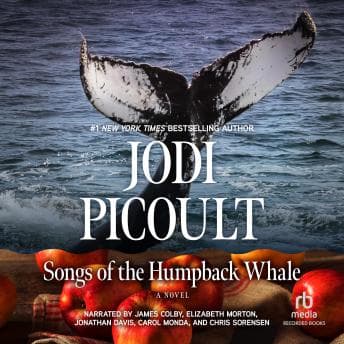

I was grading sophomore essays on The Great Gatsby at 11:30 PM—the usual parade of "Nick is a reliable narrator" takes that make me question my career choices—when I decided I needed something to drown out the red pen scratching. Picoult's debut seemed like a reasonable escape. Fifteen hours later, I'm not sure "escape" was the right word. More like "complicated emotional archaeology."
This is Picoult before she became Picoult. Before the courtroom dramas and the ripped-from-headlines moral quandaries that made her a household name. Songs of the Humpback Whale is rougher, messier, more ambitious in ways that don't always land. And honestly? That rawness is part of what makes it interesting.
Five Voices, One Fractured Family
The audiobook gives each narrator their own actual narrator—Jane gets Carol Monda, Rebecca gets Liz Morton, and the three men in their orbit (Oliver, Sam, and Joley) each get their own voice actor. It's a smart production choice for a book that's already asking a lot from its listeners. The nonlinear timeline jumps between perspectives and years with the kind of structural ambition you'd expect from a debut novelist who'd been reading too much Faulkner. (I say this with love. I assign Faulkner. I understand the impulse.)
The thing is—and my students would hate this take—the fragmented structure actually works for what Picoult is doing. This is a story about how family members experience the same events completely differently. Jane's memory of a moment isn't Oliver's memory. Rebecca's childhood exists in a different emotional register than her parents understood. The multiple narrators make that dissonance audible.
But I won't pretend it's easy listening. This is not a "throw it on while you're cooking dinner" audiobook. I lost the thread twice during faculty meetings. (Sorry, Principal Martinez. Your budget presentation was probably very important.)
Where the Seams Show
Here's what Picoult hadn't figured out yet in 1992: pacing. The cross-country journey that forms the novel's spine sometimes feels like actual cross-country driving—long stretches where not much happens, punctuated by moments of genuine emotional intensity. The ending lands hard, involving Rebecca's pain in ways that feel almost too raw, but getting there requires patience.
The character work is uneven too. Oliver, the marine biologist husband, comes across as more symbol than person—his whale research functioning as heavy-handed metaphor for communication breakdowns. The prose deserves to be savored, but some of the symbolism could use a lighter touch. Jane's journey toward understanding her troubled past carries real emotional weight, but some of the men orbiting her story feel like sketches rather than fully realized people.
Jonathan Davis and Chris Sorensen do what they can with the male characters, and Carol Monda brings genuine warmth to Jane's sections. But the standout is Liz Morton as Rebecca—she captures that specific teenage quality of understanding more than adults think you do while still being fundamentally a child. Railway Children works with that same tension—kids who grasp the adult world's dangers without losing their essential childhood resilience. It's a difficult balance, and she nails it.
The Picoult Before Picoult
If you've read her later work—My Sister's Keeper, Nineteen Minutes, Small Great Things—you'll recognize the DNA here. The fractured families. The impossible moral situations. The way she refuses to let anyone be purely villain or purely victim. That moral complexity shows up differently in To Kill a Mockingbird, where Scout's childhood perspective forces us to see how good people can still participate in broken systems. But compared to those more polished novels, this one feels like watching an artist figure out her voice in real time.
That's not a criticism, exactly. There's something valuable about encountering a writer's first attempt, especially when you know what they'll eventually become. The rough edges are instructive. You can see her reaching for effects she'll master later.
Worth Pausing the Faculty Meeting For?
I need to be honest: this audiobook requires commitment. Fifteen hours is a significant investment, and the nonlinear structure means you can't zone out for twenty minutes and pick up the thread easily. Some listeners found it genuinely confusing—the jumps between timelines and perspectives can feel disorienting rather than illuminating.
But if you're a Picoult completist, or if you're interested in watching a major contemporary novelist find her footing, there's real value here. The themes of childhood abuse, infidelity, and family fracture are handled with the seriousness they deserve, even when the execution is imperfect.
My students would hate this. The structure is demanding, the pacing is uneven, the symbolism is sometimes too obvious. But I found myself thinking about it while walking the lakefront with Denise the next morning, trying to explain why a flawed debut novel from 1992 had gotten under my skin.
This reminds me of what Hemingway said about first novels—they're usually the writer's most personal work, before they learn to hide behind craft. Picoult isn't hiding here. For better and worse, that vulnerability is the point.
Mr. Williams's Final Grade
If you loved Picoult's later work and want to understand where she started, this is essential listening. If you're new to her, start with something more polished—My Sister's Keeper or Nineteen Minutes—and come back to this one later. Skip it if you need something for background listening or your commute. This one demands your attention, even when it doesn't always reward it.