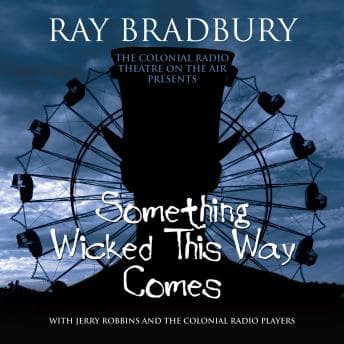

"The autumn people. That's what they are. They don't live off you, they live off your nightmares."
I was grading sophomore essays on The Great Gatsby at 11:47 PM—the usual parade of "Gatsby was rich and sad"—when I decided I deserved something better. Two hours later, I'd finished this entire production and completely forgotten about Nick Carraway's unreliable narration. (The essays could wait. They always can.)
Here's the thing about Ray Bradbury adapting his own novel into audio drama: the man understood that his prose was always meant to be heard. Those sentences that sometimes feel overwrought on the page? They're incantations when spoken aloud, layered over carnival calliope music and the creak of the carousel.
When Radio Theatre Meets Literary Horror
Colonial Radio Theatre didn't just record this—they conjured it. The full cast approach means Jim Nightshade and Will Halloway actually sound like thirteen-year-old boys caught between childhood wonder and adult terror. There's a moment when Mr. Dark speaks, and I swear the temperature in my kitchen dropped. The sound design does the heavy lifting that Bradbury's descriptive passages do in the novel: the mechanical groan of the carousel running backwards, the distant calliope that sounds wrong in a way you can't quite name.
At under two hours, this is a sprint through material that could have been stretched thin. It isn't. The pacing feels like that week before Halloween when time moves strangely—too fast and too slow simultaneously.
Charles Halloway Deserves His Own Discussion
The heart of this story has always been Will's father, the aging library janitor who must find courage he thought he'd lost decades ago. Whoever voices him in this production (the cast list doesn't specify roles, which is my one frustration) captures that particular exhaustion of a man who's spent his life reading about heroes while believing himself too old, too tired, too ordinary to become one.
This reminds me of what Hemingway said about courage being grace under pressure—except Bradbury's asking something harder. He's asking if a man who's already given up can find grace at all. The audio drama doesn't shy from the quieter philosophical passages between Charles and Will. They kept them. Thank God they kept them.
The Prose Deserves to Be Savored
I listen at 1.0x because the author chose those words, and Bradbury chose these words with the precision of a poet who happened to write novels. The adaptation maintains his language even while condensing the plot. You still get lines like "a man should keep his little empty spaces" and "too late, I found you can't wait to become perfect." My students would hate this. I love it.
The sound effects never overwhelm the dialogue—a common sin in audio dramas. The music swells at precisely the right moments and knows when to disappear entirely. When the Dust Witch floats through town, you hear it before anyone describes it. That's the production trusting its audience.
Who This Carnival Is For (And Who Should Keep Walking)
If you loved Bradbury's Fahrenheit 451 and wished it had more darkness, more October, more of that particular American Gothic that tastes like caramel apples and rotting leaves—this is its spiritual successor. That same immersive quality—where prose becomes atmosphere—is what makes All the Light We Cannot See work so beautifully in audio format. If you're introducing someone to Bradbury, this might actually be the better entry point than the novel. The dramatization makes the metaphors visceral rather than abstract.
Skip this if you need longer listening experiences or if you prefer your horror without philosophy. This isn't a haunted house—it's a meditation on mortality that happens to feature a sinister carousel. Also skip if you're the type who needs clear narrator credits. (I spent ten minutes trying to figure out who played Mr. Dark. Still don't know. Still haunted by his voice.)
Class Dismissed
Two hours. That's all Bradbury and Colonial Radio Theatre need to remind you why we still read the classics—and why some classics deserve to be heard rather than read. I finished this instead of grading those Gatsby essays, and I regret nothing.
The show is about to begin, the man said. He wasn't wrong. He was never wrong about autumn, about boyhood, about the particular terror of wanting something so badly you'd sell your soul for it.
Denise found me at midnight, headphones still in, staring at nothing. "Good book?" she asked.
"Good nightmare," I said. "The best kind."
I'm assigning this to my AP Lit class next October. They'll complain. They always do. Then they'll understand.