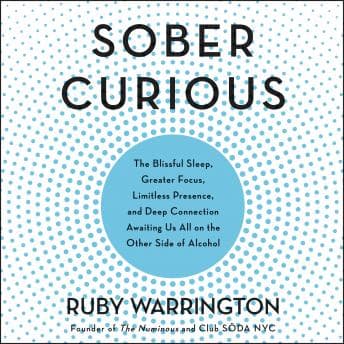

How many of us are green-juicing our way through mornings while polishing off a bottle of Pinot by 9PM and pretending those two things don't contradict each other?
That's basically the central question Ruby Warrington drops in the first twenty minutes of Sober Curious, and honestly, it hit different at 6:17 AM on a Wednesday Caltrain when I was nursing a headache from exactly two glasses of wine the night before. Kevin had poured them. Kevin is now on notice.
The "Could've Been a Blog Post" Audit
Let me get this out of the way: at 6 hours 34 minutes, this is mercifully short for a self-help book. The ROI on this audiobook is decent - you're not wading through 14 hours of padding. But could it have been shorter? Yeah. Warrington has a habit of circling back to the same core thesis - that we drink on autopilot, that society pressures us into it, that questioning that autopilot is the whole game - from slightly different angles, chapter after chapter. By the third or fourth reframe of essentially the same idea, I caught myself reaching for the 1.75x button. Which, for a self-help book, is my "get to the point" reflex.
The thing is, the core thesis is good. She's not preaching sobriety like a recovery manual. She's not saying you're an alcoholic. She's saying: what if you just... got curious about why you drink? That framing is genuinely useful. It's basically mindfulness but for your relationship with alcohol. And for someone like me - not a heavy drinker, but definitely someone who defaults to "wine after a bad on-call" without thinking - the reframing landed. That same quietly radical idea - that awareness itself is the intervention - is what made Mindful Athlete stick with me too, even though performance optimization felt like a different universe from my Caltrain commute.
Where it gets wobbly is when Warrington drifts into her mystical/spiritual lane. She's the founder of a site called The Numinous, which bridges "mystical and mainstream," and you can feel that influence bleeding in. Moon cycles, energetic shifts, that kind of thing. If you're the type who's into that, cool. If you're an engineer who wants data and research, you'll feel your eyes glazing over during those stretches. I wanted more of the expert interviews and research she references and less of the woo-woo detours.
Author-Narrated: The Double-Edged Sword
Warrington narrates her own book, and the consensus among listeners is split - and I get why. On the positive side, her tone is genuinely warm and non-judgmental. She sounds like a friend at brunch (an alcohol-free brunch, naturally) telling you about this thing she discovered. There's an ease to it that makes the content feel approachable rather than preachy.
But here's the problem: some sections feel like she's reading rather than talking. The pacing gets uneven - she'll be conversational and flowing for a stretch, then hit a more research-heavy passage and the delivery goes flat, almost disjointed. One reviewer nailed it when they said the narration "made it hard to take in the content," and I felt that specifically during the chapters where she's synthesizing other people's research. It's like the difference between someone telling you a story they lived versus reading you a Wikipedia summary. A professional narrator - someone who could modulate between the personal and the informational - might have smoothed those transitions.
For the 6AM zombie train crowd: it's followable, mostly. The conversational bits work great half-asleep. The flatter research sections are where I'd zone out and have to rewind. Not ideal.
Who This Is Actually For (And Who Should Hard Pass)
Perfect for: anyone who's not in recovery but has started quietly wondering if their "totally normal" drinking is actually serving them. The person who does Dry January and feels amazing but can't articulate why they go back to drinking in February. That's Warrington's sweet spot, and she writes to that audience with zero shame or judgment.
Skip for: anyone wanting hard science. The research is there but it's light - more anecdotal and interview-based than data-driven. Also skip if spiritual frameworks make you itch. She can't fully help herself on that front.
Perfect for: commute, walks, housework. Skip for: deep work or anything requiring your full analytical brain - it's not that kind of book.
The Commit, Push, or Stash Decision
TL;DR: Worth your commute if you're alcohol-curious (sober-curious?), but manage your expectations on depth. I finished this in about 4 commutes at 1.5x, and I came away genuinely more aware of my own autopilot drinking habits. That's not nothing. But I also skimmed through some mystical tangents that lost me, and the narration inconsistency kept pulling me out at the wrong moments. It's a 3.5 - a solid conversation starter that could've been a tighter, sharper book with a professional narrator and a ruthless editor.