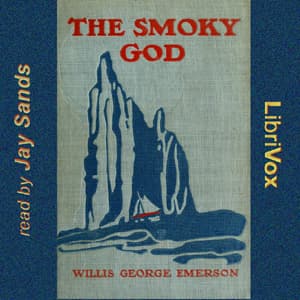

I'll be honest—I went into this expecting some cheesy early 1900s sci-fi I'd half-listen to while pretending to work on my thesis. What I got was something way weirder and more fascinating than I bargained for.
The Smoky God is one of those books that's been sitting in the hollow Earth conspiracy theory canon for over a century, and listening to it in 2024 is this bizarre experience of recognizing where so many modern fantasy tropes actually came from. This is 1908, folks. Emerson was doing inner world stuff before it was cool—before Pellucidar, before Journey to the Center of the Earth got its millionth adaptation, before every LitRPG author discovered that "hidden civilization" is basically a cheat code for world-building.
The OG Hollow Earth Build
Here's what got me: the magic system is chef's kiss. Okay, it's not technically magic—it's presented as this pseudo-scientific travelogue from an elderly Norwegian sailor named Olaf Jansen. But the internal logic of this inner world is surprisingly consistent for something written when people still thought radium was a health supplement. The "Smoky God" itself is this massive central sun that illuminates the inner Earth, and Emerson commits to the bit completely. The giants living inside? They're not just "big people"—they're described as twelve feet tall, living 600-800 years, with technology that makes surface dwellers look like cavemen.
At just over two hours, this is basically a novella, and honestly? That's perfect. Emerson doesn't pad it out. You get the voyage in, the discovery of the inner world, the encounter with the giant civilization, and the harrowing escape. No filler. My D&D group would love this as inspiration for a one-shot—the whole "entering through the polar opening" thing is literally how I'd structure an adventure hook.
The hidden-passage-into-a-secret-world setup also reminded me of Dance of Cloaks, which does something similarly fun with layered political intrigue underneath a deceptively simple surface.JaySands and the LibriVox Experience
Let's talk about the elephant in the room: this is a LibriVox recording, which means it's free and volunteer-read. JaySands delivers a straightforward reading—no dramatic voice acting, no distinct character voices, just clear and competent narration. If you're coming from a Tim Gerard Reynolds or Steven Pacey production (Steven Pacey walked so other narrators could run, after all), you'll need to adjust your expectations. But for a two-hour listen? It works. The narrator doesn't get in the way of the story, and for public domain stuff, that's honestly a win.
The audio quality is clean enough—no weird pops or background noise that I noticed. I listened to this while allegedly working on my procedural generation chapter (sorry, Dr. Patel) and never had to rewind because of audio issues.
When Conspiracy Theory Meets World-Building
Here's the thing that makes The Smoky God genuinely interesting rather than just a curiosity: Emerson frames the whole narrative as a "true account" that Olaf Jansen shared on his deathbed. The framing device is surprisingly effective. You've got this old man who spent years in an asylum because nobody believed his story, finally unburdening himself to the author. It's melancholy in a way I didn't expect.
And look—is this scientifically accurate? Obviously not. The hollow Earth theory is bonkers. But as a fantasy premise? This is Sanderson-level world-building for 1908. Emerson thought through the ecology, the society, the technology. The giants have electric vehicles. They've conquered disease. They live in harmony with nature. It's basically a utopia narrative wrapped in adventure fiction wrapped in fake-documentary framing.
The progression is satisfying—you start with skepticism (the narrator literally says he expects to be disbelieved), move through the dangerous Arctic voyage, hit the wonder of discovery, and end with tragedy and isolation. For something this short, it hits all the beats.
Roll for Initiative (Or Don't)
If you're into the history of speculative fiction, this is essential listening. You can trace direct lines from this to everything from At the Earth's Core to modern portal fantasy. World-building nerds who want to see how authors handled "hidden civilization" before we had a hundred years of genre conventions to draw on—absolutely grab this.
Skip it if you need high-production audiobooks with full casts and sound effects. Skip it if you want something longer than a movie. And if you can't handle early 1900s prose style (which is more formal than modern fantasy), you might bounce off it.
But honestly? It's two hours and it's free. I listened to this instead of writing my thesis. No regrets.
Campaign Complete
The Smoky God is a fascinating artifact—part adventure story, part utopian fiction, part accidental conspiracy theory fuel. It's not going to blow your mind, but it's a genuinely enjoyable listen that punches above its weight for something written 116 years ago. Perfect for a single afternoon when you want something weird and short. Just don't go looking for the polar opening afterward. (Or do. I'm not your advisor.)