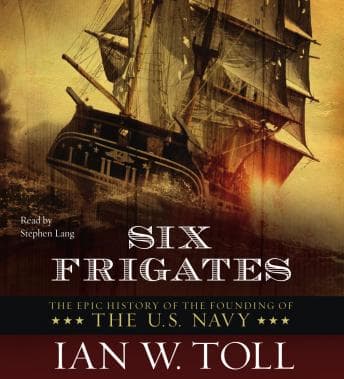
People told me this was a dry naval history. People were wrong.
I started this one on a late-night drive back from a client site in San Antonio, the kind of empty I-35 stretch where your headlights feel like the only lights in Texas. Expected a solid but academic listen about shipbuilding. What I got was a political knife fight wrapped around some of the boldest naval actions in American history, narrated by a guy whose baritone voice could probably command a quarterdeck.
The Founders Couldn't Agree on Anything (Sound Familiar?)
Here's what grabbed me first - and I wasn't expecting this from a book with "frigates" in the title. The political maneuvering over whether to even have a navy is genuinely riveting. Jefferson flip-flopping, Hamilton pushing hard, Madison calculating angles. Toll treats these guys like the flawed, ambitious, sometimes contradictory politicians they were. Not marble statues. Not civics-class cardboard cutouts. You get the sense that building six warships was as politically explosive as any defense appropriation fight we've had since. I've sat in enough Pentagon briefings to recognize the dynamics - the cost overruns, the logistical nightmares of sourcing live oak from Georgia swamps, the contractors who couldn't deliver on time. Some things never change.
The book covers roughly 1794 through the War of 1812, and Toll is smart about how he structures it. The early political debates build tension for the Barbary campaigns, and Stephen Decatur's raid to burn the captured USS Philadelphia in Tripoli harbor - that sequence alone is worth the listen. Toll writes it with enough tactical detail to satisfy anyone who's studied small-unit operations, but he doesn't drown you in jargon. The man clearly did his homework. You can feel the heat of the harbor, the absurd courage required to sail a small crew into an enemy port at night. That same commitment to putting you inside an impossible situation - where ordinary people do extraordinary things under conditions that would break most of us - is what made Tower of Skulls hit me just as hard, though the theater and the century are completely different.
Stephen Lang Knows What He's Doing Behind a Mic
Lang's narration is the right tool for this job. His baritone sits in that sweet spot - authoritative without being pompous, warm without being soft. He reads this like a man who understands the weight of what's being described. The battle sequences between USS Constitution and HMS Guerriere? He doesn't oversell it with dramatic theatrics. He lets the writing do the heavy lifting, which is exactly the right call when the material is this strong. There's a confidence in his delivery that reminds me of the best briefers I ever worked with - the ones who knew they didn't need to shout because the intel spoke for itself.
No funny accents, no character voices to speak of, but for narrative history that's fine. This isn't a novel with dialogue on every page. It's a story told through events and decisions, and Lang handles the shifts between political argument and naval combat without missing a beat.
The Abridged Problem (And It Is a Problem)
Now here's where I have to be straight with you. This is the abridged version. Seven hours and change. The full book is significantly longer, and you can feel the cuts. Certain political debates get compressed in ways that left me wanting more context. The shipbuilding sections - which I suspect are fantastic in the unabridged text - feel rushed. It's like watching a great documentary that got edited down for a TV time slot. Everything that's here is good. But I kept sensing there was more, and that nagged at me.
For a book that won the Samuel Eliot Morison Award, getting the abbreviated version feels like ordering a prime steak and having someone cut it in half before it reaches your table. Still delicious. Still satisfying. But you know what you're missing.
Who Gets the Green Light
If you're into early American history, naval warfare, or the messy birth of American military institutions - this is your book. If you've read Patrick O'Brian and wished someone would give you the real history behind that era with the same narrative energy, Toll delivers. Anyone who's served and dealt with defense procurement politics will find some dark humor in how little has changed in 230 years.
Skip it if you need constant action. The first couple hours are heavy on political maneuvering (which I loved, but I know not everyone's wired that way). And if the idea of an abridged version bothers you on principle, maybe grab the print edition and save the audio for something else.
Mission Debrief
Ranger fell asleep during the Jeffersonian debate sections but perked up for Tripoli. Smart dog. This is quality history that treats its audience like adults, narrated by a pro who respects the material. The abridged format is the only real casualty here - it keeps this from being a full-send recommendation. But what's here? Worth your time. Especially at 1.25x on a dark Texas highway.






![Steve Jobs [unabridged audiobook] audiobook cover](/_next/image?url=https%3A%2F%2Fcovers.audiobooks.com%2Fimages%2Fcovers%2Ffull%2F9788499923406.jpg&w=1920&q=75)