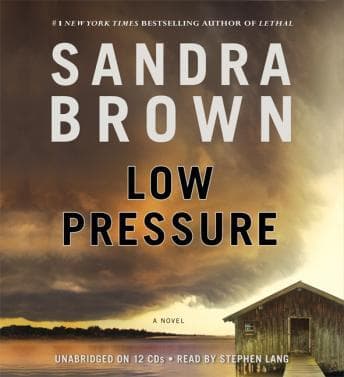

"Bellamy's fear of storms is a legacy of the tornado that destroyed the crime scene along with her memory of what really happened."
I was halfway through a batch of dal makhani — the onions just hitting that deep golden stage where you can't walk away — when that line landed somewhere around hour two, and I actually stopped stirring. Because psychologically? That's a genuinely interesting setup. Trauma-induced amnesia tied to a specific sensory trigger (storms), layered with survivor guilt and the complicated grief of losing a sibling you were too young to properly mourn. Sandra Brown set herself up with rich material here. The question is whether she follows through.
The Case File on Bellamy Lyston
The protagonist exhibits classic avoidant coping — she wrote an entire bestselling novel about her sister's murder under a pseudonym, which is both a therapeutic act and a profound act of distance. I found myself asking: why does Bellamy really write this book? Is it processing or performing? Brown hints at both, which I appreciated. When Bellamy's cover gets blown by a tabloid reporter, the fallout isn't just external danger — it's the collapse of the psychological wall she built between her trauma and her public self.
But here's where I got frustrated. The amnesia recovery arc follows a pretty predictable unlock-the-memory trajectory. Bellamy gets closer to the truth, has a flashback, pulls back. Gets closer, flashback, pulls back. The research actually shows that traumatic memory recovery is far messier and less linear than fiction usually allows, and Brown doesn't quite escape that trap. The memories return when the plot needs them to, not when the psychology demands it.
Dent Carter — Susan's ex-boyfriend, prime suspect, obvious love interest — is more interesting than he first appears. He's spent eighteen years under suspicion, which should've warped him in specific ways, and to Brown's credit, she gives him genuine anger about it rather than noble suffering. What makes this character compelling is that he doesn't just want to be cleared — he wants someone to acknowledge the damage that suspicion did. That's a real human motivation.
The romance between Bellamy and Dent, though? Psychologically, this doesn't entirely track. She's reconnecting with the man who dated her murdered sister while simultaneously recovering repressed memories of that murder. The intimacy between them escalates fast — and yes, there are some fairly explicit scenes — but Brown doesn't spend enough time on the inherent weirdness of this dynamic. My therapist would have thoughts about this relationship, is all I'm saying.
Stephen Lang and the Hillbilly Problem
Stephen Lang's narration is a fascinating case study in choices that work for some listeners and alienate others. His male characters land well — there's a gruffness and authority that fits the Texas setting and the suspense tone. He's solid at distinguishing between the cast, and there are moments where his pacing genuinely builds tension.
But his Bellamy? Bland. Flat. Almost affectless in a way that might be a deliberate choice — conveying emotional numbness — or might just be a male narrator struggling to voice a female protagonist with interior depth. It's the central performance in a thirteen-hour audiobook, and it never quite arrives.
And then there's the accent issue. Some of the secondary characters come across with a drawl so thick it borders on caricature. I wouldn't say they all sound like "dumb hillbillies" — that's the criticism floating around — but a few of them lean that direction. It's distracting when you're trying to take a murder investigation seriously and a character sounds like they wandered in from a parody.
Who's Buying What Brown Is Selling
This is Sandra Brown doing what Sandra Brown does: romantic suspense with a body count and a love interest you're not sure you should trust. If you're already a fan, you know the formula and you're here for it. The mystery itself has a decent final twist — I didn't see the killer coming, which at thirteen hours of investment, I consider a basic requirement.
But if you need psychologically rigorous character work — if you need the amnesia to feel real, the romance to feel earned, the trauma to be more than a plot device — you'll spend chunks of this book mildly annoyed. Like I did. While burning my dal.
People who love Sandra Brown's particular blend of danger and desire will eat this up. The romantic suspense crowd that made me fall hard for Finlay Donovan Jumps the Gun — which actually does earn its chaos by keeping the protagonist psychologically coherent under pressure — will have a pretty good time here. People who want their thriller characters to behave like actual humans with actual psychological patterns will find gaps. If unrealistic character motivations bother you (hi, it's me), adjust your expectations accordingly.
My Clinical Assessment
Low Pressure is a competent romantic thriller with a genuinely interesting psychological premise that it doesn't fully exploit. The storm-trauma-amnesia framework deserved deeper treatment. The mystery delivers. The romance is fine if you don't think too hard about it (I always think too hard about it). Lang's narration is serviceable but uneven — strong on suspense, weak on the woman at the center of it all. At thirteen hours, it's a solid companion for a long road trip or a weekend of mindless cooking, but it won't be the audiobook I'm still thinking about next month.