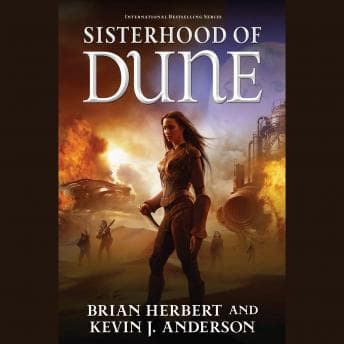

Sisterhood of Dune is the Dune equivalent of a D&D session where the DM has incredible lore notes but keeps introducing NPCs faster than you can write them on your character sheet.
I burned through this during a week of "thesis work" — and by thesis work I mean I had my procedural generation code open on one monitor and twenty hours of Dune prequel pumping through my headphones. Dr. Patel, if you're reading this: I was multitasking. (I was not multitasking.)
Where the Spice Flows (And Where It Doesn't)
Here's what's genuinely cool about this book: you get to watch the Bene Gesserit, Mentats, and Spacing Guild Navigators being built from the ground up. Raquella Berto-Anirul founding the Bene Gesserit on Rossak, Gilbertus Albans literally hiding an Erasmus memory core while teaching humans to think like computers, Venport Holdings developing spice-saturated Navigators — this is origin-story world-building for institutions that define the Dune universe. If you've ever sat through a three-hour wiki dive on the Butlerian Jihad, this is that wiki dive in audiobook form. And I mean that mostly as a compliment.
The Butlerian movement stuff — Manford Torondo leading anti-technology mobs across the Imperium from his palanquin — hits differently now than it probably did in 2012. There's something uncomfortably familiar about watching a populist movement destroy technology based on fear rather than understanding. Brian Herbert and Kevin Anderson aren't subtle about the Reason vs. Faith throughline, but they don't need to be. It works as a campaign setup.
But — and this is the big but — the characters feel like quest-givers rather than people. The Harkonnen revenge subplot, with Griffen and Valya blaming Vorian Atreides for their family's downfall, should carry the kind of emotional weight that makes you put your headphones down and stare at the ceiling. Instead it reads more like a faction conflict in a grand strategy game. Compare that to how Sanderson handles Dalinar's guilt in Stormlight — you feel every ounce of that man's shame. Here, the motivations are told to you rather than earned. The pieces are all on the board. They just don't bleed when you knock them over.
Scott Brick: The Forever DM of Dune
Scott Brick is basically the canonical voice of Dune at this point. He's narrated so many of these books that hearing someone else read Dune prose would feel wrong — like hearing a different DM run your home campaign. His pacing is measured, his tone carries the weight of the setting, and he keeps the threads distinct enough that you don't lose track of which faction you're following. Given there are like seven major POV threads weaving through this thing, that's no small feat.
That said, "measured" is doing a lot of work in that sentence. Brick doesn't do the kind of sharp character voice differentiation that someone like Steven Pacey would bring. Steven Pacey walked so other narrators could run, and Brick is... walking at a very consistent, professional pace. He's narrating rather than performing, which works for the sweeping political scope but makes the already-flat character moments feel even flatter. When you're solo-narrating 20+ hours of political maneuvering across half a dozen factions, some variety in vocal energy would go a long way. That's one area where Deserter surprised me—same narrator, but the thriller pacing forces him into a more dynamic performance.
Around hours 12-15, when yet another faction's political setup is being established, I caught myself drifting back to my code more than once. The progression isn't satisfying in the way a good setup book should be — it's more like watching someone arrange miniatures on a battle map for a session that hasn't started yet.
Your Party Composition Matters
If you've already listened to the Legends of Dune trilogy and you want to see the bridge between ancient Dune history and Frank Herbert's original — this is your book. The lore density is real. My D&D group would love the faction politics in this. I got way more invested in the faction conflict in The Battle of Corrin, which actually pays off the generations-long Atreides/Harkonnen feud with real narrative weight.
If you're coming in cold, or if you're a Frank Herbert purist who treats the originals as sacred text? You're probably going to bounce off this hard. The prose doesn't have Frank's density, the characters don't have his psychological weight, and the philosophical themes are painted in much broader strokes. That's not necessarily a deal-breaker. But it's the difference between a fully written novel and a really detailed campaign setting guide that happens to have a plot attached.
If you don't like info-dumps, this isn't for you (but you're wrong). Except — okay, maybe in this specific case, the info-dumps needed stronger characters to anchor them.
Save Your Spell Slot
Sisterhood of Dune is a solid B-tier Dune experience. The world-building scratches the itch, Scott Brick is reliably good, and if you're invested in the expanded Dune universe, the 20 hours go down easier than you'd expect. But it's not essential listening unless you're prepping for the Dune: Prophecy series. Yes, it's 40 hours if you count the whole trilogy. No, I'm not sure it's worth it at full price.
Wait for a 2-for-1 sale, listen at 1.25x during your next coding marathon, and keep your expectations at "interesting lore supplement" rather than "Frank Herbert-level experience."
I read this instead of writing my thesis. The thesis might've been the better call this time.