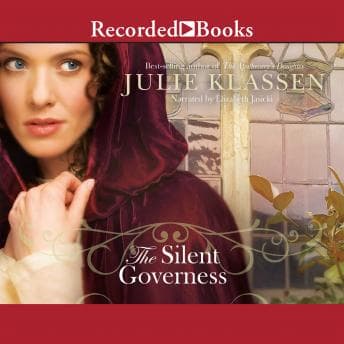

What happens when silence becomes the most powerful weapon a woman has? Not metaphorical silence - literal, enforced, survival-level silence. That's the premise Julie Klassen builds her Regency world around, and it's a question that kept me company through a long Sunday afternoon while Denise was at her sister's and I had the apartment to myself with nothing but coffee and the lakefront light coming through the windows.
Olivia Keene stumbles onto a secret that could ruin Lord Bradley's family, and his solution isn't violence or exile - it's employment. He traps her in his household as a governess, banking on propriety and position to keep her quiet. Klassen keeps nearly all of her tension below the waterline - what you hear on the surface is polite Regency conversation, and what you feel underneath is a woman one loose sentence away from ruin. The real story isn't the secret itself. It's what silence does to a person forced to carry it.
When Gothic Meets the Vicarage
Klassen has been compared to Victoria Holt, and I get it. There's that same sense of a woman navigating a grand house full of people who know more than she does. But where Holt would lean into genuine menace, Klassen keeps one foot firmly in the inspirational fiction lane. The faith elements aren't subtle - they're woven into Olivia's internal monologue and the moral architecture of the plot. That kind of faith-as-structural-load-bearing-wall rather than decoration reminded me of Redeeming Love, where the theological scaffolding is so load-bearing that pulling it out would collapse the whole story - though Francine Rivers goes somewhere considerably darker with it than Klassen does here. If you're coming to this expecting pure gothic suspense, you'll find the edges softer than anticipated. If you're a reader of Christian historical fiction who wants a little more atmosphere than the typical bonnet romance, though? This is your sweet spot.
The Christy Award win for Historical Romance makes sense. Klassen clearly did her homework on Regency customs, servant hierarchies, and the specific claustrophobia of being a woman with no connections and no money in early nineteenth-century England. Her prose carries the formality of the era without ever tipping into parody. At 15 hours and 19 minutes, this is not a quick listen. The pacing reflects that length honestly. There are stretches in the middle - probably around hours six through nine - where the domestic rhythms of the manor settle into a comfortable groove that some listeners will find immersive and others will find, well, slow. Some folks have called the plot bland. I wouldn't go that far, but I understand the complaint. The mystery element does take a back seat to the romance for long stretches, and if you need constant plot momentum, you'll feel that.
Elizabeth Jasicki and the Art of Restraint
Here's where I have to be honest about what the research gives me and what it doesn't. I couldn't find detailed breakdowns of Jasicki's character differentiation or specific accent work. What I can tell you is that listeners who've heard her across multiple Klassen novels - she's narrated several - consistently praise her as an excellent story reader, and some actually prefer her work here over later Klassen audiobooks like Secret of Pembrooke Park. That phrase "story reader" is interesting to me. It suggests competence and warmth rather than theatrical fireworks. For a book like this, where the emotional register stays within a certain range - genteel anxiety, quiet longing, moral wrestling - that's probably the right approach. You don't need a narrator doing dramatic vocal gymnastics for a Regency inspirational romance. You need a reader who knows when to let a drawing room go quiet, and Jasicki does.
I listened at 1.0x, naturally. Fifteen hours is a commitment at normal speed, but rushing Klassen's prose would strip the period texture right off it. I liked it quite a lot without quite loving it - love is reserved for the books that keep me up past midnight, and this one I was happy to pick up and happy to set down.
Who Gets Trapped in This Manor - And Who Escapes
This is for you if: you read Julie Klassen already and want to hear her breakout novel performed well. If you loved Jane Eyre and wished it had more explicit Christian faith. If you want a slow-burn Regency romance with genuine period detail and don't mind that the suspense elements serve the love story rather than the other way around.
Skip this if: you need your historical fiction dark and morally ambiguous. If faith-based fiction isn't your thing - it's central here, not decorative. If a 15-hour audiobook without major plot twists every few chapters tests your patience. And apparently check your download before committing - at least one listener reported the audiobook cutting off with three hours remaining, which is a technical issue worth knowing about.
The Red Pen Says
If you loved Jane Eyre, this is its spiritual successor - lighter in tone, gentler in its worldview, but built on that same foundation of a capable woman navigating a powerful household while keeping dangerous knowledge locked behind her teeth. It's a B+ audiobook of a B+ novel. Solid, well-performed, occasionally lovely. Not one I'd press into a colleague's hands first thing Monday morning. But right for a quiet Sunday alone with good coffee? Absolutely.