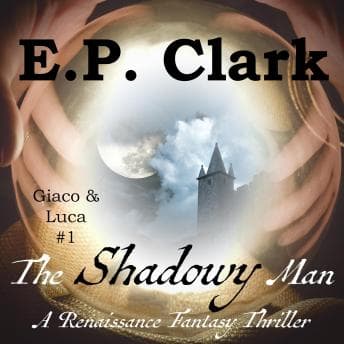

Renaissance Florence but with shadow magic and a kidnapped prince? Yeah, I was going to listen to this instead of writing my thesis no matter what.
At 2 hours and 20 minutes, Shadowy Man is basically a one-sitting listen — I knocked it out during a late-night board game cleanup session, sorting Gloomhaven tiles back into their absurd little baggies while Giaco chased his missing prince through fantasy Florence. The premise hooked me immediately: a battle-hardened rationalist bodyguard forced to confront the occult underbelly of a city going through its own Renaissance. That's a killer setup. It's like if a fighter/paladin multiclass got dropped into a Call of Cthulhu campaign and had to grapple with the fact that his INT score doesn't help against shadow monsters.
A World That Deserves More Room to Breathe
The setting — La Città dei Fiori, a fantasy Florence caught between Enlightenment-style reason and old-world magic — is genuinely interesting. Clark sets up this tension between the Reborn movement (think proto-humanism, rational thought, rejection of superstition) and the literal magical darkness lurking in the city's forgotten places. Giaco's whole identity is built on the Reborn philosophy, so when he has to wade into the shadow to rescue Prince Luca, it's not just a physical journey — it's an ideological crisis. That conflict is the strongest thing the book has going for it. The Midnight Library does something similarly ambitious with its identity-versus-belief tension, and Matt Haig actually gets the room to let that conflict breathe across a full runtime — makes the resolution hit so much harder.
But here's the thing: at 2 hours and 20 minutes, you barely get to marinate in it. The world-building gestures at something rich — the political factions, the old ways versus the new, the specific mechanics of how shadow magic works — but there's not enough runtime to really dig in. I wanted a Sanderson-level breakdown of how the shadow operates, what the rules are, what the costs are. Instead you get impressions. Atmosphere over architecture. Which isn't bad, exactly, but if you're the kind of listener who wants a magic system that is chef's kiss, you're going to feel a little hungry.
The last book that actually fed that craving was Witch's Cauldron, which treats every spell like it costs something real.The pacing moves quick, which the short runtime demands. Giaco's search for Luca has genuine urgency, and the moments where he confronts things his rational worldview can't explain land well conceptually. There's a scene where he essentially has to abandon his identity as a Reborn thinker to even perceive what's happening in the shadows — that's good character work. My D&D group would love that as a character arc for a skeptic cleric.
The Elephant in the Recording Booth
Okay. I have to talk about this. E.P. Clark narrates her own book, and — look, I respect the hustle. I do. Writing a novel is hard. Writing a fantasy novel with Renaissance Italian flavor is harder. And then deciding to narrate it yourself? That takes guts.
But guts don't equal good audio.
The delivery is flat in places where it desperately needs energy. Giaco is supposed to be this battle-scarred, emotionally complex guy wrestling with his entire belief system, and too often the narration just... sits there. Monotone in stretches where you need grit, or fear, or that barely-contained fury that Steven Pacey could deliver in his sleep. (Steven Pacey walked so other narrators could run, and this narration is, uh, still crawling.) There's one listener review that said the author adds emphasis where she feels it in the narrative, and I can see that — there are moments where the emotional intention comes through. But those moments are islands in a sea of sameness.
I'm not someone who says authors should never narrate. But I am someone who believes that voice acting is a skill, and this book's setting and characters deserve someone who can differentiate between a grizzled bodyguard, a young prince, and the shadowy forces threatening them. When everyone sounds roughly the same, the tension bleeds out.
Who's Rolling Initiative on This One
If you're a dark historical fantasy reader who primarily reads text, honestly? Check out the ebook. The concept is strong — Renaissance Florence meets urban dark fantasy with a rationalism-versus-magic conflict. That's a campaign setting I'd run in a heartbeat.
I gave Spectacular (German Edition) a spin for the same reason, and it delivers the genre goods with a lot more runway for its world.If you specifically want the audiobook experience, go in with calibrated expectations. The narration is a real barrier. If you can push past it, there's an interesting short story underneath — emphasis on short. This is more of a novella-length appetizer than a full meal.
Skip if: you need strong narrator performance to stay engaged (and honestly, for audio, that's not an unreasonable need). Also skip if you want deep world-building — there's not enough runtime for Clark to really flex what I suspect is a much bigger world in her head.
Try it if: you're curious about Renaissance-flavored dark fantasy and you've got a two-hour window to fill. At this length, the commitment is low.
My Thesis Can Wait, But Maybe Not For This
I wanted to love this more than I did. The ingredients are there — the setting, the central conflict, the idea of a man literally walking into shadow and coming out changed. But the narration flattens what should be sharp, and the short runtime means the world never gets the deep treatment it deserves. It's a concept that punches above its weight class wrapped in a production that doesn't quite land the hit.